India's solar energy sector has grown at a pace that few industries anywhere in the world can match. From rooftop installations in Gujarat to utility-scale solar parks sprawling across Rajasthan, Andhra Pradesh, and Karnataka, the country is building renewable energy infrastructure at an extraordinary rate.
But here is something that does not get discussed enough in all this excitement about megawatts and capacity additions. The electrical switching equipment inside solar substations matters just as much as the panels generating the power. And among all the equipment in a solar substation, the 11kV outdoor isolator is one of the most frequently underspecified components on the entire project.
Get it right and your solar substation operates safely and reliably for twenty-five years. Get it wrong and you are dealing with contact failures, insulator flashovers, and maintenance headaches in some of the most remote and environmentally challenging locations in India.
This blog is a practical guide for electrical engineers, EPC contractors, and procurement managers working on solar substation projects who want to understand exactly what to look for in an 11kV outdoor isolator and why the solar application demands more careful specification than a conventional distribution substation.
Why Solar Substations Put Unique Demands on the 11kV Outdoor Isolator
A conventional 11kV distribution substation in an urban or semi-urban area is typically located in a relatively accessible location, maintained by a trained utility crew, and surrounded by other infrastructure. Solar substations are different in almost every respect.
Most utility-scale solar projects in India are built in high-irradiance zones that happen to coincide with some of the most environmentally aggressive landscapes in the country. Rajasthan brings extreme heat, desert dust storms, and temperature swings of 40 degrees or more between day and night. Andhra Pradesh and Tamil Nadu coastal zones bring salt-laden humid air and cyclone-force winds. Karnataka's solar belts experience extended dry periods followed by intense monsoon rainfall.
Every one of these environments places specific and severe demands on an 11kV outdoor isolator that simply do not apply to equipment installed in milder conditions.
Beyond the environment, the operational pattern of a solar substation creates its own challenges. Solar generation follows the sun. Power flow through the substation ramps up from zero in the morning, peaks around noon, and drops back to zero after sunset. This means the isolator and all other equipment experience a daily thermal cycle that conventional grid substations, with their more stable load patterns, do not face to the same degree.
Add the fact that many solar substations are unmanned and located hours away from the nearest maintenance base, and the case for specifying a genuinely robust 11kV outdoor isolator becomes very clear.
What an 11kV Outdoor Isolator Does in a Solar Substation
For readers who are newer to substation equipment, a quick explanation of the isolator's role is useful here.
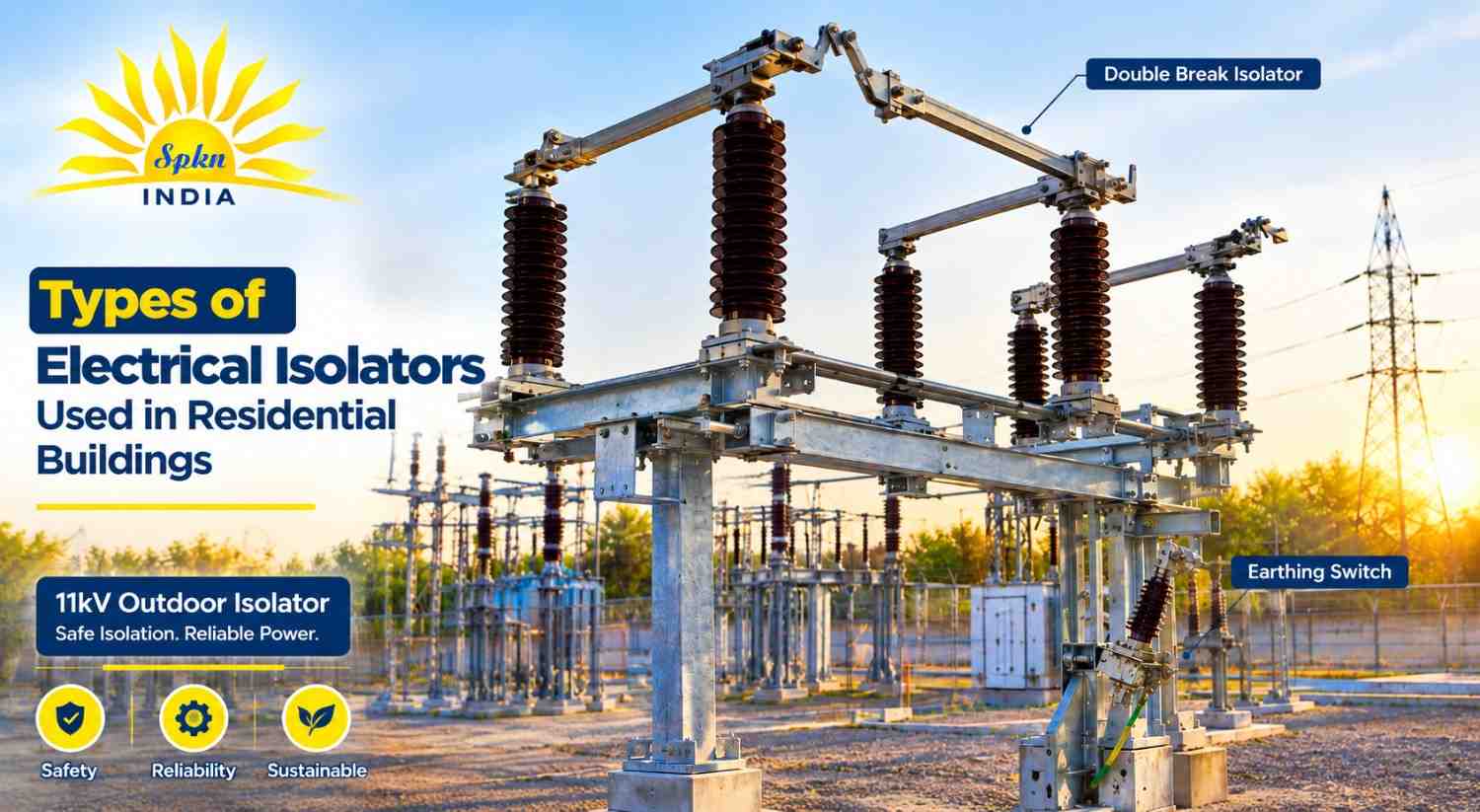
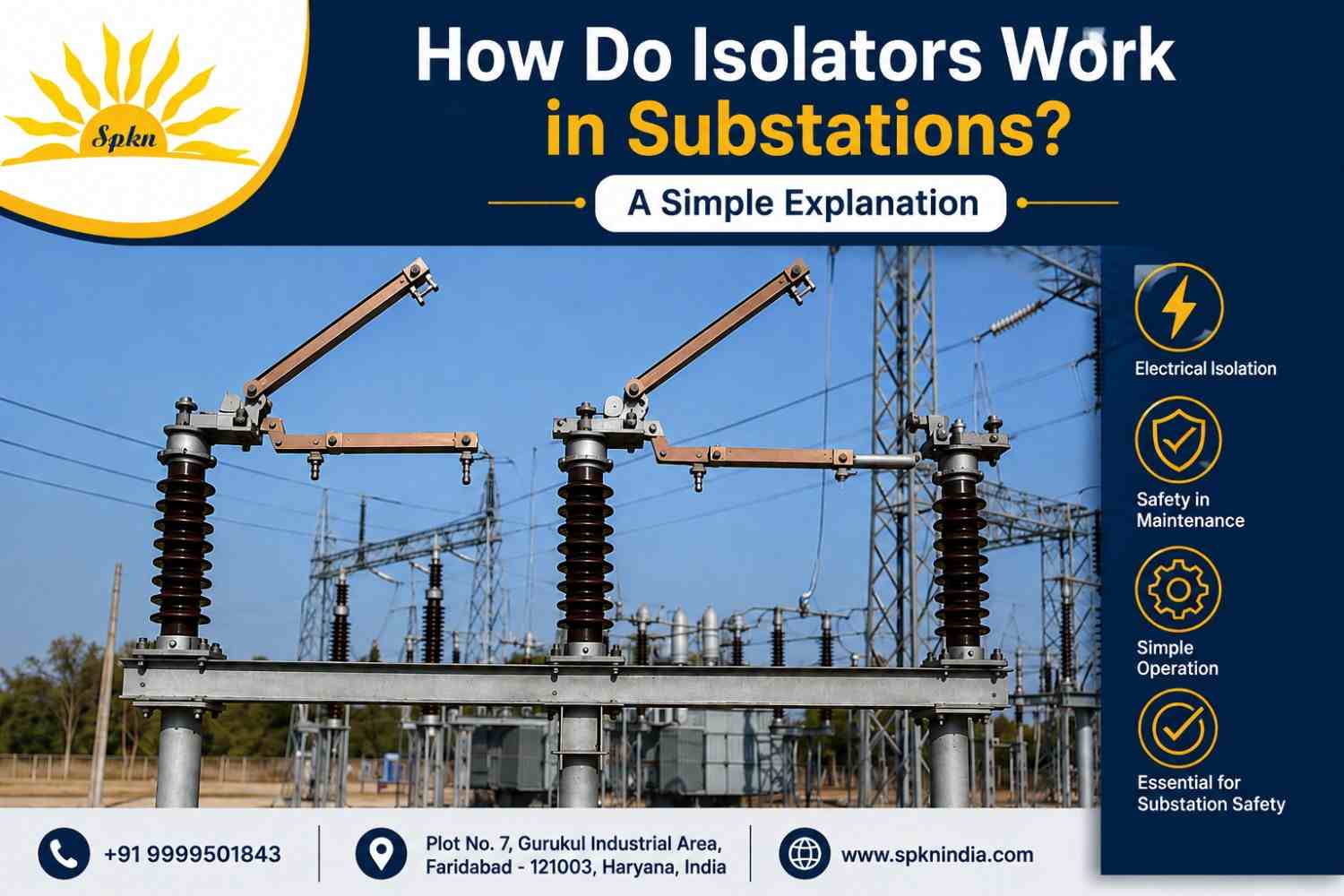
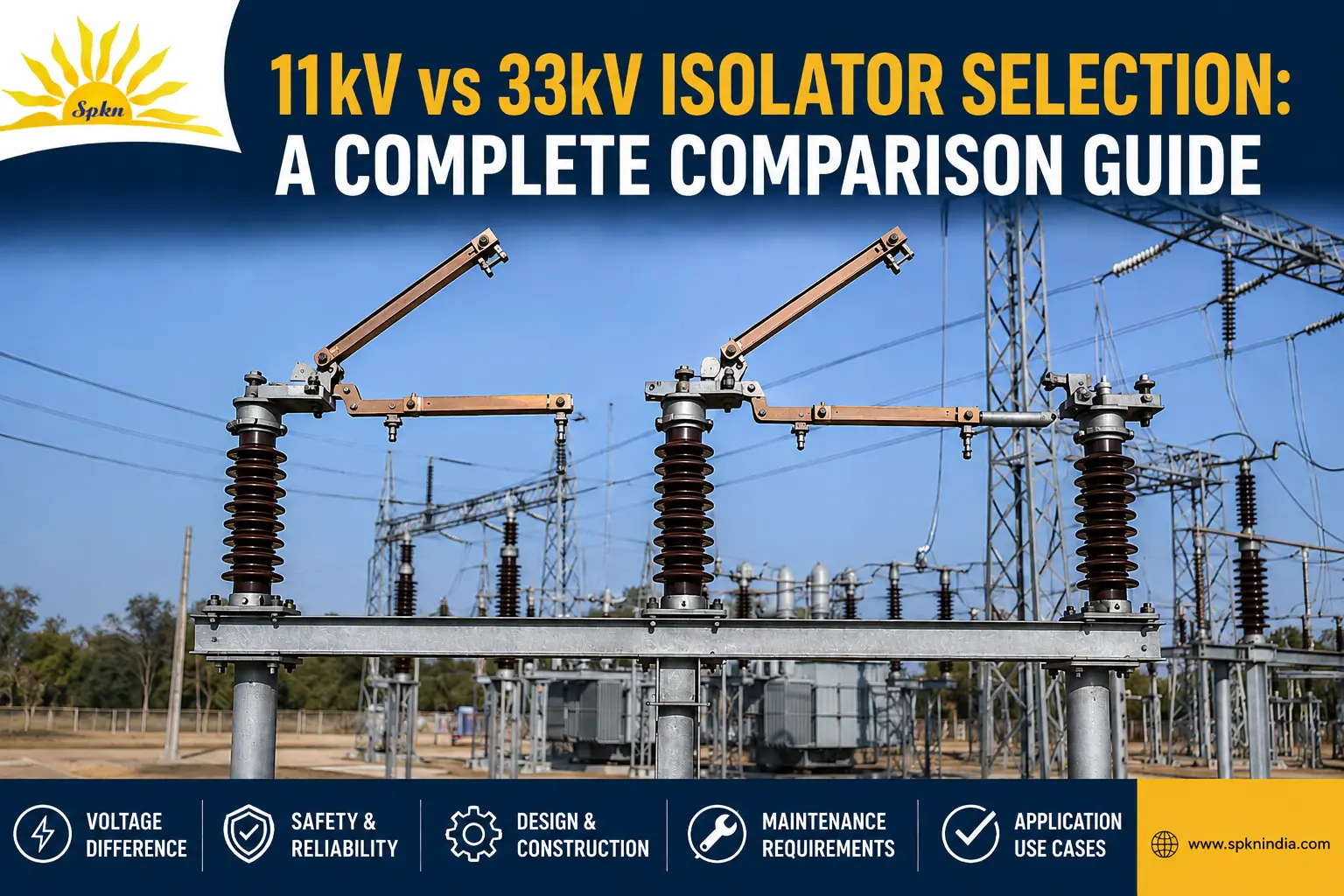
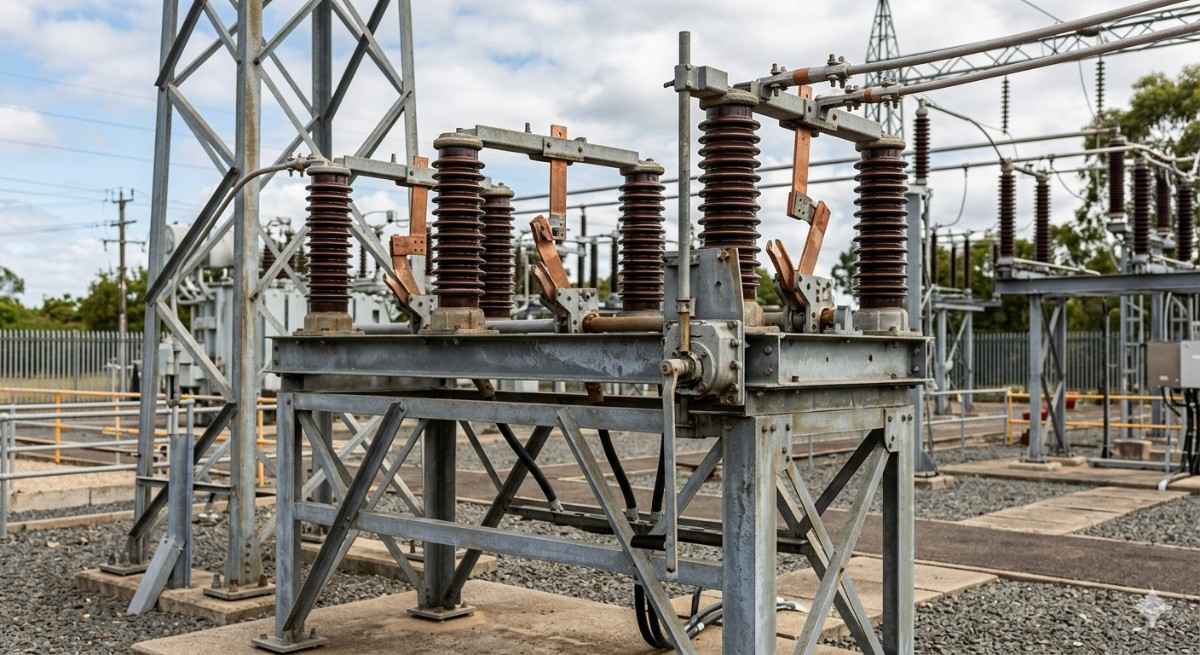
An 11kV outdoor isolator is a manually or motor-operated switching device that creates a visible air gap in the electrical circuit, confirming that a section of the substation is de-energised before maintenance work begins. It operates under no-load conditions, meaning it is not designed to interrupt fault current. That job belongs to the circuit breaker.
In a typical solar substation, 11kV outdoor isolators are installed at several locations. They are used on the 11kV feeder panels connecting the inverter transformer outputs to the 11kV bus bar. They appear at the outgoing feeder positions where power leaves the substation toward the grid interconnection point. They are also used in bus section arrangements where the substation bus bar is divided into sections for operational flexibility.
Each of these locations has slightly different mechanical and electrical requirements, but all of them share the fundamental need for reliable operation, weather resistance, and long service life with minimal maintenance.
The Five Specification Factors That Matter Most for Solar Project Isolators
This is where the technical decisions get made. Here are the five things that most directly determine whether an 11kV outdoor isolator will perform well in a solar substation environment.
Creepage Distance and Pollution Level Rating
Creepage distance is the shortest path along the insulator surface between two live parts or between a live part and an earthed surface. In clean environments, the standard creepage distance for 11kV equipment is sufficient. In polluted environments, it is not.
Solar sites in India span every pollution severity level from light to very heavy. A site in the Thar Desert near an industrial corridor may carry heavy dust contamination. A coastal solar farm in Andhra Pradesh faces saline pollution. An agricultural zone in Maharashtra may have fertiliser and pesticide contamination on insulator surfaces during certain seasons.
IS 9921 and IEC 62271-102 classify pollution severity into four levels, from light to very heavy, with corresponding minimum creepage distance requirements. For most Indian solar project locations, specifying a minimum creepage distance of 25mm per kV phase-to-earth voltage is a conservative and appropriate starting point. For coastal and heavily polluted sites, 31mm per kV is worth specifying.
Never assume the standard creepage distance is adequate for a solar site without first confirming the pollution severity classification of the specific location.
Insulator Material: Porcelain vs Polymer
This is a choice that many solar project engineers do not think carefully enough about, and it has real consequences.
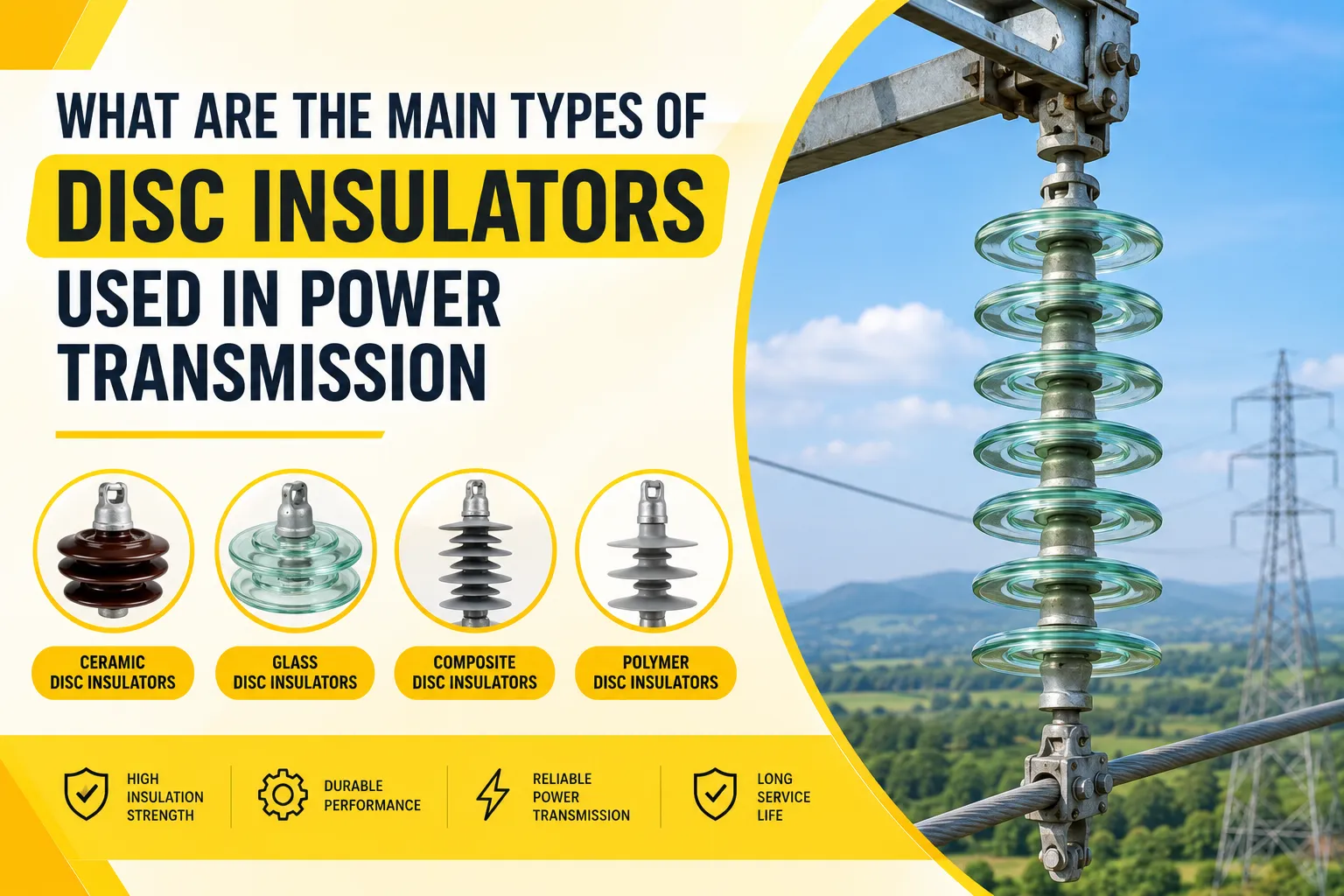
Porcelain insulators are the traditional material and remain widely used. They are robust, have a long track record, and are easy to source. Their limitation in solar project environments is that their smooth glazed surface accumulates dust, bird droppings, and pollution films relatively easily. In heavily contaminated environments, porcelain insulators require more frequent cleaning to maintain their dielectric performance.
Polymer or composite insulators use a fibreglass core with a silicone rubber housing and shed profile. The silicone surface has a natural hydrophobic property, meaning water beads up on it rather than forming a continuous conductive film. This makes polymer insulators significantly more resistant to pollution-induced flashover in humid conditions.
For solar projects in coastal zones, high-humidity regions, or locations with heavy industrial or agricultural pollution, polymer insulators offer a genuine performance advantage that justifies their slightly higher cost.
Current Rating and Temperature Rise
Solar substations operate at high ambient temperatures. A substation in Rajasthan may experience ambient temperatures of 48 to 50 degrees Celsius on peak summer afternoons. At the same time, solar generation is at its maximum, meaning current through the isolator contacts is also at its peak.
Standard equipment ratings in IEC and IS standards are defined at a reference ambient temperature of 40 degrees Celsius. If your site ambient temperature regularly exceeds this, the effective current-carrying capacity of the isolator is reduced. Contact heating at elevated ambient temperatures can accelerate oxidation of contact surfaces and reduce contact spring tension over time.
For solar sites with high ambient temperatures, specify an 11kV outdoor isolator with a nominal current rating that provides a comfortable margin above your maximum expected load current. A 630A rated isolator on a feeder that peaks at 400A gives you that margin. Specifying exactly to the load limit does not.
Motor Operation vs Manual Operation
Solar substations are increasingly being integrated into SCADA systems that allow remote monitoring and switching operations from a central control room. For this to work, the 11kV outdoor isolator needs to be equipped with a motor-operated mechanism.
Motor-operated isolators have an electric drive that receives switching commands from the control system, executes the open or close operation, and sends position feedback signals back to the SCADA. This eliminates the need for a technician to travel to a remote site every time a switching operation is required.
For solar projects connected to state grids under power purchase agreements, remote switching capability is often a requirement from the utility or SLDC. Even where it is not explicitly required, the operational efficiency benefit of motor-operated isolators at unmanned solar sites is substantial.
When specifying a motor-operated 11kV outdoor isolator for a solar project, confirm the following: voltage and phase of the control supply, operating time from open to close and close to open, mechanical and electrical interlocking requirements with the associated circuit breaker, and the IP rating of the motor mechanism enclosure.
Earthing Switch Integration
Most solar substation designs incorporate an earthing switch integrated with the 11kV outdoor isolator. This allows the maintenance team to earth the de-energised conductor locally before working on it, providing a critical safety function in an unmanned substation environment.
The key requirement here is that the earthing switch must be mechanically interlocked with the main isolator blade so that it cannot be closed while the isolator is in the closed position, and the isolator cannot be closed while the earthing switch is closed. This interlocking prevents the catastrophic scenario of accidentally energising an earthed conductor.
Verify that the interlocking mechanism is purely mechanical and does not depend on any electrical or electronic interlock that could fail due to control supply issues. For safety-critical functions in remote substations, mechanical interlocks are always more reliable than electrical ones.
Common Mistakes Solar EPC Contractors Make With Isolator Specification
Having worked with EPC contractors across solar projects of different scales, certain patterns of specification errors come up repeatedly.
Copying the isolator specification from a previous conventional distribution substation project without reviewing it for solar site conditions is one of the most common. Distribution substation specs are written for accessible, maintained locations. Solar substation specs need to account for remote location, extreme environment, and unmanned operation.
Specifying standard pollution class insulators for coastal or desert solar sites is another frequent mistake that reveals itself only after the first monsoon or dust season, when thermographic surveys start finding flashover damage on insulator surfaces.
Overlooking the control supply voltage for motor-operated isolators during the early design stage leads to last-minute design changes and procurement delays. Confirm the control supply voltage, whether 110V AC, 220V AC, or 24V DC or 48V DC, at the very beginning of the equipment specification process.
Ignoring the mechanical endurance rating of the isolator is a subtler but important mistake. IEC 62271-102 defines mechanical endurance classes for isolators. Class M0 covers 1000 operations, M1 covers 2000 operations, and M2 covers 5000 operations. For a solar substation that performs multiple switching operations per day for SCADA-controlled reconfiguration, a higher mechanical endurance class is worth specifying.
Why Solar EPC Contractors and Project Developers Trust SPKN India
SPKN India manufactures and supplies 11kV outdoor isolators specifically suited for solar substation projects across India. Our isolators are available in single break and double break configurations, with manual or motor-operated mechanisms, with or without integrated earthing switches, and with porcelain or polymer insulator options depending on site pollution severity requirements.
Our 11kV outdoor isolators are manufactured and type-tested as per IS 9921 and IEC 62271-102, with complete type test certificates available for customer review. We offer creepage distance options from standard to enhanced levels for coastal and heavily polluted solar project environments.
Motor-operated variants are available with control supply options to match your substation control system requirements, complete with position feedback contacts and manual override capability for emergency local operation.
We have supplied isolators for solar substation projects across Rajasthan, Gujarat, Andhra Pradesh, Karnataka, and Maharashtra, giving us direct experience with the specific environmental and operational requirements of each of these major solar development zones.
Our team can review your substation single line diagram and site location details to recommend the most appropriate isolator specification for your project, saving your design team time and ensuring that your equipment procurement is aligned with actual site conditions from day one.
You can also read about our range of substation structures, earthing materials, and overhead line hardware to support your complete solar substation procurement requirements.
Conclusion
India's solar energy ambition is real, it is large, and it is accelerating. The substations that connect all this solar capacity to the grid need to be built right, not just quickly. And building them right means specifying every component correctly, including the 11kV outdoor isolator.
The right isolator specification for a solar project accounts for site-specific pollution levels, ambient temperature, operational patterns, remote location challenges, and the integration requirements of modern SCADA-controlled switching. None of these considerations are complicated. They just require deliberate attention at the specification stage rather than a copy-paste approach from a previous project.
SPKN India is ready to support your solar substation project with technically appropriate, competitively priced, and fully certified 11kV outdoor isolators. Contact our team today to discuss your project requirements and let us help you specify the right equipment from the start.
Frequently Asked Questions
What is the standard current rating for an 11kV outdoor isolator used in solar substations?
The most common ratings are 400A, 630A, and 1250A depending on the feeder capacity. For solar substations, always specify a rating that provides a margin above the maximum expected feeder current to account for elevated ambient temperature effects on contact performance.
Is a motor-operated 11kV outdoor isolator mandatory for solar substation projects?
It is not universally mandatory by regulation, but it is strongly recommended for unmanned solar substations integrated with SCADA systems. Many state grid utilities and SLDCs require remote switching capability as a condition of grid interconnection approval.
What pollution class should I specify for a solar project isolator in Rajasthan?
Rajasthan solar sites typically fall in pollution severity class III or IV due to desert dust and occasional industrial contamination. A minimum creepage distance of 25mm per kV phase-to-earth is generally appropriate, with 31mm per kV recommended for sites near industrial areas or saline lake zones.
Can the same 11kV outdoor isolator specification be used for both incoming and outgoing feeder positions?
In most cases yes, as the voltage level and current requirements are similar. However, the outgoing feeder position may have different earthing switch requirements or mechanical interlocking needs depending on the substation protection philosophy. Always review each position individually.
What is the difference between single break and double break isolators?
A single break isolator opens the circuit at one point, creating a single air gap. A double break isolator opens at two points simultaneously, creating two air gaps in series. Double break isolators provide greater contact gap and are generally preferred at higher voltage levels or where the available space for single break rotation arc is limited.
How often does an 11kV outdoor isolator need maintenance in a solar substation?
In clean environments, annual maintenance including contact inspection, lubrication, and hardware check is generally sufficient. In dusty or polluted environments, insulator cleaning may be required more frequently, and thermographic inspection should be carried out at least twice a year to catch developing contact problems early.
Does SPKN India provide type test certificates for their 11kV outdoor isolators?
Yes. SPKN India provides complete type test certificates as per IS 9921 and IEC 62271-102 for all isolator variants. These certificates are available for customer review during procurement and can be included in your project quality documentation package.