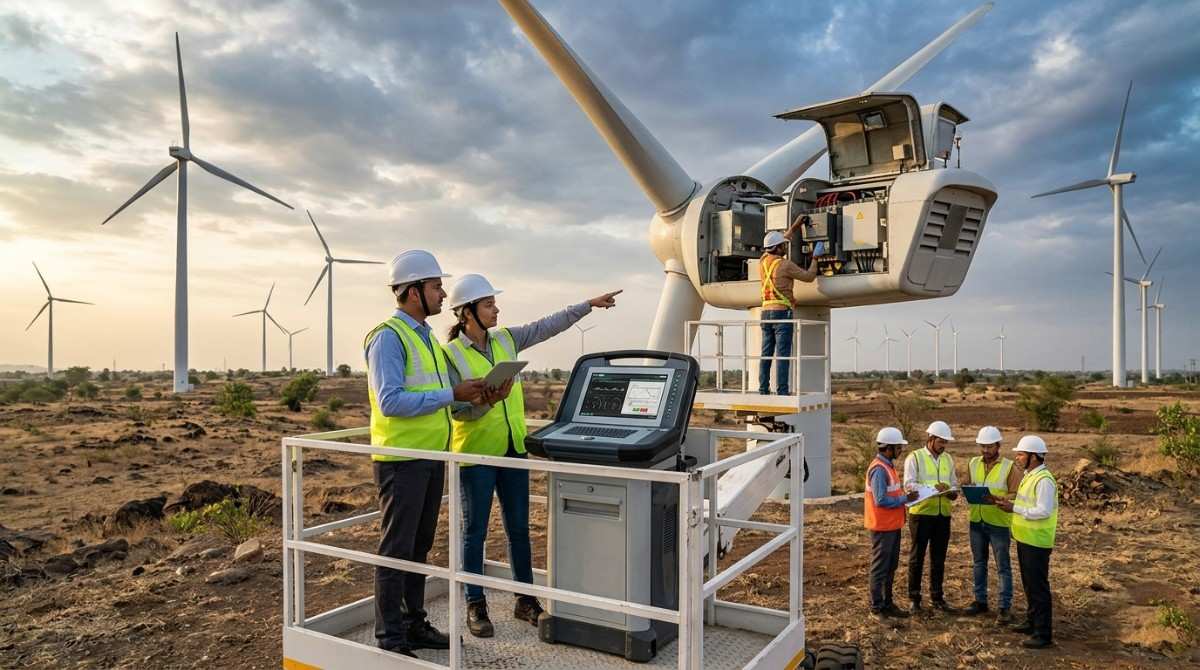
India's wind energy capacity crossed 47 GW in 2024 and is still climbing. Tamil Nadu, Gujarat, Rajasthan, Karnataka, and Maharashtra are home to thousands of wind turbines spinning across ridgelines, coastal plains, and semi-arid plateaus. The hardware gets a lot of attention. The electrical systems that keep those turbines generating, protected, and connected to the grid rarely do.
That gap between turbine performance and electrical system quality is exactly where wind farm operators lose money.
Unreliable switchgear at the wind turbine transformer. Poorly terminated medium voltage cables between turbines. Earthing systems that degrade after the first monsoon. Control and protection systems that trip unnecessarily because nobody verified the relay settings against the actual grid code requirements. These are not hypothetical problems. They are the daily operational reality at hundreds of wind installations across India.
Finding the Best Windmill Electrical Services in India means knowing what to look for before you sign a contract, not after something fails at 2 AM on a high-wind night when your entire array has tripped offline.
This listicle-style guide breaks down the ten things that genuinely distinguish reliable windmill electrical service providers from those who just look good on paper.
1. They Understand Wind-Specific Electrical Architecture, Not Just General Power Systems
A general electrical contractor knows how to wire an industrial plant. A windmill electrical specialist understands the specific architecture of a wind power plant: the turbine transformer, the medium voltage collection network, the wind farm substation, the SCADA system, and how all of these interact with the grid interconnection point.
Wind turbines generate power at low voltage (typically 690 V) and step it up through a turbine transformer to medium voltage (usually 33 kV) for collection. That collection network runs underground or overhead to the wind farm substation, where it is further stepped up to the grid voltage (132 kV or 220 kV).
Every component in this chain has wind-specific requirements. Turbine transformers must handle frequent voltage and power fluctuations. Medium voltage switchgear must perform reliably in outdoor environments with high dust, humidity, and temperature cycling. Substation equipment must meet the grid operator's technical requirements.
Ask any prospective service provider to explain this architecture and walk through their experience at each stage. If they cannot, they are a general electrical contractor, not a windmill electrical specialist.
2. They Have Documented Experience with Indian Grid Code Compliance
Connecting a wind farm to the Indian grid is not as simple as plugging in. The Central Electricity Authority (CEA) and state load dispatch centres have specific technical requirements for grid-connected renewable energy plants. These include low voltage ride-through capability, reactive power compensation, protection relay settings, and metering standards.
A competent windmill electrical service provider understands CEA regulations, the relevant Indian Electricity Grid Code (IEGC) requirements, and state-specific interconnection standards. They have worked through the grid connectivity approval process before and know what documentation, testing, and commissioning records the authorities will ask for.
Service providers who have not navigated this process will cost you months of delay and potential re-work when the grid operator's protection coordination study reveals incompatible relay settings.
3. They Specify and Supply Equipment That Meets Wind Application Standards
Not all switchgear, cables, and protection equipment is suitable for wind farm applications. The electrical equipment used in a wind power plant faces unique stresses.
Turbine transformers must handle cyclic loading profiles that are very different from industrial or utility transformer duty. Switchgear at the turbine level must survive high humidity, condensation, and dust ingress in nacelle and tower base environments. Underground cables in the collection network must be rated for the actual ground temperatures and soil thermal resistivity at the site.
The best windmill electrical service providers do not simply use whatever switchgear or cable they habitually supply to industrial projects. They specify equipment to IEC 60076 (power transformers), IEC 62271 (switchgear), and IS 1554 or IEC 60502 (power cables) with ratings matched to the specific wind application duty.
When evaluating a service provider, ask for their equipment specification methodology and check whether the datasheets they provide are genuinely wind-application rated.
4. They Treat Earthing and Lightning Protection as Engineering Disciplines, Not Afterthoughts
Wind turbines are among the most lightning-exposed structures in the world. A 100-metre turbine tower on a hilltop ridge is an ideal lightning capture point. The earthing and lightning protection system for a wind turbine must be engineered to handle direct strikes, conduct the resulting current to ground without damaging the turbine, and protect the control and power electronics inside the nacelle from the associated electromagnetic impulse.
IEC 61400-24 is the international standard specifically covering lightning protection for wind turbines. A competent windmill electrical services provider knows this standard and designs earthing systems that comply with it.
In the Indian context, rocky terrain at many wind sites in Karnataka, Rajasthan, and Himachal Pradesh makes achieving low earth resistance values challenging. Service providers who understand soil resistivity testing, chemical earthing electrode selection, and earthing mesh design for high-resistivity ground are the ones who deliver systems that actually protect turbines through the monsoon season.
Providers who simply drive a few earth rods and move on are setting up the project for lightning damage claims within the first operational year.
5. They Have a Credible Medium Voltage Cable Jointing and Termination Capability
The underground cable network connecting turbines to the substation is one of the most failure-prone elements of a wind farm's electrical infrastructure. Cable joint and termination failures are the leading cause of collection network outages in Indian wind farms.
The reason is not usually the cable itself. It is the quality of the jointing and termination work. Heat shrink or cold shrink termination kits for 33 kV cables require precise preparation: correct conductor stripping dimensions, semiconductor layer removal to the right depth, insulation surface cleanliness, and proper application of stress control components. Get any step wrong and the joint becomes a partial discharge source that progressively degrades until it fails.
Reliable windmill electrical service providers employ jointers who hold current certification from cable manufacturers (TE Connectivity, 3M, Raychem, or equivalent). They maintain temperature and humidity logs during jointing operations in the field. And they test every completed joint with partial discharge measurement before backfilling.
This is not standard practice across all contractors in India. It is the standard that separates good providers from average ones.
6. They Provide SCADA and Protection Relay Commissioning, Not Just Installation
Installing a protection relay and commissioning it are completely different activities. Installation means the relay is physically mounted, wired, and powered. Commissioning means the relay settings have been calculated for the specific system configuration, verified against the grid operator's protection coordination study, and tested with secondary injection to confirm correct operation.
Many wind farm electrical contractors in India install protection equipment but do not have the competency to commission it properly. The result is either nuisance tripping (relay operates when it should not, costing generation revenue) or failure to trip (relay does not operate when it should, causing equipment damage or safety incidents).
SCADA integration is equally important. A wind farm without a functioning SCADA system is flying blind. The service provider must be able to configure the communication interfaces between turbine controllers, substation automation systems, and the wind farm management platform.
Ask any prospective provider for their relay commissioning methodology and examples of protection coordination studies they have contributed to on past projects.
7. They Have Genuine Experience with Indian Wind Site Conditions
India's wind sites are not comfortable working environments. Ridgeline sites in Tamil Nadu and Andhra Pradesh experience 50 degrees Celsius summer temperatures and high-humidity coastal conditions simultaneously. Sites in Rajasthan deal with severe dust storms that compromise electrical equipment unless properly sealed. Sites in Gujarat face saline coastal air that accelerates corrosion on all exposed metalwork.
Service providers who have worked exclusively in urban industrial environments are not prepared for these conditions. The best windmill electrical service providers have site references in actual Indian wind farm locations and can speak specifically about how they handled the environmental challenges those sites presented.
8. They Offer Operation and Maintenance Contracts Backed by Technical Capability
Wind farms have design lives of 20 to 25 years. The electrical systems must be maintained across that entire period. A service provider who can only handle initial installation but has no O and M capability forces the project developer to manage multiple vendor relationships throughout the plant's life.
Credible providers offer structured O and M contracts that include:
- Scheduled preventive maintenance with documented checklists
- Thermographic scanning of switchgear and transformer connections
- Annual protection relay testing and setting verification
- Earth resistance measurement during dry season
- Cable insulation resistance testing
- Emergency response with defined response time commitments
The quality of an O and M contract tells you a great deal about the provider's actual technical depth. Surface-level contracts with vague scope descriptions indicate a contractor who is not genuinely equipped to maintain wind farm electrical systems over the long term.
9. They Are Transparent About Certifications, Type Tests, and Supply Chain
Equipment failures at wind farms are expensive. Generation losses during repair, costs of replacement parts, and potential grid penalty charges add up quickly. The best service providers are transparent about the product certifications and type test records behind everything they supply and install.
For substation switchgear, transformer and cable equipment, ask for CPRI or NABL-accredited lab type test certificates. For protection relays and SCADA hardware, ask for compliance documentation against IEC 61850 (for communication protocols) and the relevant IEC protection device standards.
Providers who hesitate on this request or supply photocopied documents without original test report references are a risk. The Indian electrical equipment market has a persistent problem with under-specified or non-standard products being passed off as compliant. Verified documentation is the only protection against this.
10. They Have the Application Depth That SPKN India Brings to Windmill Electrical Projects
SPKN India has established itself as one of the Best Windmill Electrical Services providers in India by combining certified product manufacturing with genuine wind application expertise.
The SPKN India product range relevant to wind power plants covers turbine transformers, medium voltage switchgear, earthing systems compliant with IEC 61400-24, surge protection devices for turbine and substation applications, and complete substation equipment packages. All products are manufactured and tested to applicable IS and IEC standards, with type test documentation available for project approval processes.
What makes SPKN India particularly valuable for EPC contractors and wind farm developers is the application engineering support that comes with the product supply. The SPKN India technical team has experience with collection network design, protection coordination requirements for CEA and state SLDC approvals, and the specific equipment challenges that Indian wind site environments create.
For procurement managers sourcing equipment across a multi-turbine wind farm project, SPKN India offers the consistency of a single technically accountable supplier across multiple product categories, reducing the coordination burden and ensuring compatibility between equipment from different parts of the electrical system.
Wind farm project timelines are unforgiving. SPKN India's track record on delivery reliability and documentation completeness has made it a preferred partner for EPC contractors who cannot afford to have electrical equipment become the critical path item on a commissioning schedule.
Industry Insight: Why Electrical System Quality Determines Long-Term Wind Farm Profitability
Wind farm financial models are built on availability assumptions. Most assume 97 percent or higher electrical system availability. Every hour of unplanned electrical downtime directly reduces revenue and pushes the project further from its IRR target.
Analysis of operational Indian wind farms consistently shows that electrical system failures, particularly in collection network cables, turbine transformers, and substation switchgear, account for a disproportionate share of unplanned downtime. The pattern almost always traces back to installation quality issues, not inherent product failures.
This is why finding the Best Windmill Electrical Services in India is fundamentally a financial decision, not just a technical one. The difference between a provider who delivers correctly the first time and one who leaves behind a trail of latent defects shows up in the generation data over the first three operational years.
Conclusion
India's wind energy sector is one of the fastest-growing in the world, and the electrical infrastructure that supports it demands the same level of engineering rigour as any other critical power system. Finding the Best Windmill Electrical Services in India requires evaluating providers against the technical criteria that actually determine long-term performance, not just who submits the lowest tender price.
The ten criteria covered in this guide give engineers, procurement managers, and EPC contractors a practical framework for that evaluation. Apply them consistently, ask the hard questions before contracts are signed, and the risk of costly electrical failures across your wind farm's operational life drops significantly.
SPKN India is ready to support your wind power project with certified products, application-specific expertise, and the reliability that long-term wind farm performance depends on. Share your project details with the SPKN India team today.