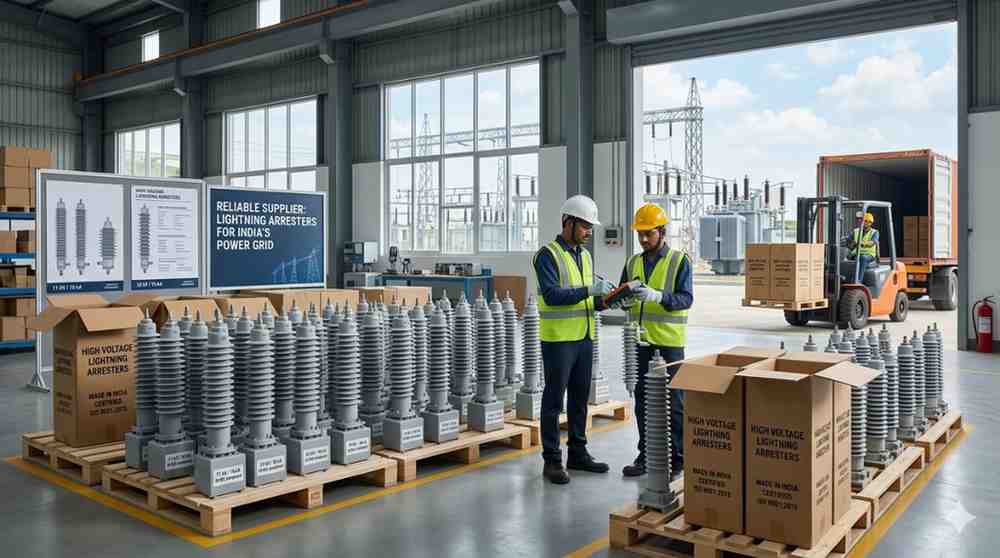
A transformer that has run quietly for six years can fail in a single monsoon evening. Nothing was wrong with the transformer. A surge from a nearby lightning strike travelled down the line, found no arrester to divert it, and went straight into the windings.
Failures like this are common, and they are usually avoidable. This guide is for engineers, contractors, plant owners and procurement teams comparing lightning arrester suppliers in India. It explains what these devices do, which types exist, which ratings matter, and what to check before you place an order.
SPKN India manufactures lightning arresters along with isolators, air break switches, horn gap fuses, polymer insulators and substation connectors. We have seen where arresters work well and where they are installed in ways that defeat their purpose, so the advice below comes from the field as much as from the datasheet.
What a Lightning Arrester Does
A lightning arrester protects electrical equipment from overvoltage. When lightning strikes near a line, or when a switching operation creates a spike, the voltage in the system can jump far beyond what insulation is built to withstand.
The arrester sits connected between the live conductor and earth. At normal voltage it behaves like an insulator and carries almost no current. When a surge arrives, its resistance drops sharply and it diverts the surge current safely to earth. Once the surge has passed, it returns to its insulating state and the system carries on as if nothing happened.
That fast switch between insulating and conducting is the whole job. It is simple to describe and very demanding to build, because the device must do it thousands of times without ageing.
Types of Lightning Arresters
Suppliers use different names for similar things, so it helps to know the main categories.
Metal oxide and gapped arresters
Older arresters used silicon carbide blocks in series with spark gaps. Modern designs use zinc oxide (metal oxide) blocks with no gaps, which respond faster, hold voltage more stably and stand up to repeated surges better. Today most utilities specify gapless metal oxide arresters, built to standards such as IEC 60099-4 and IS 3070 Part 3.
Polymer-housed and porcelain-housed arresters
The housing protects the internal blocks from weather and pressure. Porcelain is the traditional choice and has a long track record. Polymer housing is lighter, easier to transport and install, and handles pollution well, so it has become popular on distribution lines and in coastal and industrial areas. Both work, and the better choice depends on the site and the utility’s specification.
Distribution, station and line arresters
Distribution class arresters are fitted on pole-mounted and plinth-mounted transformers and along 11 kV and 33 kV feeders. Station class arresters protect substation equipment such as power transformers and switchgear, and are built for higher energy. Line arresters are installed on towers to reduce lightning outages on the line itself.
Surge arresters and ESE air terminals
You will also meet “ESE” (early streamer emission) lightning conductors. These are air terminals mounted on buildings to intercept strikes. They are a different product from the surge arresters used on power lines and transformers, and their claimed coverage areas are a debated topic in the industry. For buildings, a design based on IEC 62305 and a qualified protection engineer is the safest route. For power lines, transformers and substations, a metal oxide surge arrester is the standard solution.
Ratings to Know Before Asking for a Quote
A good supplier will ask for details before quoting. These are the numbers that matter:
- System voltage and earthing method, which decide the arrester’s rated voltage
- Maximum continuous operating voltage, so the arrester does not heat up in normal service
- Nominal discharge current, commonly 5 kA for distribution and 10 kA or more for station applications
- Energy handling or line discharge class, which matters on long lines and capacitor banks
- Housing type and creepage distance, based on how polluted the site is
- Mounting arrangement and terminal type, so it fits your structure and connectors
One point catches many buyers out. An arrester for a 33 kV system is not simply a “33 kV arrester”. Its rated voltage depends on how the system is earthed and what fault conditions it must survive. This is why sending a bare voltage figure is not enough for a correct recommendation.
How to Choose Lightning Arrester Suppliers in India
Product pages look alike, so check the evidence behind them:
- ISO 9001:2015 quality certification and compliance with IEC and IS standards for the product
- Type test and routine test reports for the exact rating you are buying
- Clear technical data sheets with rated voltage, discharge current, residual voltage and creepage
- Experience with your type of customer, whether that is a DISCOM, EPC contractor, solar plant or factory
- Honest advice on rating selection, not just a quotation for whatever you wrote on the enquiry
- Delivery time, packing quality and technical support after supply
Ask whether the supplier manufactures the arrester or resells it. A manufacturer can answer detailed questions about the internal blocks and testing, and can fix a problem at the source. A reseller can only pass your question along.
Compare offers on the same scope, too. One quote may include mounting brackets, earth leads and disconnectors, while another leaves them out.
Installation: Where Most Failures Begin
Even a perfect arrester can fail to protect if it is installed badly. Three details matter most.
Place the arrester as close as possible to the equipment it protects, ideally right at the transformer terminals. The further away it sits, the more the surge voltage at the equipment can exceed the arrester’s own protection level.
Keep the connecting leads short and straight. Long, looped leads add inductance, and during a fast surge that adds extra voltage right where you do not want it.
Finally, give it good earthing. An arrester with a poor earth connection cannot discharge surge current properly, so the protection exists on paper only. Earth resistance targets differ by installation, so follow your utility’s requirement and test after installation. Our team also handles earthing electrode installation, which keeps the arrester and its earth system in the hands of one supplier.
Where SPKN India Fits In
SPKN India Isolators Pvt. Ltd. is a Faridabad-based manufacturer with more than twelve years in high voltage equipment and over 1,100 installations across India. Our quality system is ISO 9001:2015 certified, and every product is tested before dispatch.
Our lightning arresters are made to protect lines and transformers from surges and lightning strikes, and they work alongside the rest of our range. A typical transformer installation might combine an arrester for surge protection, a horn gap fuse for fault protection and an isolator disconnector for safe maintenance, all supplied together so ratings and mounting match.
We also supply polymer insulators and substation connectors, and our team can install and commission the equipment on site. We dispatch across India, including Delhi, Mumbai, Maharashtra, Nashik, Gujarat, Ahmedabad, Hyderabad, Chennai, Bengaluru, Karnataka, Kolkata and Goa.
If you are not sure what rating you need, tell us your system voltage, earthing method and application. We will recommend a suitable option, or tell you honestly if we are not the right fit.
Mistakes to Avoid When Buying Lightning Arresters
A few mistakes come up repeatedly.
The first is choosing on price alone. A cheaper arrester may use lower-grade blocks or lack proper test reports, and the saving disappears the first time it fails and takes a transformer with it.
The second is guessing the rating. Too low, and the arrester overheats and fails in normal service. Too high, and it lets damaging surge voltages reach your equipment.
The third is treating the arrester as an afterthought. It needs to be on the drawing, the bill of materials and the commissioning checklist from day one, not added at the last minute.
Protect the Equipment That Matters Most
A lightning arrester costs a small fraction of the transformer, switchgear or line it protects. The right choice depends on your voltage, earthing and site, and the right supplier is the one who can show test reports, explain the rating and stand behind the product after delivery.
If you are planning a new installation or replacing arresters on an existing one, SPKN India can supply and install the protection your system needs.
Need a quotation? Share your voltage class, earthing method, quantity and site location, and we will send a technical offer. Contact SPKN India or call +91 9810040983.