Every monsoon season, India records millions of lightning strikes. Power transformers trip. Control panels blow out. Substations go dark. And somewhere in an industrial plant, a production line comes to a halt because a surge traveled through an unprotected feeder and took out the switchgear.
The solution is not complicated. A properly selected and installed lightning arrester stops that surge before it reaches your equipment. But the effectiveness of that protection depends almost entirely on who manufactured the device and whether it was specified correctly for your application.
This guide breaks down what you need to know about Lightning Arrester Manufacturers in India, what separates a dependable product from a substandard one, and how to make the right sourcing decision for your next project.
Why Lightning Protection Is Non-Negotiable in Indian Power Systems
India sits in one of the most lightning-active regions in the world. States like Bihar, Jharkhand, West Bengal, Odisha, and Andhra Pradesh record exceptionally high ground flash densities during the monsoon months. Even outside these zones, switching surges from grid operations pose a constant overvoltage threat to electrical equipment.
Transformers, switchgear, motors, and control systems are all vulnerable. A single unprotected surge event can cause damage that costs far more to repair than an entire protection system would have.
Yet many procurement decisions around lightning arresters are still driven by price alone. That is a mistake that engineers and project managers across India have paid for more than once.
What a Lightning Arrester Actually Does: Explained Simply
A lightning arrester, also called a surge arrester, is a protective device connected between a power line and ground. When a high-voltage surge travels along the line, whether from a direct lightning strike or a switching operation, the arrester provides a low-resistance path to ground. The surge energy is diverted safely, and the arrester returns to its non-conducting state, ready for the next event.
Modern arresters use Metal Oxide Varistors (MOV), typically made from zinc oxide blocks. These components respond almost instantaneously to overvoltage conditions and handle enormous energy without degrading quickly.
The older gap-type arresters are still found in legacy systems, but any new installation today should use metal oxide technology. The performance difference is significant, particularly in terms of response time, energy absorption capacity, and long-term reliability.
Types of Lightning Arresters Used Across Indian Industries
Understanding the variants available helps you match the right product to your specific voltage class and application.
Distribution Class Arresters
Used on 11 kV and 33 kV distribution networks. These are the most commonly installed type across Indian utility networks and industrial feeder systems. They protect distribution transformers, capacitor banks, and line switches.
Intermediate Class Arresters
Applied at voltage levels between distribution and station class. Suitable for sub-transmission systems in the 33 kV to 66 kV range.
Station Class Arresters
Designed for high-voltage and extra-high-voltage substations operating at 110 kV, 220 kV, and 400 kV. These are heavy-duty devices with the highest energy handling capability and the tightest protective margins. Used by state transmission utilities and large industrial captive power systems.
Polymer Housed Arresters
The housing is made from silicone rubber over a fiberglass core, replacing the older porcelain-housed designs. Polymer arresters are lighter, shatterproof, and significantly better in polluted environments. Most new substation projects in India now specify polymer-housed units.
Porcelain Housed Arresters
Still found in older installations and specified in certain utility contracts. Mechanically robust but heavier, more fragile under mechanical impact, and less effective in high-pollution zones.
Key Technical Parameters Every Buyer Must Understand
When evaluating a lightning arrester, these are the numbers that matter:
| Parameter | What It Means |
|---|---|
| Rated Voltage (Ur) | Maximum continuous operating voltage of the arrester |
| Maximum Continuous Operating Voltage (MCOV) | Highest voltage the arrester can handle continuously |
| Nominal Discharge Current (In) | Standard test current the arrester is classified by (5 kA, 10 kA, 20 kA) |
| Energy Handling Capability (kJ/kV) | Defines how much surge energy the arrester can absorb |
| Residual Voltage (Vres) | Voltage across the arrester during discharge (lower is better) |
| Line Discharge Class | Energy class rating per IEC 60099-4 |
| Pollution Level | Determines creepage distance and housing material choice |
These parameters need to be matched to your system voltage, fault level, and installation environment. A mismatch on any one of these can result in either under-protection or premature arrester failure.
Real-World Scenarios: Where These Devices Prove Their Worth
Scenario 1: 33 kV Substation in a Coastal Industrial Zone
A chemical manufacturing unit in Gujarat operates a 33 kV receiving substation within 2 kilometers of the coastline. The combination of high salt-fog pollution and frequent monsoon lightning strikes makes this one of the most demanding environments for surge protection. Polymer-housed station class arresters with extended creepage distance are mandatory here. Porcelain units in this environment would require cleaning every three months and are at high risk of flashover from pollution-induced surface conductivity.
Scenario 2: Solar Power Plant Grid Interconnection in Rajasthan
A 100 MW solar plant connects to the STU grid at 132 kV. The interconnection bay requires station class arresters at each busbar and transformer terminal. The flat, open terrain of Rajasthan offers no topographical shielding, meaning the site is exposed to direct lightning strikes during pre-monsoon and monsoon periods. Energy handling capability becomes the critical specification here, not just voltage rating.
Scenario 3: Steel Plant in Jharkhand
A steel manufacturing complex draws power at 11 kV for its arc furnace feeders. The plant generates significant internal switching surges during furnace tap-changing operations. Distribution class arresters are installed on every feeder transformer to handle both external lightning and internally-generated switching transients. Incorrect energy class selection here results in arrester failure within one monsoon season.
Myths That Lead to Poor Purchasing Decisions
Myth 1: Higher kA rating always means better protection
The nominal discharge current rating (5 kA, 10 kA, 20 kA) defines the test class, not the actual protection quality. What matters more is the residual voltage at the discharge current. A 10 kA arrester with high residual voltage offers worse equipment protection than a 5 kA arrester with a low clamping voltage.
Myth 2: All polymer arresters are the same
The quality of the silicone rubber compound, the tracking and erosion resistance, and the interface between the rubber housing and the MOV stack vary significantly between manufacturers. A low-grade polymer arrester loses its hydrophobicity within two to three monsoon seasons. A quality product retains surface water-repellency for the full design life.
Myth 3: Porcelain is always more reliable than polymer
This was true twenty years ago. Modern polymer arrester technology has surpassed porcelain in most practical applications, particularly for outdoor installations in India's varied climate zones. The non-shattering property of polymer also makes it significantly safer in enclosed substation bays.
Myth 4: Lightning arresters do not need maintenance
They require periodic inspection. Leakage current monitoring, visual inspection for tracking marks or housing damage, and resistance checks help identify aging MOV elements before they fail. Ignoring maintenance leads to unexpected failures during the peak of monsoon season.
What Separates a Good Lightning Arrester Manufacturer from a Mediocre One
This is the practical question every procurement manager needs answered.
Type Test Certification
Any serious manufacturer holds valid type test reports from CPRI (Central Power Research Institute) or an NABL-accredited laboratory. These tests cover impulse withstand, partial discharge, thermal stability, and energy handling capacity. Ask for the test report before raising a purchase order. If a supplier cannot produce it, walk away.
IEC 60099-4 and IS 3070 Compliance
IEC 60099-4 is the international standard for metal oxide surge arresters. IS 3070 is the Indian standard equivalent. Products from credible manufacturers are designed, tested, and documented against these standards. This is not optional for utility-grade applications.
Manufacturing Process Control
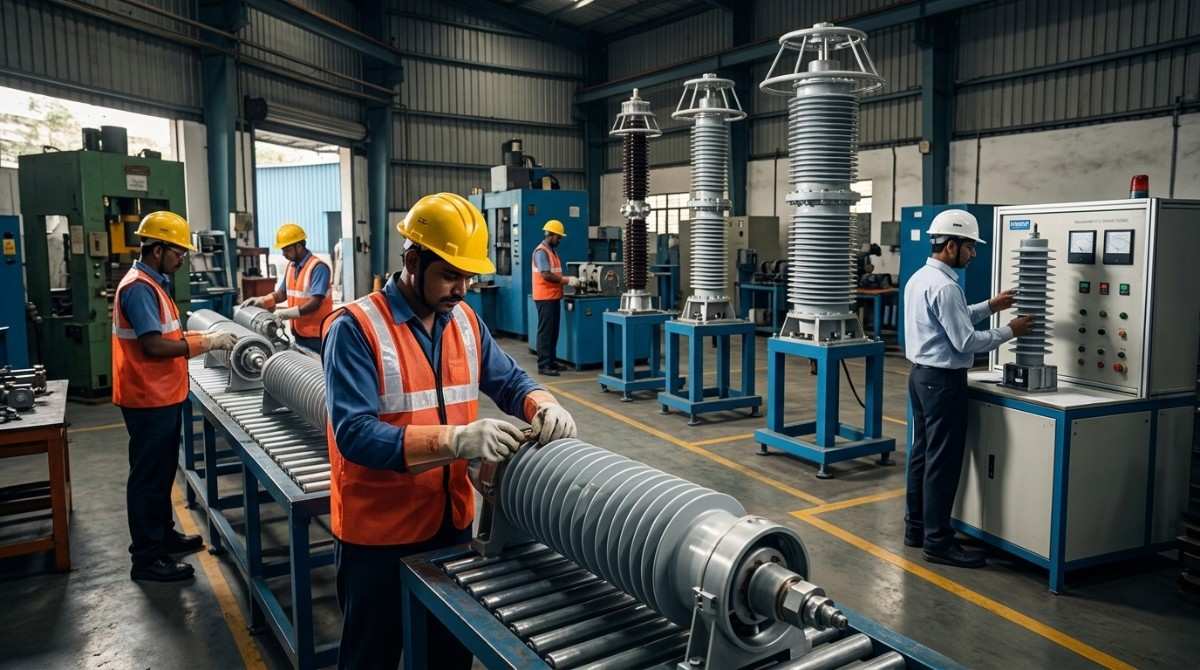
The performance of MOV-based arresters depends heavily on the consistency of zinc oxide block manufacturing. Density uniformity, sintering temperature control, and contact surface quality all affect the varistor's energy handling and aging characteristics. Manufacturers who invest in controlled manufacturing environments produce arresters with tighter performance spreads and longer service lives.
Application Engineering Support
A manufacturer worth partnering with helps you select the right product for your specific system conditions, not just match a catalog number to your voltage class. This includes guidance on MCOV selection, pollution class, energy handling requirements, and mounting configuration.
Why SPKN India Stands Out Among Lightning Arrester Manufacturers in India
SPKN India has built a strong reputation across Indian utility projects, EPC contracts, and industrial installations by focusing on exactly the things that matter: product performance, standards compliance, and honest technical support.
Their lightning arrester range covers distribution class through station class, in both polymer and porcelain housing, across voltage levels from 11 kV to 220 kV and beyond. Every product in the range is manufactured to IEC 60099-4 and IS 3070 requirements, with type test documentation available for customer review.
What makes SPKN India a preferred source for procurement managers is the combination of verified product quality and application-specific guidance. Their technical team does not simply send a catalog. They work through the system parameters with you: rated voltage, MCOV, pollution level, energy class, and installation configuration. This prevents the common field problem of correctly-rated arresters failing prematurely because the energy class was under-specified.
For EPC contractors managing large substation packages, SPKN India supports factory acceptance testing, delivers complete documentation sets for utility approval, and maintains consistent supply timelines across project phases. These are not small considerations when a project commissioning date depends on them.
For industrial buyers protecting plant infrastructure, the long-term reliability of SPKN India products translates directly into fewer unplanned outages and lower lifecycle maintenance costs.
A Quick Selection Checklist Before You Buy
Before finalizing any arrester purchase, confirm the following:
- System voltage and MCOV requirement clearly defined
- Voltage class matched to installation point (distribution, intermediate, or station)
- Energy handling class matched to prospective fault and switching surge levels
- Pollution level assessed and creepage distance specified accordingly
- Housing material selected (polymer recommended for new projects)
- Nominal discharge current class confirmed (5 kA, 10 kA, or 20 kA)
- Type test certificate from CPRI or NABL-accredited lab verified
- IEC 60099-4 and IS 3070 conformance confirmed
- Manufacturer application support available for technical queries
Conclusion
Choosing the right lightning arrester for your project is not about picking the most well-known brand name or the lowest quote. It is about matching technically verified products to your specific system conditions and trusting them to perform when a surge actually arrives.
In India's electrical landscape, where monsoon season brings millions of lightning strike events and grid switching operations create constant overvoltage exposure, the quality of your Lightning Arrester Manufacturers in India selection determines the resilience of your entire electrical system.
SPKN India brings together the product range, technical credentials, and application expertise that industrial buyers and EPC contractors need. Connect with the SPKN India team with your project specifications and get the right product recommendation backed by real engineering knowledge.