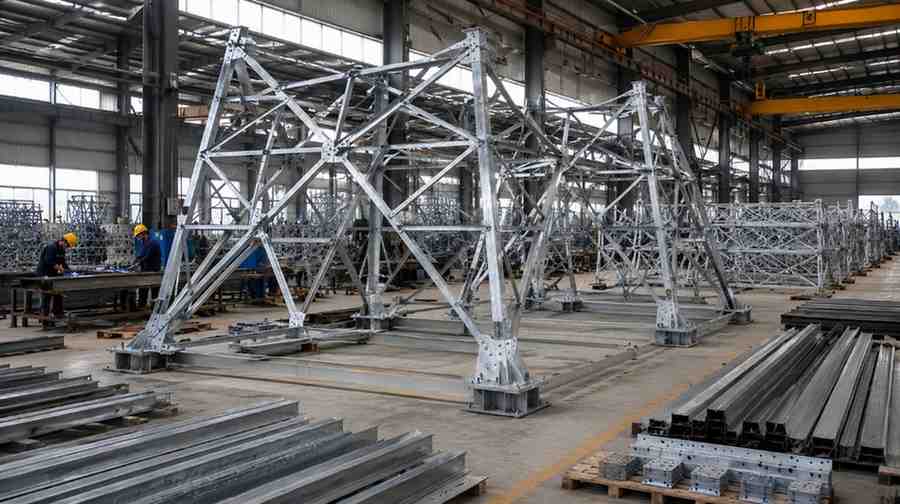
A line that looks perfect on the drawing can fail on the ground for very ordinary reasons. A tower arrives with thin galvanizing, a few members are cut slightly out of tolerance, and the erection crew loses days forcing parts together. Nobody planned for it, yet it delays the energisation date.
Most of these problems start at the selection stage. This guide is for engineers, EPC contractors and project buyers comparing transmission line tower manufacturers in India. It explains what a tower actually has to do, what to check in a manufacturer, and how the tower fits with everything else on the line.
A quick word about SPKN India before we begin. We make isolators, air break switches, lightning arresters, polymer insulators and substation connectors, and we install them. We do not fabricate towers. We do work on the same lines, so we know where tower decisions affect everyone else’s work.
What a Transmission Line Tower Does
A tower holds conductors at a safe height above ground, keeps them apart from each other and from the structure, and carries the weight, wind and tension loads of the line. It has to do this for decades, in sun, monsoon, dust and sometimes salt air.
That sounds simple, but the loads are demanding. A single span carries the weight of the conductor and ground wire, wind pressure across a long length of cable, and in some regions ice or heavy rain. At bends and line ends, the conductor also pulls sideways with great force. Tower design is the art of resisting all of that with as little steel as is safely possible.
Types of Transmission Line Towers
Before comparing suppliers, make sure you know which towers your line needs. Suppliers quote very differently depending on the mix.
Suspension and tension towers
A suspension tower carries the conductor’s weight on straight stretches. A tension tower anchors the conductor’s pull where the line turns, ends, or crosses a river or railway. Tension towers, including dead-end types, are built much heavier, and they usually make up a smaller share of the line but a larger share of the steel cost.
Towers are commonly grouped by how much the line deviates at that point. Small-angle, medium-angle and large-angle towers are often labelled A, B, C and D in utility specifications, though the exact angles vary by voltage class and utility.
Single circuit and double circuit towers
A single circuit tower carries one set of three-phase conductors. A double circuit tower carries two, which doubles the capacity on the same corridor. This matters in places where land is scarce, such as near cities and industrial belts.
Lattice towers and monopoles
Lattice towers, made from angle sections bolted together, remain the standard for most Indian transmission lines because they are strong and economical. Tubular steel poles take up less land and suit urban or space-constrained routes, but cost more per kilometre.
Materials, Galvanizing and Standards
Steel quality and coating quality decide how long a tower lasts. These are the points to read closely in any offer.
Towers in India are normally built from structural steel to IS 2062, in E250 or E350 grade depending on load. The higher grade allows lighter sections for the same strength, which can reduce weight and transport cost.
Galvanizing is the tower’s main defence against corrosion. Hot-dip galvanizing should follow IS 2629 and IS 4759, and thicker members usually need a heavier coating than thin ones. Ask for coating thickness records from actual production, not from a sample plate.
Fasteners deserve the same attention. Bolts, nuts and washers should be of specified strength class and galvanized too, because a failed bolt can be as serious as a failed member.
The main standards to look for are:
- IS 802 for the use of structural steel in overhead transmission line towers
- IS 5613 for design, installation and maintenance of overhead lines
- IS 2062 for structural steel grades
- IS 2629 and IS 4759 for hot-dip galvanizing
Always confirm the latest edition and any utility-specific requirements in your tender.
What to Check in Transmission Line Tower Manufacturers in India
Brochures look alike. These checks show real capability:
- Valid ISO 9001:2015 certification and compliance with the relevant IS standards
- Proof of tower design and prototype testing, with test reports you can read
- Galvanizing done in-house or at a certified plant, with traceable coating records
- Fabrication capacity that matches your tonnage and delivery schedule
- Documented inspection at each stage, including third-party inspection if your contract requires it
- Experience on lines of similar voltage, terrain and tower mix
- Willingness to support erection, with marking, packing and drawings that make site work easy
Two of these separate the careful from the careless. The first is the prototype test: a tower that has been loaded to failure on a test bed behaves as designed, while an untested one is an assumption. The second is packing and marking. Well-marked members saved time on site, and badly marked ones cost it.
Ask for references and call them. A manufacturer’s recent project list, with names of customers you can contact, tells you more than any certificate.
Erection, Hardware and Everything Else on the Line
A tower is only the beginning of a transmission line. Once it is standing, the line needs insulators to hold the conductor away from the steel, hardware to connect and support it, and protection to keep surges from damaging equipment.
On many lines, polymer insulators are a common choice because they are light, resist pollution and are easy to handle during stringing. At the substation end, substation connectors and clamps have to match the conductor size and terminal, or joints overheat in service. Lightning arresters at line entries protect transformers and switchgear from surges that travel down the line.
All of this has to be planned alongside the towers, not after. Tower top geometry, insulator string length and conductor size all affect each other, and a late change in one forces changes in the others.
Erection is the other place where decisions overlap. Even excellent towers go up slowly if the foundation levels are wrong or the drawings do not match the supplied steel. Many buyers now prefer one team to handle supply, erection and commissioning, because it removes the gap between vendors. Our turnkey electrical projects are built around exactly that idea.
Where SPKN India Fits In
SPKN India Isolators Pvt. Ltd. is a Faridabad-based manufacturer with over twelve years in high voltage equipment and more than 1,100 installations across India. Our quality system is ISO 9001:2015 certified, and our products are built to PGCIL and utility specifications.
On a transmission project, we supply the equipment that works with the towers: isolators, arresters, insulators, connectors and line hardware, from 11 kV up to 220 kV. We also handle installation, commissioning and maintenance, so the same team that supplies the equipment can put it into service.
If you already have a tower supplier, that is fine. We work with whoever you select, and we match our equipment to your tower and conductor details. If you are still choosing, share your voltage class and route requirements, and we can tell you what the rest of the line will need.
Mistakes to Avoid When Selecting a Tower Manufacturer
Three mistakes come up repeatedly.
The first is comparing quotations by price per tonne alone. A cheaper rate can hide thinner galvanizing, weaker bolts or an incomplete scope, and the difference shows up as corrosion in a few years.
The second is skipping the prototype and inspection requirements to save time. A tower that has not been tested, or that left the plant without independent inspection, turns site problems into contract disputes.
The third is treating towers, hardware and erection as separate purchases with no one coordinating them. Small mismatches between components add up to real delay, so assign clear responsibility for the interfaces early.
Plan the Whole Line, Not Just the Towers
The best tower manufacturer is the one that can show you tested designs, traceable galvanizing and a clear erection plan. Check certificates against real records, compare scope before price, and think about how the tower connects to insulators, hardware and protection from the start.
If you are planning a transmission or substation project, SPKN India can supply and install the equipment that completes it.
Planning a line or substation project? Share your voltage class, site location and requirements, and we will send a technical offer. Contact SPKN India or call +91 9810040983.