Quick answer: A 33 kV substation isolator is an off-load switch that creates a visible, safe gap between live and dead sections of a substation. It is opened only after the circuit breaker has cleared the current, and it lets crews work on equipment without risk.
The Basic Concept: What Does "Isolation" Actually Mean?
Isolation means physically separating a piece of equipment from every source of power, with a gap you can see. A closed circuit breaker may look safe on a panel, but an isolator gives the visible proof that a transformer bay, bus section or line is truly disconnected.
That is why a 33 kV isolator is called an off-load device. It is not built to interrupt current. The circuit breaker does that job, and the isolator opens afterwards to create a safe working zone. To see how the two roles fit together, read the difference between an isolator and a circuit breaker.
How Does a 33 kV Substation Isolator Actually Work?
The operating sequence is simple, and the order matters.
- The circuit breaker opens and interrupts the load current.
- The operator confirms that the circuit is dead and that the interlocks allow isolator operation.
- The operating mechanism, whether a manual handle, a gear box or a motor drive, rotates the support insulators.
- The moving blades separate from the fixed contacts and open a visible air gap.
- If an earth switch is fitted, it closes to discharge any trapped charge and hold the section at earth potential.
Behind this sequence sit a few main parts: a base frame, support insulators, current-carrying blades and contacts, an operating mechanism and interlocks. The quality of each one decides how smoothly the isolator operates after years in a yard. For a wider explanation, see how isolators work in substations.
Types of 33 kV Substation Isolators You Should Know
Centre rotating double break isolators
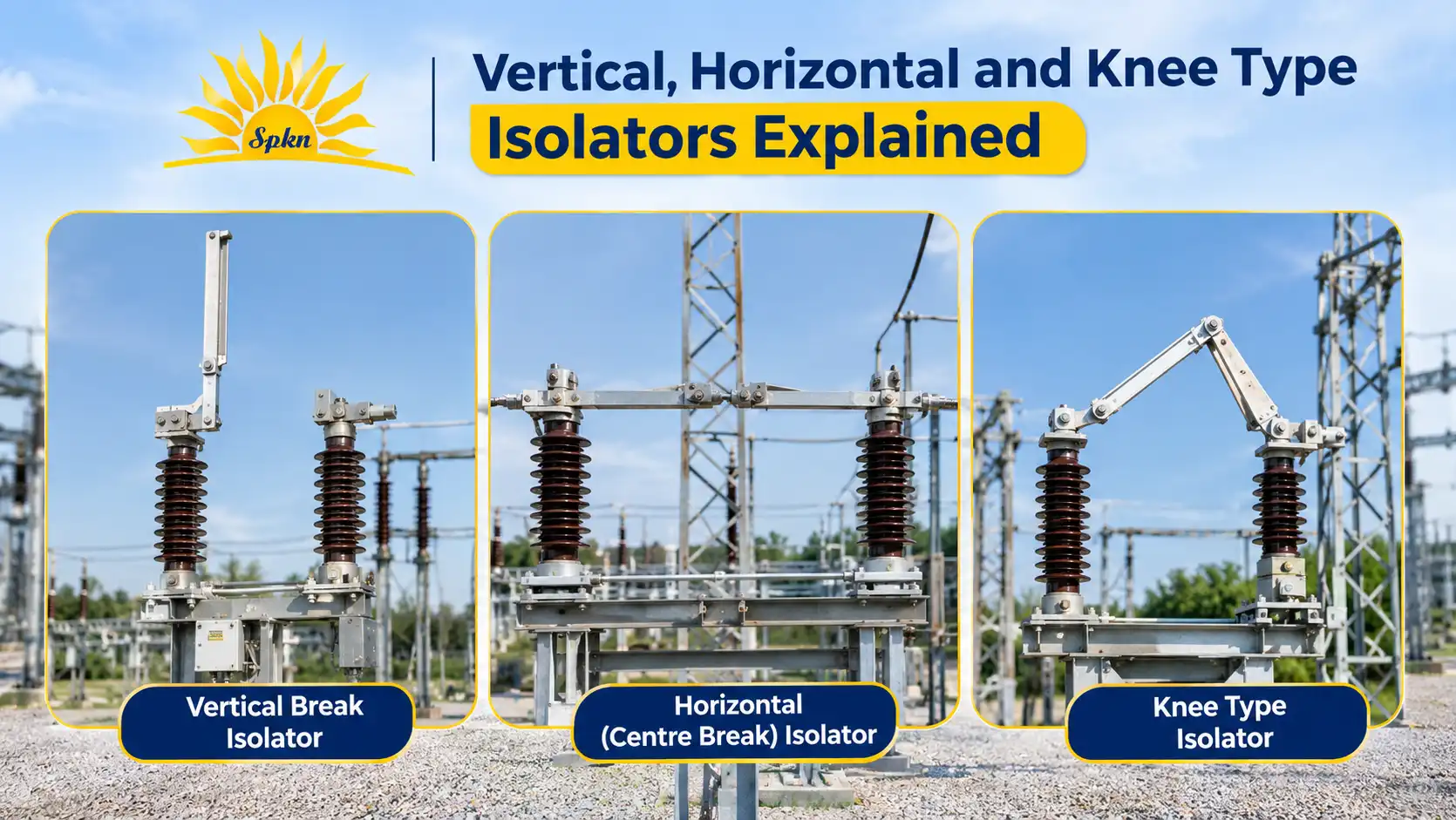
The most common type at 33 kV. Two insulator stacks rotate and open the contact in the middle, creating two gaps in series. They suit horizontal mounting and standard bay layouts. The trade-offs between this design and single break designs are covered in single break and double break isolators.
Vertical break isolators
The blade lifts vertically, which saves horizontal clearance. They suit compact layouts where phase-to-phase spacing is limited. Before you choose one, review the factors to consider before buying a vertical break isolator.
Isolators with earth switches
An integrated earth switch removes the need for a separate earthing arrangement and adds a safety interlock. Many 33 kV line and transformer bays specify them, so confirm the requirement with your consultant before ordering.
Real-World Applications Across Indian Industries
- State and private distribution substations that step 33 kV down to 11 kV
- Industrial plants such as cement, steel, textile and chemical units with their own 33 kV incomer
- Solar and wind projects, where 33 kV collector substations connect generation to the grid
- Railway, metro and mining installations that depend on dependable HT switching
- Large commercial campuses and data centres that run private HT networks
If your project is at a lower voltage, compare it with the guidance in 11 kV vs 33 kV isolator selection.
5 Things That Separate a Good 33 kV Isolator from a Poor One
- Contact system: silver-plated copper contacts with firm pressure keep resistance and heating low.
- Insulators: well-glazed porcelain or good polymer units with enough creepage distance for your site's pollution level.
- Mechanism: smooth operation, correct alignment and reliable interlocks, since a stiff mechanism fails when you need it most.
- Ratings and test reports: rated current, short-time withstand current and insulation level proven by type tests under IS 9921 and IEC 62271-102.
- Finish and support: hot-dip galvanised steel parts and a supplier who answers after delivery.
Key Technical Ratings Explained
A datasheet lists many numbers, but five of them decide whether an isolator suits your substation.
- Rated voltage: a 33 kV system uses equipment rated for a highest system voltage of 36 kV.
- Rated current: pick the next standard step above your maximum load current, with room for future growth.
- Short-time withstand current: the isolator must carry the fault current at your location for the rated duration, usually 1 second, or 3 seconds when specified.
- Insulation level: 36 kV class equipment is commonly specified with a 170 kV lightning impulse withstand level. Confirm the figure against your consultant's specification.
- Creepage distance: longer creepage helps in polluted areas. IEC 60815 guidance runs from about 16 mm per kV in light pollution up to 31 mm per kV in very heavy pollution.
Ask the supplier to show these values in the type test report, not only in the brochure. A brochure states what the design should achieve, while a test report shows what it did achieve.
Installation and Maintenance Tips
Even a well-built isolator can misbehave if it is installed carelessly. A few habits prevent most problems.
- Align the three poles carefully so that all blades close fully and together, and check the contact pressure after erection.
- Tighten terminal connectors to the specified torque and use the right connector material for the conductor, since a loose or mismatched joint heats up.
- Test the mechanism and the interlocks several times before energising, and make sure the earth switch and isolator cannot be closed together.
- Connect the base frame and operating mechanism to the earth grid with proper earth leads.
- Clean insulators and lubricate moving parts before the monsoon, and look for cracks, chips or flashover marks.
- Use thermal imaging during peak load to catch hot contacts before they fail.
Keep a small stock of spare contacts, fasteners and mechanism parts. A missing spare turns a short fix into a long outage, so it helps to know which isolator spare parts matter most.
Common Mistakes Buyers Make When Purchasing
- Comparing quotations on price alone and ignoring contact material and test reports
- Selecting the current rating without checking fault level and short-time withstand rating
- Ignoring pollution and monsoon conditions when choosing insulator type
- Forgetting the earth switch, interlock or mechanism type until the layout is finalised
- Skipping spares and a clear warranty, which makes small faults expensive
Why SPKN India Is a Trusted Name for 33 kV Isolators
SPKN India works from Faridabad and supplies isolators and related HT substation equipment to buyers across India. The team shares datasheets and test documents with each offer, so you can compare products on evidence instead of claims. You can browse the range on the 33 kV substation isolator page, see manufacturer options in 33kV isolator manufacturers in India, or explore the wider isolator manufacturers in India category.
Conclusion
A 33 kV substation isolator rarely gets attention until something goes wrong, yet it protects every person who works on the network. Choose it for contact quality, insulator suitability, a smooth mechanism and proven test reports, and it will operate reliably for years.
Frequently Asked Questions
What is the difference between an isolator and a circuit breaker?
A circuit breaker interrupts load and fault current. An isolator is opened only when the circuit is already dead, to provide a visible gap for safe maintenance.
Can a 33 kV isolator be operated on load?
No. A standard isolator is an off-load device. Operate it only after the circuit breaker has opened, and follow the interlock scheme of your substation.
Which standards apply to 33 kV isolators in India?
Isolators are commonly specified to IS 9921 and IEC 62271-102. Ask the supplier for type test reports that match the exact rating you plan to buy.
What does an earth switch do on an isolator?
It connects the isolated section to earth, which discharges trapped charge and keeps the section safe while crews work on it.
How often should a 33 kV isolator be maintained?
Inspect contacts, mechanism, insulators and interlocks at least once a year, and clean insulators and lubricate moving parts before the monsoon.
Need a 33 kV Isolator for Your Substation?
Share your rating, short-circuit level and quantity, and we will recommend the right 33 kV isolator. Call +91 9999501843, message us on WhatsApp, or send an enquiry and SPKN India will reply with a technical offer.