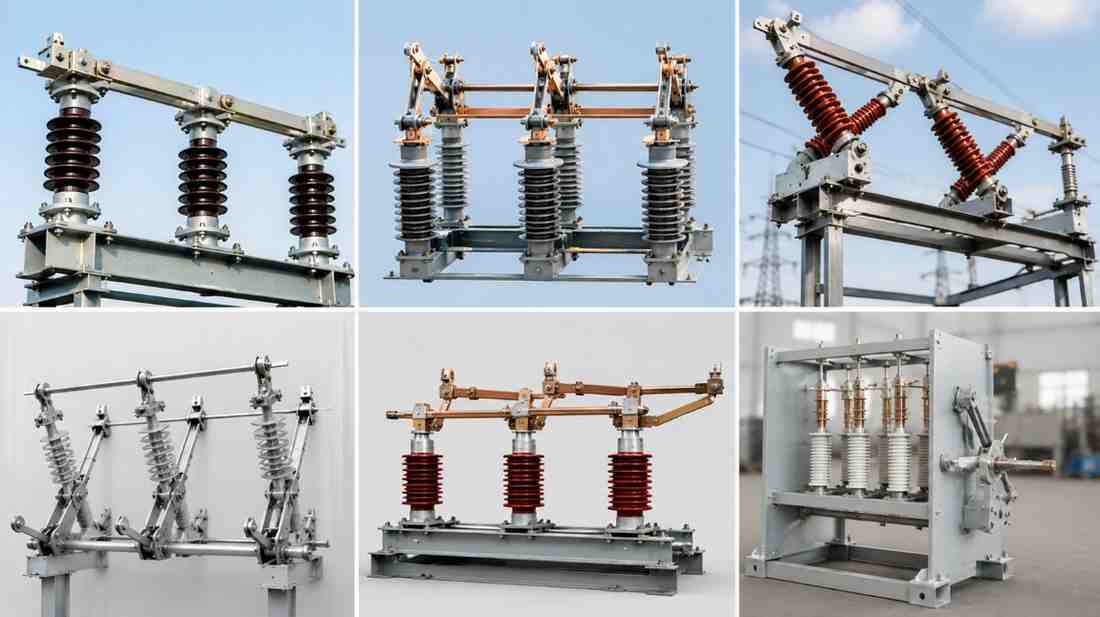
This guide classifies all major types of isolators used in Indian power systems — from 11kV distribution substations to 765kV extra-high-voltage transmission switchyards — with a practical comparison table to support your procurement decisions.
What Is an Electrical Isolator? (Quick Definition)
An electrical isolator (also called a disconnector or disconnecting switch) is a mechanical switching device that opens or closes a circuit under no-load or negligible-current conditions. Unlike a circuit breaker, an isolator cannot interrupt fault or load current. Its primary function is to provide a visible isolation point that confirms equipment is safely de-energised before maintenance begins.
Isolators are governed by IS 9921 in India and IEC 62271-102 internationally. They are rated for voltage (kV), continuous current (A), short-circuit withstand current (kA), and mechanical endurance (number of operations).
Why Isolator Type Selection Matters
India operates one of the world's largest power networks, with over 4.5 lakh circuit kilometres of transmission lines and thousands of substations at voltage levels from 11kV to 765kV. According to the Ministry of Power, the country's substation transformation capacity exceeded 1,200 GVA in 2023.
In each of these substations, the specific isolator type chosen affects: available space and bus arrangement, operational flexibility, maintenance requirements, installation cost, and safety of switching personnel. An incorrect isolator type — for instance, installing a single-break unit where a double-break is required by utility specification — can cause commissioning delays or rejection during inspection.
Classification by Number of Break Points
The most fundamental classification of an isolator is the number of points at which each phase conductor is physically broken when the switch opens.
Single Break Isolator
A single break isolator has one pair of contacts per phase. When operated, the blade or moving contact rotates or slides to create a single open gap between the source and load sides. Single break designs are compact and cost-effective, making them the standard choice for 11kV and 33kV distribution substations.
They are available in horizontal-centre-rotating, end-rotating, and vertical-break configurations. SPKN India manufactures single break isolators in ratings up to 33kV, widely used in DISCOM substations across Rajasthan, Gujarat, and Maharashtra.
Double Break Isolator
A double break isolator has two sets of contacts per phase, creating two open gaps in series when operated. The central moving arm (or "jaw") retracts from both fixed contacts simultaneously. This configuration offers: improved arc interruption, higher mechanical stability, reduced stress per contact, and wider suitability for EHV applications.
Double break isolators are the standard choice for 66kV, 132kV, 220kV, and 400kV substations. Most PGCIL and state transmission utility specifications mandate double break for transmission voltages. The trade-off is slightly higher cost and more complex alignment requirements compared to single break units.
Triple Break Isolator
Rarely used, triple break isolators provide three open gaps per phase and are found in specialised EHV applications above 400kV where the highest isolation integrity is required. They are not commonly encountered in standard Indian DISCOM or state grid substation specifications.
Classification by Movement / Mechanism Type
Beyond the number of break points, isolators are classified by how the moving contact achieves separation from the fixed contact.
Centre-Rotating (Knee-Type) Isolator
The centre-rotating isolator is the most widely used type in Indian HV substations. The central blade rotates about a horizontal axis at its midpoint, swinging away from both sets of fixed contacts. This provides a clear visual open-gap indication from the ground level — an important safety requirement for maintenance personnel.
Centre-rotating designs are compact, robust, and suitable for gang-operation (all three phases operated simultaneously by a single actuating mechanism). They are available from 11kV to 400kV.
Pantograph Isolator
The pantograph isolator uses a scissors-type folding mechanism to raise the moving contact vertically into a fixed overhead contact (usually a busbar conductor). This design is ideal for substations where horizontal space is limited and vertical clearances are more generous — particularly in AIS (Air-Insulated Switchgear) bus arrangements with multiple bays.
Pantograph isolators are extensively used in 220kV and 400kV substations in India, particularly in PGCIL's inter-state transmission network. Their compact horizontal footprint makes them suitable for constrained urban substation sites.
Vertical Break Isolator
In a vertical break isolator, the moving blade rotates upward about a horizontal base pivot, breaking the circuit in a vertical plane. The open blade stands nearly vertical when fully open, providing a highly visible isolation indicator. These are used in 11kV to 66kV systems.
Classification by Location / Application
Isolators are also categorised by their functional position within a substation's bus configuration and protection scheme.
Bus Isolator (Bus Side Disconnector)
A bus isolator connects or isolates a feeder or transformer bay from the main busbars. It is typically located on the busbar side of the circuit breaker. In a double-bus substation arrangement, separate bus isolators allow any feeder to be transferred between Bus 1 and Bus 2.
Line Isolator (Line Side Disconnector)
A line isolator is installed on the line (outgoing feeder or incoming transmission line) side of the circuit breaker. Its function is to isolate the line from the substation when the line is de-energised for inspection, maintenance, or cable work.
Transfer Bus Isolator
In substations with a transfer or bypass bus arrangement, a transfer bus isolator allows a feeder's circuit breaker to be bypassed using the transfer bus breaker while maintenance is performed — without interrupting supply to consumers. This is critical for high-reliability networks where extended outages are not acceptable.
Classification by Installation Environment
Outdoor isolators are designed for installation in open-air substations (AIS). They are constructed with weatherproof materials, UV-resistant insulators (porcelain or polymer), and sealed mechanisms. The vast majority of Indian substations up to 220kV use outdoor air-insulated isolators.
Indoor isolators are used in GIS (Gas-Insulated Switchgear) substations and indoor metal-clad switchboards, typically at 11kV–33kV in space-constrained urban or industrial locations.
Comparison Table — All Isolator Types at a Glance
| Isolator Type | Break Points | Typical Voltage | Space Requirement | Best Application |
|---|---|---|---|---|
| Single Break | 1 / phase | 11kV–33kV | Low | Distribution substations |
| Double Break | 2 / phase | 66kV–400kV | Medium | Grid & transmission substations |
| Centre-Rotating | 1 or 2 | 11kV–400kV | Medium | Standard AIS substations |
| Pantograph | 1 | 132kV–400kV | Very low (horizontal) | Compact EHV substations |
| Vertical Break | 1 | 11kV–66kV | Low | Distribution, clear visual break |
| Bus Isolator | 1 or 2 | All voltages | Varies | Bus-side isolation in all HV bays |
| Line Isolator | 1 or 2 | All voltages | Varies | Line-side isolation |
How to Choose the Right Isolator Type
When specifying an isolator for a new substation or an upgrade project, consider these factors in sequence:
- System voltage level: Determines the minimum insulation class and clearances required.
- Continuous current rating: Must exceed the maximum expected load current with a safety margin.
- Short-circuit level: The isolator's peak and RMS withstand ratings must exceed the prospective fault level at the installation point.
- Bus arrangement: Single bus, double bus, 1.5-breaker, or ring bus — each arrangement requires specific isolator configurations.
- Available footprint: Space constraints often determine the choice between centre-rotating and pantograph designs.
- Utility specification: Many DISCOMs and state transmission utilities publish standard technical specifications (STS) that mandate specific isolator types, make, and test certificates. Always check the applicable STS before ordering.
- Operation mode: Manual, motor-operated, or remote/SCADA-controlled.
SPKN India's technical team assists procurement managers and EPC contractors in matching the correct isolator type and specification to their project requirements. Drawings and type test certificates are available on request.
SPKN India manufactures a comprehensive range of electrical isolators — single break, double break, and centre-rotating configurations — for 11kV to 220kV applications. All units are IS 9921-compliant with type test certificates available. If you are specifying isolators for a DISCOM project, EPC tender, or industrial substation, our technical team can help you match the right isolator type to your drawings and utility requirements. Contact SPKN India today with your voltage, current rating, and site details — receive a technical proposal within 48 hours.