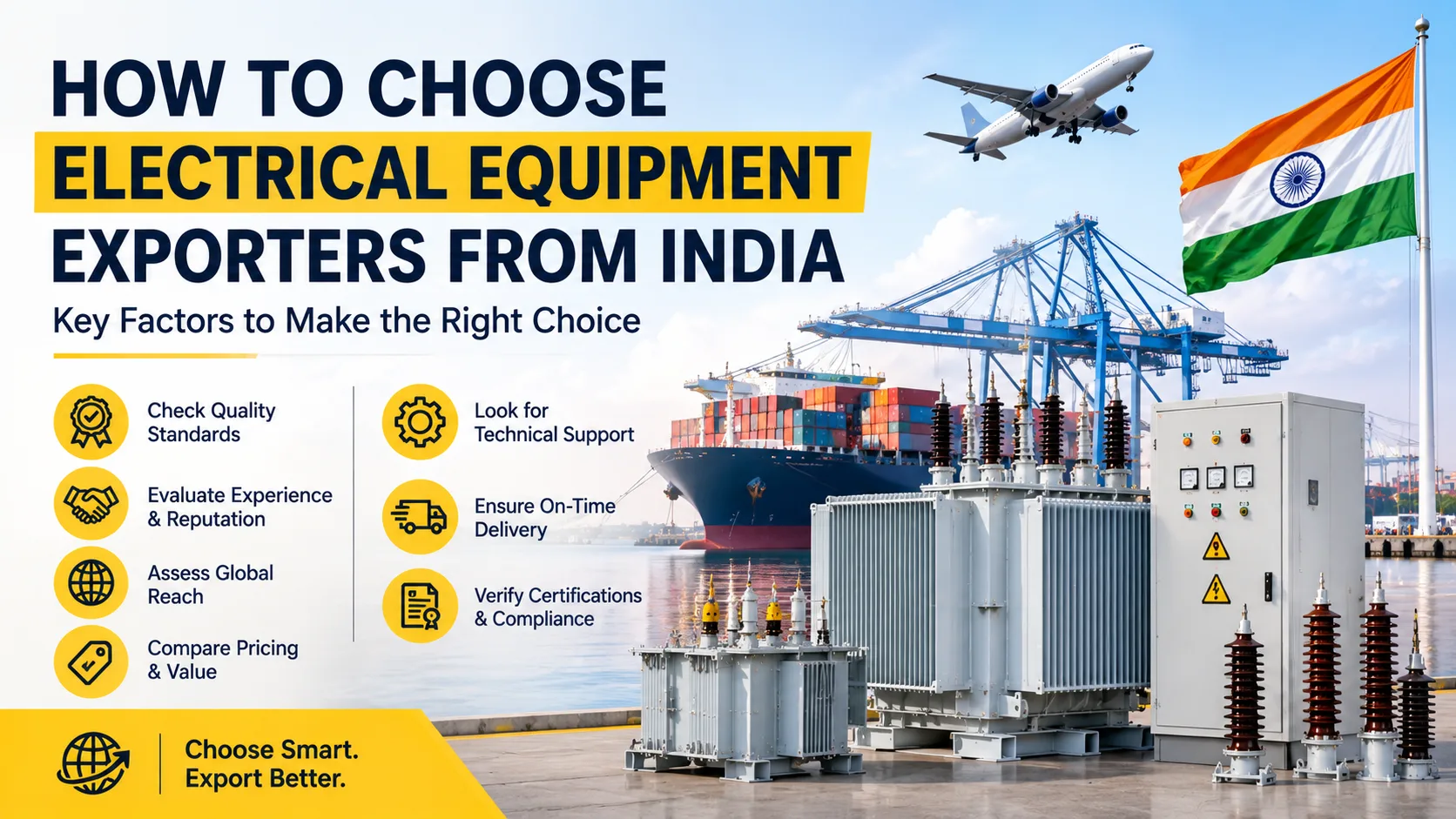
India exports a wide range of electrical equipment, from isolators and lightning arresters to insulators, connectors and substation structures. Many overseas utilities, contractors and traders now buy from Indian manufacturers because of competitive price, mature engineering and a large industrial base. But the quality of exporters varies widely, and a wrong choice can mean failed tests, late delivery or equipment that does not match the specification. This guide gives overseas buyers a practical checklist for choosing an Indian exporter of electrical equipment, from the first enquiry to after-sales support.
Start With a Clear Specification
The best way to avoid problems is to write down exactly what you need before you contact any supplier. A good specification names the product, the rated voltage, the rated current, the short-circuit rating, the standard, the insulation level, the creepage distance, the quantity and the delivery place. It also states the tests required and the documents needed. With a clear specification, you can compare exporters on the same basis, and the exporter can quote precisely. A vague enquiry usually produces a vague quotation, and a vague quotation is a source of dispute later.
Manufacturer, Trader or Merchant Exporter?
Manufacturer exporter
This company makes the equipment in its own works and exports it directly. You deal with the party that controls materials, production and testing. You can ask for technical changes, visit the works and receive test reports from the maker.
Trader or merchant exporter
This company buys from one or more factories and sells abroad. It can be useful for mixed orders or small quantities, but you should ask who actually makes each item and who is responsible if something fails.
Which to choose
For engineered high-voltage products, where ratings and test reports matter, a manufacturer exporter is usually the safer choice. For standard low-risk items, a trader may be fine if the paperwork is clear. In both cases, ask for the name of the factory and check it.
Check Standards and Test Reports
High-voltage equipment is only as good as the tests behind it. Ask which standards the exporter works to, such as IEC or Indian Standards, and whether it can build to the standard you need. Then ask for:
- Type test reports from an independent laboratory, which prove the design passes the standard.
- Routine test reports for the batch you will receive, which show each unit was checked.
- Material certificates for key materials such as zinc coating, copper, aluminium and porcelain.
- Quality system certificates such as ISO 9001, which show the company follows a controlled process.
Check that the reports match the model, rating and standard you are buying. A report for a different rating is not proof for your order. Our guides on lightning arrester exporters in India and isolator spare parts exporters in India show what we look for in these categories.
Verify the Exporter's Credentials
- Importer Exporter Code: Every Indian exporter needs this code from the Directorate General of Foreign Trade. Ask for it, and check it.
- Company registration and GST: A registered company with a tax number and a physical address is easier to deal with and to hold accountable.
- Export experience: Ask for shipments to your country or region, with references you can contact.
- Industry membership: Membership of an export council, such as the Engineering Export Promotion Council, is a sign of an active exporter, though it is not proof of quality.
- Works visit or video audit: A visit by you or a representative, or a live video tour, shows the factory floor, the test equipment and the stock.
Understand Export Paperwork
A normal export shipment needs a set of documents. The commercial invoice states the goods, value and terms. The packing list gives the contents and weights of each package. The bill of lading, for sea freight, or the airway bill, for air freight, is the transport document. A certificate of origin shows the country of manufacture, and some importing countries need a specific format. Test certificates and a conformity or inspection certificate may also be required by your customs or your utility. Ask the exporter to confirm in the quotation which documents it will provide, and check your own import rules early.
Customs classification also matters. Switching and protective apparatus for voltages above 1,000 V, which includes isolators and surge arresters, falls under heading 8535 of the Harmonised System, and electrical insulators fall under heading 8546. Exact codes and duty rates depend on the product and the importing country, so confirm them with your customs broker.
Agree Incoterms and Delivery
Incoterms define who pays for and controls each part of the journey, and at what point risk passes to you. Common choices include EXW, where you collect from the factory, FOB, where the exporter loads the goods on the ship at the Indian port, CIF, where the exporter pays freight and insurance to your port, and DAP, where the exporter delivers to a named place. Each has different cost and risk. State the term and the named place in writing, and ask the exporter for a delivery schedule with milestones such as raw material, production, testing and dispatch.
Packing for Long Journeys
Porcelain, galvanised steel and precision parts all need careful export packing. Ask how the exporter packs fragile items, whether wooden crates or pallets follow the international rule for treated wood, and how heavy items are secured inside containers. Good packing also includes clear marking, humidity protection for long sea voyages, and a packing list that matches the contents of every box. Poor packing causes damage that is expensive to claim and slow to fix.
Payment Terms and Protection
Common payment methods include advance payment, partial advance with the balance before dispatch, documentary collection, and a letter of credit. A letter of credit protects both sides because the bank pays only when the agreed documents are presented. For a first order, many buyers prefer a letter of credit or a staged payment tied to inspection. Exporters often protect themselves with export credit insurance, and you can protect yourself with a third-party inspection before shipment. Always put the payment terms, the currency and the bank details in the contract and check bank details by a trusted channel.
Use Third-Party Inspection
An independent inspector can check the quantity, the markings, the dimensions, the visual quality and the packing, and can witness the routine tests, before the goods leave the factory. The cost is small compared with the value of the order and the cost of a rejected shipment. Ask the exporter to allow inspection and to give the inspector access to the test area and the records.
Pricing: What to Compare Beyond the Unit Price
A low unit price can be misleading. Compare the full landed cost, which includes the product price, packing, inland transport in India, export clearance, sea or air freight, insurance, import duty, taxes and local delivery. Check also what the price includes in the product itself, such as terminals, mounting hardware, counters, spares and drawings. Currency matters too, so agree whether the price is in rupees, dollars or euros, and how long the quotation stays valid. A transparent exporter will break the price into clear lines, which makes comparison easy and lets you see where a lower quote is saving money, and whether that saving is real.
Lead Time and Capacity
Ask for a realistic lead time, and ask what it is based on. A real lead time reflects raw material availability, production capacity, testing time, packing and transport to the port. Ask how many units of your product the factory makes in a month, and how your order fits with its current load. For large projects, agree on a schedule with partial shipments, so that your site receives material in step with erection. Delays are the most common complaint in export orders, and a clear plan from the start is the best protection.
Communication and Language
Good exporters answer technical questions quickly and in clear language, and they send drawings and datasheets without long delays. During the enquiry stage, notice how fast and how fully they reply. A supplier who is slow, evasive or vague before an order is unlikely to improve after payment. Agree on a single contact person for the project, and keep all decisions in writing, so that no detail depends on memory or a phone call.
Check After-Sales Support and Spares
Equipment lives for decades, and your relationship with the exporter does not end at delivery. Ask about the warranty period and what it covers, how claims are handled, whether spare parts are available, and how quickly technical questions are answered. A supplier who keeps your drawings and past orders on file makes repeat orders and spares much easier.
Red Flags to Avoid
- No test reports or reports that do not match the product.
- Prices far below every other quote, which often hide thinner coatings, lower grade material or missing items.
- No factory address or refusal of a visit or video audit.
- Pressure to pay fully in advance to a personal account.
- Vague quotations that leave out ratings, standards or inclusions.
A Simple Scoring Method
When you compare two or three exporters, score each on the same list: product fit, test reports, factory evidence, export experience, documents, packing, payment terms, delivery plan and support. Give each item a score from one to five, and add weight to the items that matter most for your project. The result is not a magic number, but it forces a fair comparison and gives you a record to explain your choice to your team or your client.
Export Supply From SPKN India
SPKN India manufactures isolators, lightning arresters, insulators, connectors and gantry structures in Faridabad and supplies customers in India and abroad. We share test reports, quote against your specification and help with export documents and packing. See our products, then send your specification through the contact page or call +91 9999501843.
Get a Free Quote from SPKN India WhatsApp Us