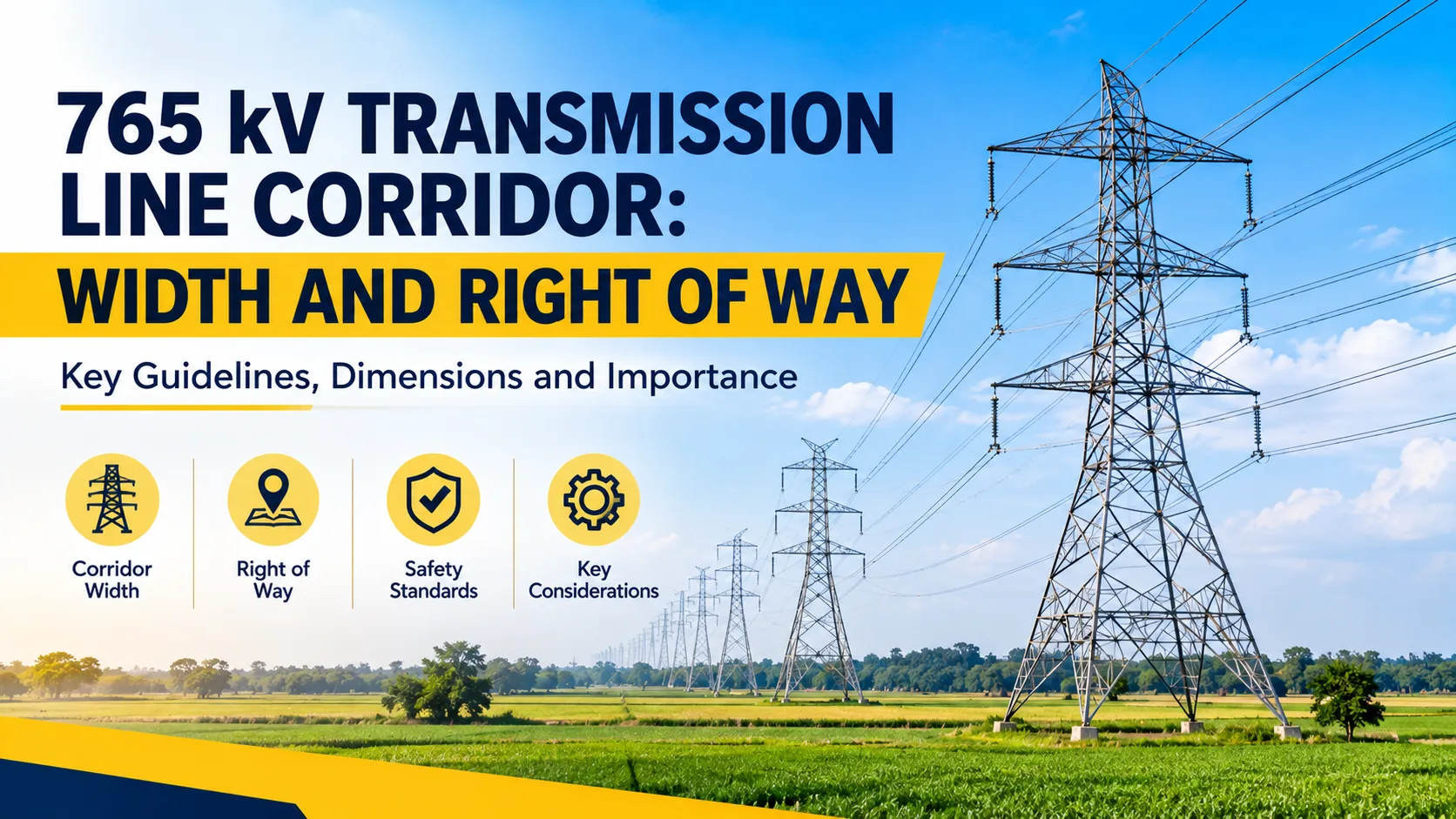
A 765 kV line is the backbone of India's high-capacity transmission network. It moves large blocks of power over long distances with lower losses than a lower-voltage line. But a line this powerful needs space. The strip of land that the utility must keep clear under and around the conductors, called the corridor or right of way, is wider than for any lower-voltage line in common use. This guide explains what the corridor is, the typical widths published in India, what decides them and why they matter to planners, landowners and equipment buyers. For a wider view of the voltage class itself, see our guide on the 765 kV transmission line in India.
What Right of Way Means
Right of way, usually shortened to ROW, is the strip of land along the route of a line in which the utility has the right to build, operate and maintain it. Within the strip, the use of the land is restricted so that nothing comes dangerously close to the live conductors. Tall trees must be cut or trimmed, and permanent buildings are generally not allowed. The width of the strip is measured across the line, from one edge to the other, with the line along the centre.
The corridor is not the same as the land under the tower itself. The tower footing takes up a small area, while the corridor is the long strip that runs from tower to tower. Compensation and permissions treat these two parts differently, which is why landowners often hear both terms.
Typical Corridor Widths in India
Central Electricity Authority guidelines list typical widths by voltage class. The values below are commonly quoted figures for planning, not a replacement for the current rule applicable to your project.
| Voltage | Typical ROW width | Notes |
|---|---|---|
| 765 kV | About 64 m single circuit (delta), about 67 m double circuit | Widest AC class in regular use in India |
| 400 kV | About 46 m | Common backbone voltage |
| 220 kV | About 35 m | Regional transmission |
The Central Electricity Authority has also released draft amendments to its technical standards, which propose narrower corridors for some tower types in forest and urban areas. Rules are updated from time to time, so always check the latest notified version before you rely on a figure.
Why a 765 kV Corridor Is Wider
Larger electrical clearances
Air is the insulation between a live conductor and anything else. The higher the voltage, the more air is needed to stop a spark. A 765 kV conductor therefore needs more distance to the ground, to trees, to buildings and to other conductors than a 400 kV line does. This drives the height of the tower and the spacing between phases.
Wider phase spacing and bundled conductors
Each phase of a 765 kV line normally carries a bundle of four or more sub-conductors, held apart by spacers, to control corona and reduce losses. The bundle is large, and the three phases are spaced widely, often in a delta arrangement, to keep electric fields acceptable. Our guide to high voltage power transmission lines explains how voltage classes are built up.
Conductor swing in wind
Conductors are not rigid. In strong wind, they swing sideways. The corridor must be wide enough that the swung conductor still keeps a safe distance from trees and structures at the edge. Longer spans and heavier bundles swing more.
Electric and magnetic field limits
The electric field at ground level, and the field at the edge of the corridor, must stay within accepted limits for public exposure. A wider corridor lets the field fall to a safe level before it reaches homes and fields beside the line. Corona noise and radio interference also depend on distance, so the corridor helps keep them acceptable at the boundary.
Tower Type and Configuration
The tower shape sets the width of the line. A horizontal arrangement spreads the phases side by side and gives a wide structure but a lower tower. A delta arrangement places one phase above the other two, which makes the tower narrower and is usually preferred where land is tight. A double circuit tower stacks the circuits one above the other, which carries more power in a single corridor but needs a taller structure. Each choice affects the corridor width, tower weight, cost and the ease of maintenance. Our page on double circuit transmission lines explains the double circuit option, and our page on transmission line towers covers tower design.
Power Carried per Corridor
A wider corridor is easier to accept when you see what it carries. The natural loading of a line rises roughly with the square of its voltage. On that basis, a 765 kV line has about 3.7 times the natural loading of a 400 kV line, because 765 squared divided by 400 squared is about 3.7. The corridor is only about 40 percent wider, so the power moved for each metre of corridor is much higher. For long routes and large power transfers, this makes 765 kV an efficient use of land.
What Is Allowed Inside the Corridor
- Farming: Normally allowed, with limits on tall crops and trees. Irrigation pumps and low structures need care.
- Roads and pipelines: Can cross the corridor, with agreed clearances and permits.
- Buildings: Generally not allowed under or very near the conductors.
- Tall trees: Must be removed or kept below a limit that preserves clearance.
- Cranes and tall machinery: Need permission, since they can come close to live conductors.
The exact rules depend on state law, the utility and the voltage, so always check before building or planting inside a corridor.
Land, Compensation and Permissions
Building a line requires permission to place towers and to run conductors over private land. Under the Electricity Act, transmission licensees have powers to place lines, and landowners receive compensation for the land and for any crop or tree damage. Government guidelines have set out compensation methods for both the tower base and the corridor, and states may adopt their own rules. Early talks with landowners and clear records of what is paid and why tend to reduce delays. For planners, land acquisition and forest clearance are often the longest part of a transmission project, which is why the corridor width is studied so carefully.
Why Corridor Planning Matters
- Cost: Land, compensation, clearing and legal work add to project cost and time.
- Environment: A narrower corridor in forest or sensitive land means less tree cutting and less impact.
- Safety: Correct width and clearance protect the public and the line.
- Reliability: Keeping trees and structures away prevents faults and outages.
- Future growth: A corridor planned for a second circuit saves a new route later.
How the Route Is Chosen
Route selection is a careful survey, not a straight line on a map. Planners start with the two end points, then look for a path that avoids dense settlements, protected forest, wetlands, airports, defence areas and difficult terrain. They compare several options for length, number of angle towers, number of river and road crossings, and the extent of tree cutting. A shorter route is not always the cheapest, because a route through forest or hills can cost more in permissions, tower foundations and construction access. The final route balances cost, schedule, safety and environmental impact, and the chosen corridor width is applied along its whole length.
Crossings Inside the Corridor
A long line must cross roads, railways, rivers, canals, other power lines and communication lines. Each crossing has its own rule for minimum height of the conductor above the object, and often needs a permit from the owner. At a crossing, the line may use a taller tower, a stronger insulator string or a special span so that the clearance stays safe even if one component fails. Good records of every crossing, with drawings and permission letters, help during operation and later maintenance.
Questions to Ask Before You Buy Land Near a Corridor
Corridor rules affect land value and land use for decades, so it pays to check them before signing any agreement.
If you own or plan to buy land near a proposed or existing 765 kV line, a few questions save trouble. Ask the utility for the notified corridor width and the exact alignment on a survey map. Ask what you may build, plant and operate inside the strip, and what needs permission. Ask how compensation is calculated and who is responsible for damage during construction and maintenance. Finally, ask whether a second circuit is planned along the same route, since that can change the tower height and the strip required.
Equipment at the End of a 765 kV Line
A transmission line ends at a substation, where isolators, circuit breakers, arresters, insulators, connectors and structures take over. At these voltages the insulation levels, the clearances in the yard and the quality of every joint become critical. Even though the corridor is a land question, the equipment at its ends decides how reliably the line can be switched, protected and maintained. Our lightning arresters, isolators, porcelain insulators and substation connectors are built for such duty, and our guide to high voltage line voltages from 33 kV to 765 kV gives the wider context. You can also read about the next step up in our article on the 1200 kV transmission line in India.
Equipment and Support From SPKN India
SPKN India manufactures high-tension substation and line equipment in Faridabad and supports customers with selection, supply and erection. Tell us your voltage class, ratings and quantities and we will send an itemised quotation. You can also call +91 9999501843.
Get a Free Quote from SPKN India WhatsApp Us