Every overhead line and every substation yard depends on insulators. They hold live conductors in the air or on a structure and stop current from flowing into the steel or the ground. But there is no single insulator for every job. Pin, post and disc insulators are built differently, carry different loads and suit different voltages. This guide explains each type in plain terms, compares them side by side and gives a simple method for choosing the right one for your line or substation.
What an Insulator Must Do
An insulator has two main jobs. Electrically, it must withstand the system voltage, plus lightning and switching surges, without flashing over its surface or breaking down through its body. Mechanically, it must carry the weight of the conductor, the pull of the line, and extra loads from wind and ice, for many years. It must also survive heat, rain, dust and sunlight. Different insulator designs give different answers to these two jobs, and that is why several types exist. For a general introduction to the material itself, see our guide on how porcelain electrical insulators work.
Pin Insulator
Construction
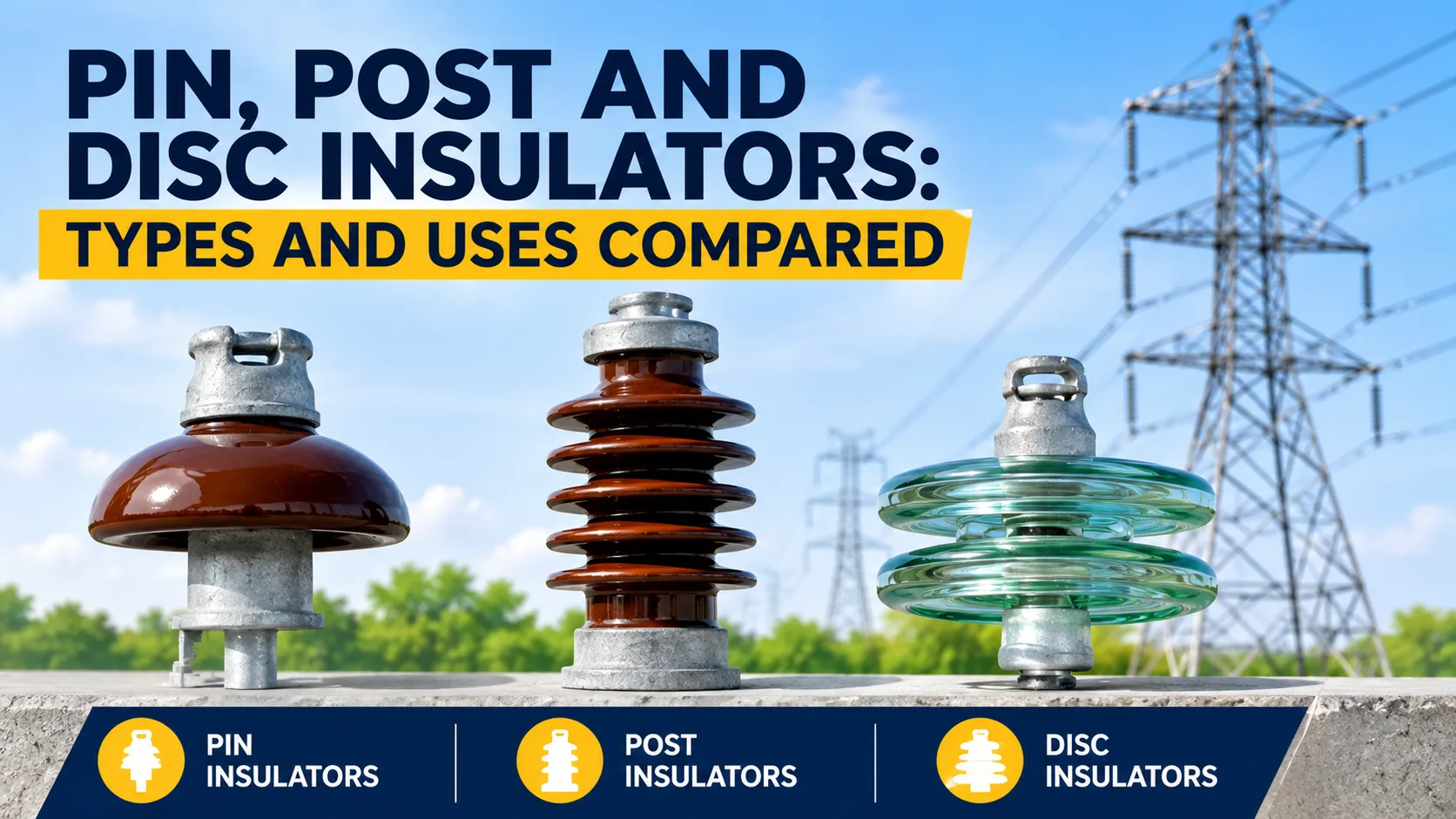
A pin insulator is a single piece, usually with two or three rain sheds, mounted on a steel pin that is fixed to the crossarm of a pole or tower. The conductor sits in a groove on the top of the insulator, or in a side groove, and is tied in place with a binding wire or held with a clamp.
Typical voltage range
Pin insulators are used mainly on distribution lines, commonly at 11 kV and up to about 33 kV. Above that, the insulator becomes too tall and heavy, and a single piece of porcelain becomes hard to make and costly. You can see a polymer version on our 11 kV polymer pin insulator page.
Strengths and weaknesses
- Strength: Simple, low-cost and quick to install on poles.
- Strength: Well suited to short spans and straight runs.
- Weakness: Limited to lower voltages.
- Weakness: Not suited to the heavy pull at angles and line ends, where a stronger fitting is needed.
- Weakness: A puncture in the single body means the whole insulator must be replaced.
Post Insulator
Construction
A post insulator looks like a taller, more solid pin insulator. It is usually a solid or stacked column with a flange at the base, and it is bolted to a structure instead of being fixed on a pin. Because it is rigid and mounted at its base, it can carry bending loads from conductors, bus tubes and equipment.
Typical voltage range
Post insulators are used for medium and high voltages. On overhead lines, they can replace pin insulators where more strength is needed. In substations, they support busbars, isolators, current transformers and other equipment at voltages from 11 kV up to the highest transmission levels, using longer or stacked units for higher voltage.
Strengths and weaknesses
- Strength: High mechanical strength, with good resistance to bending and cantilever loads.
- Strength: A rigid support, which keeps conductors and equipment in a fixed position.
- Weakness: Heavier and more costly than a pin insulator for the same voltage on a simple line.
- Weakness: Needs a proper mounting base and accurate alignment.
Disc (Suspension) Insulator
Construction
A disc insulator is a single unit shaped like a plate, with a cap and a pin joined to the insulating body. Many discs are linked, pin to cap, to form a string that hangs from the crossarm of a tower. The conductor is attached at the lower end of the string. The string can swing a little, which relieves stress from wind and from the movement of the line.
Typical voltage range
Disc insulators are the usual choice from about 33 kV upward, and they are standard on high-voltage and extra-high-voltage lines. To raise the voltage rating, you simply add more discs to the string. Our guide on the main types of disc insulators explains the disc shapes, such as standard and fog types, and our page on transmission line insulators covers how they are used on lines.
Strengths and weaknesses
- Strength: Flexible design, since you choose the number of discs for your voltage and pollution level.
- Strength: A damaged disc can be replaced without replacing the whole string.
- Strength: Strong in tension, which suits angle and dead-end towers.
- Weakness: Heavy strings add weight and need more tower strength.
- Weakness: Many discs mean more joints to inspect and more chances of a cracked unit.
Side-by-Side Comparison
| Point | Pin | Post | Disc (suspension) |
|---|---|---|---|
| How it is mounted | On a pin on the crossarm | Bolted on a base | Hung in a string below the crossarm |
| Conductor position | On top or in a side groove | On top or clamped | At the lower end of the string |
| Main load | Vertical weight | Bending and weight | Tension |
| Voltage range | Up to about 33 kV | Medium to very high | About 33 kV and above |
| Typical use | Distribution lines | Substations and rigid line support | Transmission lines |
| Flexibility | Rigid | Rigid | Flexible, can swing |
Porcelain, Glass and Polymer Versions
Each of these shapes is available in more than one material. Porcelain is the classic choice, with a long service record and good resistance to heat and ageing. Toughened glass is used for disc insulators, where a shattered disc is easy to see during an inspection. Polymer, or composite, insulators have a fibre-glass core and a silicone rubber or similar housing. They are light and perform well in polluted areas because the surface sheds water. Our pages on porcelain insulators and polymer insulators show our ranges, and our article on polymer vs porcelain insulators helps you choose between them.
How to Choose the Right Insulator
- Start with the system voltage. Up to about 33 kV, pin or post insulators are usual. Above that, disc strings or long post columns are used.
- Check the mechanical load. A straight run needs mostly vertical strength. Angle towers and line ends need tension strength, which favours discs.
- Consider the pollution level. In dusty, coastal or industrial areas, choose a longer creepage distance, a fog type disc or a polymer housing.
- Think about weight. Heavy strings need strong towers. Polymer units cut weight, which helps on weak or old structures.
- Check the location. In a substation, a post insulator is the standard support. On a line, the voltage and the load decide between pin and disc.
- Compare lifecycle cost. Include the cost of replacement, inspection and outage, not just the purchase price.
Which Insulator Fits Which Application
- Rural 11 kV feeder on poles: Pin insulators on straight runs, with stronger fittings at angles and line ends.
- 33 kV line with long spans: Post insulators or short disc strings, depending on the tension and the pollution level.
- 132 kV and 220 kV transmission line: Disc strings, or long polymer suspension insulators where weight must be low.
- Substation busbar support: Post insulators, sized for the bus load and the short-circuit forces.
- Coastal or heavily polluted site: Fog type discs, longer creepage units or polymer housings, with a cleaning plan.
Electrical Strength and Creepage in Simple Terms
Two measures describe the electrical strength of an insulator. The first is the dry and wet flashover voltage, which is the voltage at which a spark jumps across the surface in clean and rainy conditions. The second is the creepage distance, which is the length of the shortest path along the surface between the live end and the earthed end. A longer creepage distance gives more resistance to surface flashover in dirty, damp air. That is why insulators in polluted areas have deeper sheds or extra discs. When you compare two quotations, compare the creepage distance in millimetres per kilovolt, not only the height of the insulator.
Mechanical Ratings You Should Ask For
Each type has its own key mechanical rating. For a pin or post insulator, ask for the cantilever strength, which is the sideways load at the top that the insulator can carry. For a disc insulator, ask for the electro-mechanical failing load, which is the tension at which the unit fails, written in kilonewtons. A rating too close to the working load leaves no margin for wind, ice or a broken conductor, so check the safety factor in your design standard.
Common Mistakes
- Using a pin insulator beyond its limit. At higher voltage or heavy line pull, it is not the right support.
- Too few discs. Selecting a string without allowing for pollution can lead to flashover in wet, dirty conditions.
- Ignoring the cantilever rating of a post insulator. A rating that is too low can bend or break under bus or conductor loads.
- Mixing metal fittings. Fittings must match the insulator and the conductor, or corrosion and heating can follow.
- Skipping inspection. Cracks, chips and tracking marks are far easier to fix when found early.
Inspection and Maintenance
All insulators need regular inspection. Walk the line or the yard and look for cracked or chipped porcelain, burn marks from flashover, tracking on polymer surfaces and rusted or loose hardware. In polluted areas, clean the insulators on a schedule, since a layer of dust and salt can cause flashover in damp weather. Thermal imaging can find hot joints at the fittings, and special testers can detect faulty discs in a string. Keep a record of what you found and when, so that you can plan replacements before an outage forces them.
Insulators in a Complete System
An insulator is only one part of the line. It must work with the conductor, the clamps, the tower or pole, and the surge protection. A poorly chosen clamp can damage the conductor, and a missing arrester can leave the insulator exposed to a lightning surge it was not built to take. See our guides on the overhead line insulators and the transmission system for how the parts fit together, and our substation connectors for the joints at the terminals.
Insulators From SPKN India
SPKN India manufactures porcelain and polymer insulators and supplies the hardware that goes with them from its works in Faridabad. Send us your voltage, mechanical load, pollution level and quantity, and we will recommend the right type and send an itemised quotation. You can also call +91 9999501843.
Get a Free Quote from SPKN India WhatsApp Us