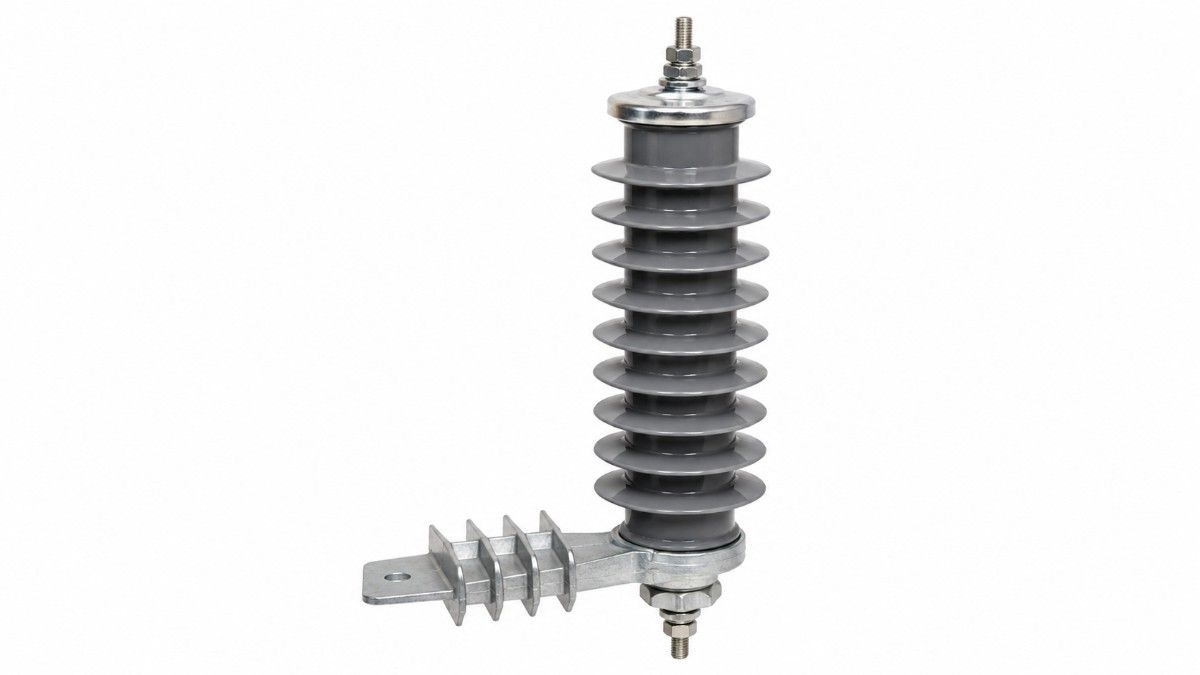
11 kV Lightning Arrester: Ratings, Selection, Installation and Maintenance
The 11 kV distribution network is the part of the grid closest to consumers, and it is also the part most exposed to lightning. Thousands of kilometres of overhead feeders, pole-mounted transformers and cable terminations stand in the open, with no tall tower or shield wire above them. A nearby lightning strike can induce a surge of tens of kilovolts on the line. Without protection, that surge can puncture a transformer winding or flash over an insulator. A 11 kV lightning arrester is the small device that stops this.
This guide explains how an 11 kV lightning arrester works, how to select the right rating, where to fit it, and how to keep it working. It is written for distribution utility engineers, contractors and plant electricians. For arresters at higher voltages and for a broader overview, see our page on lightning arresters.
What a Lightning Arrester Does on an 11 kV Line
An arrester is connected between the live conductor and earth. At normal voltage it passes only a few milliamperes, so the line behaves as if the arrester were not there. When a surge arrives, the resistance of the arrester falls very quickly and the surge current flows to earth. This clamps the voltage at the equipment to a safe value. When the surge is over, the arrester returns to its high-resistance state and the line goes on working. The protection depends on three things: the arrester's rating, its lead length and the earth resistance.
How Surges Reach an 11 kV Line
There are two main routes. A direct strike hits the conductor and injects a very large current, but because 11 kV insulation is low, a direct strike nearly always causes a flashover somewhere on the line whatever you do. The more common route is an induced surge: a strike to the ground or a tree near the line creates a changing electric field that induces a voltage on the conductors, often 50 to 150 kV. These induced surges travel along the line in both directions and reach any transformer or cable end. Arresters are chosen mainly to deal with these induced surges, and also with the part of a direct strike current that flows to the equipment after the first flashover.
Protective Margin: A Simple Check
Every piece of equipment has a basic insulation level (BIL), the surge voltage it is built to withstand. A standard 11 kV distribution transformer is designed for 75 kV. The arrester, in turn, limits the surge to its residual voltage at the discharge current. For a 9 kV, 10 kA metal oxide arrester, the residual voltage is typically about 25 to 30 kV, and the data sheet gives the exact value. The protective margin is the BIL divided by the arrester's residual voltage, plus an allowance for lead voltage. A margin of at least 1.2 is the usual minimum, but a good installation should reach 1.5 or more.
| Item | Value in this example |
|---|---|
| Transformer BIL | 75 kV |
| Arrester residual voltage at 10 kA | About 28 kV |
| Voltage across a 1 m lead (rough allowance) | About 1 to 1.5 kV per metre of lead in a fast surge |
| Total at the transformer | About 32 kV with a short lead |
| Protective margin | 75 divided by 32, about 2.3 |
If the lead were five metres long, the lead voltage could add more than five kilovolts and the margin would fall. This simple calculation shows why the mounting position and lead length matter so much in practice.
What Happens When an Arrester Fails
An arrester can fail from repeated surges, ingress of moisture, or a temporary overvoltage above its rating. When a metal oxide arrester fails it usually becomes a short circuit to earth. This causes the line to trip, or the fuse upstream to blow, and the utility must find the faulty arrester. Many arresters therefore have a disconnector on the earth lead. If the arrester fails, the disconnector blows and drops the lead away from the arrester, which removes the fault from the line and gives a visible sign for the lineman. Polymer-housed arresters also fail safely, without scattering pieces, which is a key reason for their use in street areas.
11 kV Arrester Specification Checklist for a Tender
- System voltage 11 kV, highest system voltage 12 kV, 50 Hz, neutral earthing arrangement.
- Rated voltage, MCOV and nominal discharge current (5 kA or 10 kA), line discharge class.
- Maximum residual voltage at the nominal discharge current and at lightning impulse.
- Housing material, creepage distance and the pollution class at site.
- Pressure relief or failure mode, and the type of disconnector, if any.
- Mounting arrangement, terminals and earth lead size.
- Applicable standards: IS 3070 Part 3 and IEC 60099-4.
- Type test and routine test reports, and the warranty period.
Types of 11 kV Lightning Arresters
Metal oxide (gapless) arresters
Modern 11 kV arresters use blocks of zinc oxide, which have a highly non-linear voltage-current characteristic. They have no series spark gap, so they respond faster and give lower residual voltage than older types. They are made to IS 3070 Part 3 and IEC 60099-4. This is the standard choice for new installations.
Polymer-housed arresters
Silicone rubber housing is lighter than porcelain, does not shatter if the arrester fails and sheds water well. It suits pole-mounted use, polluted areas and places where a failing porcelain housing could injure people below.
Porcelain-housed arresters
These have a long record of service and are still used in substations. They are heavier and need good mounting, but they work well when kept clean.
Expulsion type and horn gap arresters
Older networks use horn gaps and expulsion arresters. They are cheap but give less precise protection. Our guide on horn gap devices explains how they work and where they still make sense.
Key Ratings for an 11 kV Arrester
| Rating | What it means | Typical choice for 11 kV |
|---|---|---|
| System voltage | Nominal line-to-line voltage | 11 kV (highest 12 kV) |
| Rated voltage (Ur) | Highest voltage the arrester can operate at for a short period | 9 kV for solidly earthed systems, 12 kV for isolated neutral |
| Continuous operating voltage (MCOV) | Voltage it can hold continuously | About 7.2 kV for a 9 kV arrester |
| Nominal discharge current | Test surge current used to classify it | 5 kA or 10 kA |
| Housing | Insulating shell | Polymer or porcelain |
| Creepage distance | Surface leakage path | Higher in polluted zones |
The neutral treatment of the system decides the rated voltage. Most Indian 11 kV networks are fed from transformers with the neutral earthed through a resistor or solidly earthed, and a 9 kV arrester is common, but your utility's rule must be followed.
5 kA or 10 kA: Which One?
A 5 kA arrester is enough for many pole-mounted transformers in areas with moderate lightning. A 10 kA arrester gives a larger margin and is chosen for substation entries, cable terminations, long exposed feeders and areas with heavy lightning. The price difference is small compared with the cost of a failed transformer, so many utilities now standardise on 10 kA for all new work.
Where to Install 11 kV Arresters
- At distribution transformers, on the high-voltage side, as close to the bushings as possible. Our guide on the lightning arrester in a transformer shows the connection.
- At the junction of an overhead line and an underground cable, because the cable end reflects surges and doubles the stress.
- At line entries to substations, ahead of the isolator and breaker.
- At long exposed spurs and rural feeders, especially on hill tops and open ground.
- Near ring main units and capacitor banks, which are sensitive to surges.
Installation Practice
- Mount the arrester on a bracket or cross-arm as close as possible to the equipment, at the manufacturer's recommended distance.
- Keep the line lead short, thick and straight, because every metre of lead adds voltage during a surge.
- Connect the earth lead directly to the transformer tank and to the earth electrode, with a short, low-inductance path.
- Fit an isolator or disconnector on the earth side if the utility requires, so that a failed arrester can drop off the line.
- Measure the earth resistance after installation and make sure it meets the design value.
For a step-by-step guide, read our page on lightning arrester installation. The earth electrode is as important as the arrester, so see our guide to earthing electrodes.
Choosing Between Polymer and Porcelain for 11 kV
For pole-mounted use on 11 kV lines, polymer housing is now the default in most new work. It weighs a few kilograms less than porcelain, which makes mounting on a pole bracket easy, and it can be handled without the breakage risk that comes with ceramic. It also copes well with the vibration of wind and passing traffic. Porcelain remains common at substation yards where heavy supports are available and where a long service record matters. Whichever you choose, check the creepage distance against the pollution at your site and ask for the type test report for the exact model.
Maintenance and Testing
- Inspect arresters visually before the monsoon for cracks, flashover marks and loose connections.
- Measure the leakage current during routine tests, where the equipment is available. A rising leakage current means the arrester is ageing.
- Use thermal imaging to find arresters that run hotter than their neighbours.
- Replace any arrester with a damaged housing or one whose disconnector has operated.
- Record each arrester's serial number and installation date to plan replacement.
Common Mistakes
- Fitting the arrester far from the transformer, with long leads that cancel the protection.
- Choosing the rated voltage without checking how the neutral is earthed.
- Using a high earth resistance, so the surge voltage stays high at the equipment.
- Mixing new and old arresters on the same three-phase set.
- Skipping inspection and leaving failed arresters on the line.
11 kV Arresters From SPKN India
SPKN India is a Faridabad-based manufacturer of high-tension equipment including lightning arresters. Send us your system voltage, neutral earthing, discharge rating and quantity, and we will prepare a technical offer. You can also call +91 9999501843.