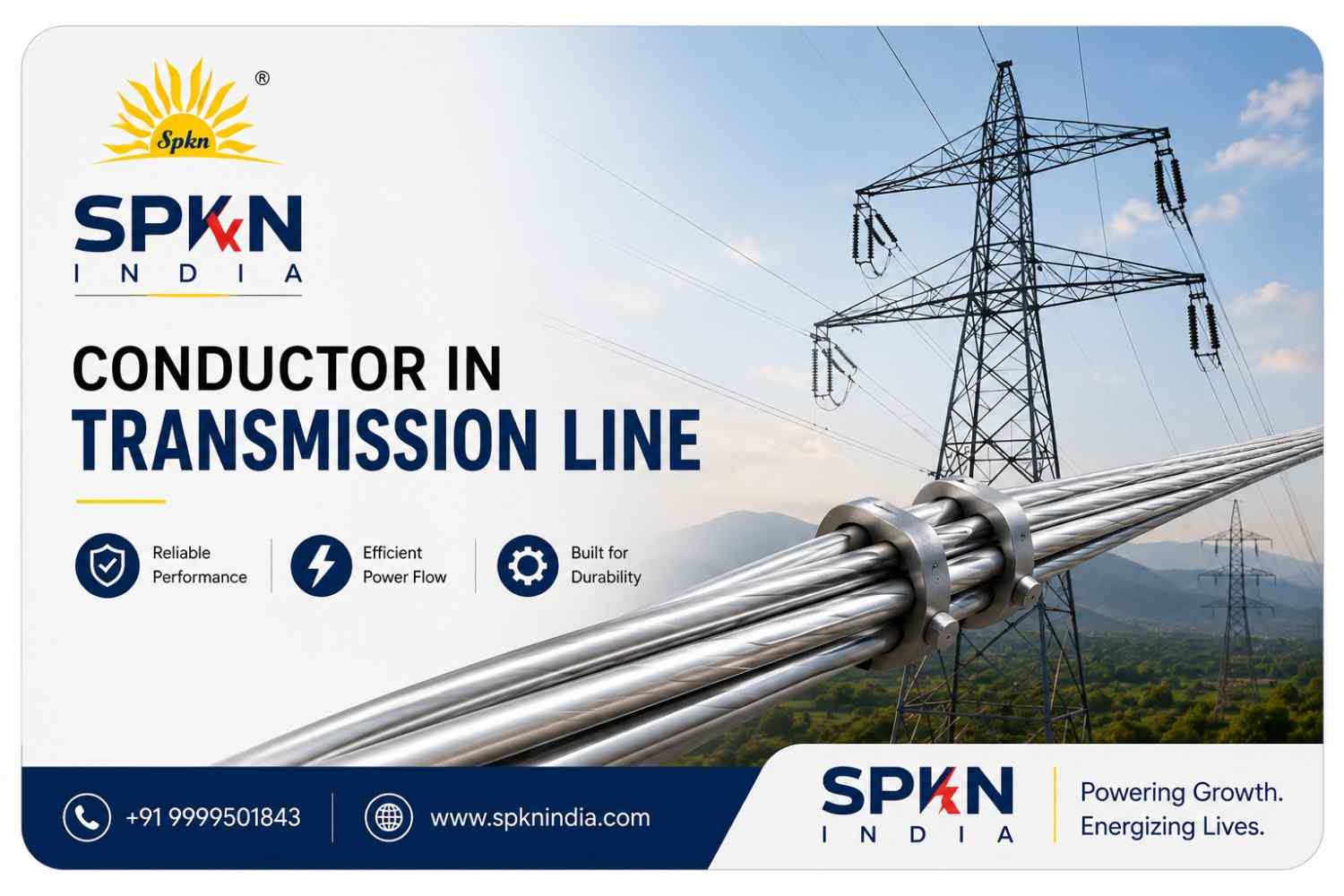
Conductor in Transmission Line: Role, Materials, Properties and Design Factors
The conductor in a transmission line is the metal wire that actually carries the electric current. Towers, insulators and substations all exist to hold it up, keep it safe and connect it to the rest of the network. If the conductor is chosen well, the line carries its load with low losses for forty years or more. If it is chosen badly, the line overheats, sags too low, hums with corona or fails in a storm.
This guide looks at the conductor from the physics side: what it must do, why aluminium dominates, which electrical and mechanical properties matter, and how losses, corona, skin effect and sag shape the design. If you want a catalogue of AAC, ACSR, AAAC and HTLS types, read our companion page on transmission line conductor types.
What a Conductor Must Do
A line conductor has to do four things at the same time. It must carry the rated current without heating beyond its limit, so its resistance must be low. It must hold its own weight, plus wind and ice, across spans of 200 to 400 metres, so it must have enough tensile strength. It must survive decades of sun, rain, pollution and temperature swings, so it must resist corrosion and fatigue. And it must be light and cheap enough that the towers and the line cost stay reasonable. These needs pull in different directions, which is why a single wire material rarely does everything and why steel-cored and alloy conductors exist.
Why Aluminium Replaced Copper on Overhead Lines
Copper is a better conductor than aluminium, but it is much heavier and costs more. For the same current-carrying ability, an aluminium conductor is larger in cross-section but about half the weight of a copper one. Lighter conductors mean lighter towers, longer spans and lower total cost, so aluminium became the standard for overhead lines.
| Property | Copper | Aluminium |
|---|---|---|
| Electrical conductivity (percent of annealed copper) | 100 percent | About 61 percent |
| Density | About 8.9 g per cubic cm | About 2.7 g per cubic cm |
| Weight for equal resistance | Baseline | About half |
| Tensile strength | Higher per unit area | Lower, needs steel or alloy help |
| Cost | Higher | Lower |
| Typical use | Cables, busbars, earthing, substations | Overhead lines |
Copper is still used inside substations, for earthing and for cables, where space is tight and weight does not matter. Our page on earthing electrodes shows where copper still wins.
Electrical Properties That Matter
Resistance
Resistance turns current into heat, and that heat is lost energy. It depends on the metal, the length and the cross-section, and it rises with temperature. Doubling the cross-section halves the resistance. This is why heavily loaded lines use larger or bundled conductors, even though they cost more at the start.
Inductance and capacitance
A line also has inductance and capacitance, set by the spacing between phases, the height above ground and the conductor radius. These values decide how much reactive power the line produces or absorbs, how voltage changes along the line and how much power it can carry over a given distance. A larger conductor radius lowers the inductance, which is another benefit of bundling.
Skin effect
At 50 Hz, alternating current tends to flow nearer the surface of a conductor than in its centre. This raises the effective resistance in very thick conductors. It is the reason why the steel core of an ACSR conductor carries little current, and why a hollow or stranded design makes good use of the metal.
Corona
When the electric field at the surface of a conductor exceeds the breakdown strength of air, a faint glow and a crackling noise appear around it. This corona discharge wastes energy, produces radio interference and ozone, and gets worse in rain and fog. At 220 kV and above, designers reduce corona by using larger diameter conductors or by splitting each phase into a bundle of two, three or four sub-conductors. Smooth fittings, with no sharp edges, are part of the same defence.
Mechanical Properties That Matter
- Tensile strength. The conductor must carry its weight, wind and ice loads without exceeding a safe fraction of its breaking load, typically 25 to 30 percent at everyday conditions.
- Sag. A hanging conductor takes a curve called a catenary. Sag increases with span length and temperature, and decreases with tension. Too much sag breaks ground clearance, and too much tension overloads the tower.
- Creep. Over the years aluminium stretches slowly under load, which increases sag. Allowance is made for this in the stringing tables.
- Vibration. Wind makes conductors vibrate at high frequency, which can fatigue the strands where they leave a clamp. Dampers and armour rods reduce this risk.
- Corrosion. Salt, industrial gases and moisture attack steel cores and joints, and coastal lines often move to all-aluminium alloy types.
Bundled Conductors
At extra-high voltage, each phase is made of two, three, four or more conductors held apart by spacers, usually 40 to 50 centimetres. A bundle acts like one very large conductor. It lowers corona, reduces inductance, increases the current-carrying capacity and lowers the line's surge impedance. The extra cost of the additional wire is paid back through lower losses and the ability to carry more power on one corridor. Bundles also need more complex clamps, spacers and dampers, so the hardware must be designed together with the conductor.
Conductor Selection Factors
- Current rating (ampacity). The conductor must carry the peak load, and the load after the loss of a parallel line, without exceeding its maximum temperature.
- Voltage drop and losses. Check that the voltage at the end of the line stays within limits, and that the yearly energy loss is acceptable.
- Corona performance. Needed at 220 kV and above.
- Span and mechanical load. Decide the conductor strength, the tower height and the sag together.
- Environment. Choose corrosion-resistant types for coastal and polluted areas.
- Cost over life. Compare purchase cost plus the value of losses for the life of the line.
Worked Example: Losses in a Conductor
Suppose a 33 kV line carries 10 MVA. The current is 10,000 kVA divided by 1.732 times 33 kV, which is about 175 A. If the conductor has a resistance of 0.27 ohm per kilometre and the line is 20 km long, the resistance of one phase is 5.4 ohm. The power lost in the three phases is three times the current squared times the resistance, which is 3 x 175 x 175 x 5.4, or about 496 kW. Over a year of continuous operation that is more than four million units of energy. If the line used a conductor with twice the cross-section, the resistance would roughly halve and the loss would fall to about 250 kW. The larger conductor costs more, but at a typical energy price the saving pays for the extra metal in a few years. This simple calculation shows why the cheapest conductor is rarely the cheapest line.
Conductor Temperature and Ampacity
The current a conductor can carry is limited by temperature, not by the metal itself. Heat from losses and from the sun raises the temperature, and wind and low ambient temperature cool it. A standard ACSR conductor is usually designed for a maximum operating temperature of about 75 degrees Celsius in India, though many utilities now allow up to 85 degrees on older lines after sag checks. Higher temperature lowers the strength of aluminium over time and raises sag, which can break clearances. Because of this, the permitted current changes with the season: the same line can carry more in winter than in a hot, still May afternoon. Dynamic line rating systems measure the real conditions and let operators use that spare capacity safely.
Standards and Quality Checks
Indian practice follows the IS 398 series for overhead conductors, with IEC 61089 as a common international reference. For quality checks, ask for the wire drawing and stranding records, breaking load test, resistance measurement and zinc coating test on the steel wires, for each production lot. Inspect drums on delivery for damaged wire, mixed lots and loose layers, because defects found after stringing are very expensive to fix.
Conductors and the Hardware Around Them
A conductor depends on its fittings for both mechanical strength and electrical contact. Suspension and tension clamps hold it to the tower string. Joints and repair sleeves connect lengths. Spacers and dampers control bundles and vibration. At the substation end, connectors join the line to the bus or equipment, and these must match the conductor diameter and take the full current without heating. See our substation connectors for the range. Insulator strings that carry the conductor are described in transmission line insulators, and the full picture of a line from tower to terminal is covered in our guide to the overhead electrical line.
Inspection and Failure Signs
- Broken outer strands near clamps, which show up as sharp wire ends or a bird-caged section.
- Discoloured or burnt joints, found by a thermal camera survey at peak load.
- Unusual sag compared with neighbouring spans, which can mean creep, a loose clamp or a damaged strand.
- Corrosion of the steel core in coastal areas, often visible as a rusty stain at the lower end of the span.
- Corona noise or glow at night in damp weather, which suggests a rough fitting or a damaged surface.
Common Mistakes
- Choosing the conductor only on current rating and ignoring corona, sag and losses.
- Mixing conductor sizes or types in one span without proper joints.
- Using fittings that do not match the conductor diameter, which causes hot joints.
- Stringing at the wrong tension for the temperature of the day.
- Ignoring creep in the sag calculation for long, high-tension spans.
Get Line and Substation Hardware From SPKN India
SPKN India is a Faridabad-based manufacturer of high-tension equipment that connects to line conductors, including connectors, isolators, insulators and arresters. Send us your conductor type, voltage and quantity, and we will prepare a technical offer. You can also call +91 9999501843.