A 33 kV feeder designed for a modest load often carries far more within a few years of commissioning. New industrial units, solar plants and wind farms keep connecting to it. The conductor strung on day one decides whether that growth is easy or expensive, because the wrong choice means re-stringing, re-tensioning and sometimes strengthening towers.
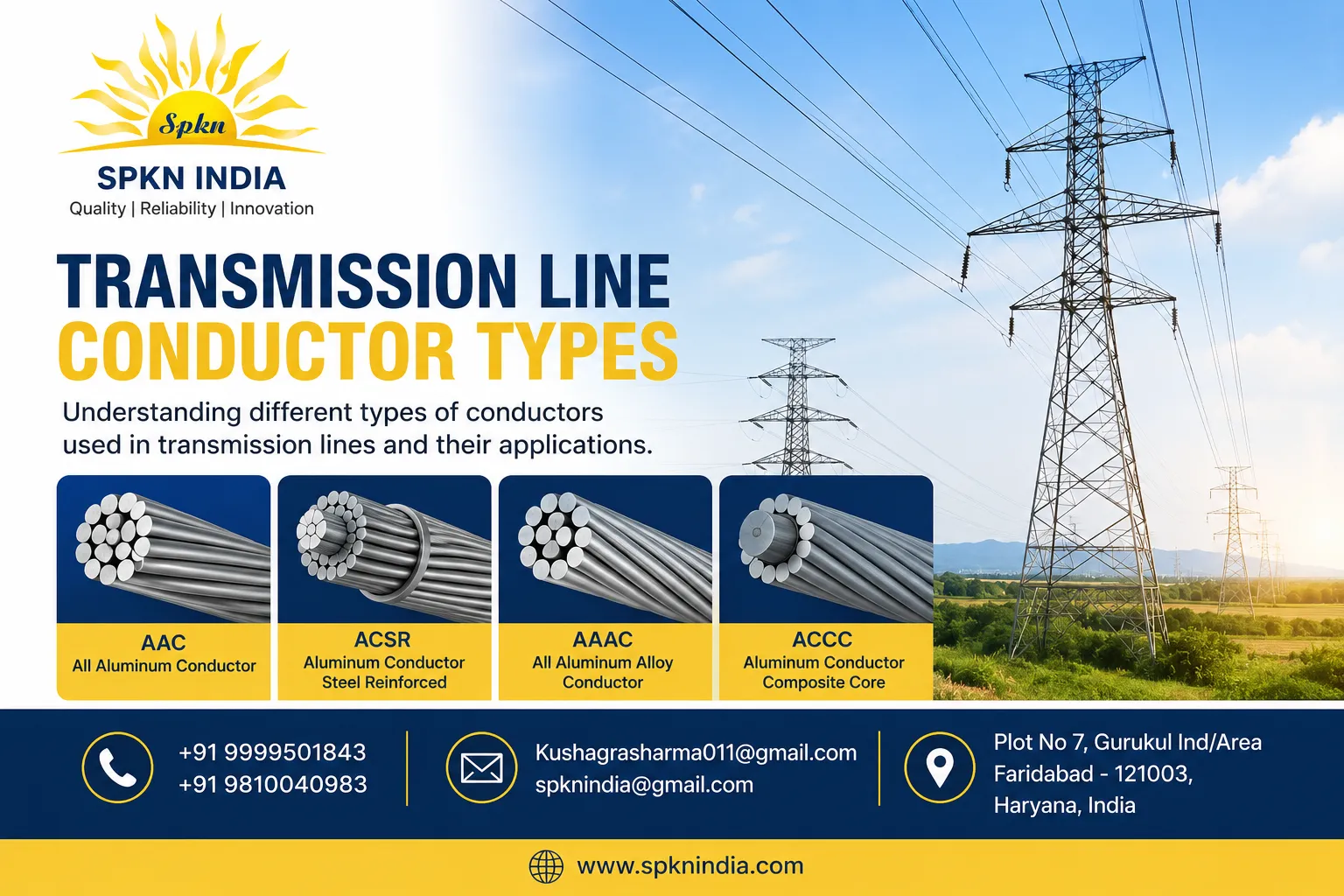
This guide explains the main transmission line conductor types used on Indian overhead lines: AAC, ACSR, AAAC and the newer high-temperature low-sag (HTLS) family. It covers how each is built, where it performs best between 11 kV and 220 kV, and what it demands from the hardware around it.
SPKN India manufactures the equipment that sits along these lines, including isolators, connectors, clamps and lightning arresters. We see what happens where a conductor meets a fitting, and that is why this guide pays attention to the hardware as well as the wire.
What a Transmission Line Conductor Does
A conductor carries current from the source to the load. Every design is a trade-off between conductivity, mechanical strength, weight and resistance to the environment. Aluminium won this contest long ago because it conducts well for its weight and costs less than copper. Its weakness is low tensile strength, so designs either add a steel core or use a stronger aluminium alloy.
Conductors also lose energy as heat, sag as they warm, and vibrate in wind. Each conductor type handles these problems differently, which is why no single option suits every line.
The Main Transmission Line Conductor Types
AAC (all aluminium conductor)
AAC is built from hard-drawn aluminium strands with no core. It has the best conductivity per unit weight of the common types, which suits short spans and dense urban distribution where towers or poles are close together.
Its limit is strength. Over long spans AAC sags more than a steel-cored conductor, so designers rarely choose it for lines above 33 kV. It does resist corrosion well, which makes it useful along coasts.
ACSR (aluminium conductor steel reinforced)
ACSR is the workhorse of Indian overhead networks. Aluminium strands wrap a galvanised steel core, the steel carries most of the mechanical load, and the aluminium carries most of the current. The result is high tensile strength, which allows long spans and fewer supports.
The steel core is also its weak point. In heavily polluted or coastal air, moisture can attack the galvanising, and galvanic corrosion can develop where aluminium meets steel. Grease-filled ACSR and aluminium-clad steel cores reduce this risk, at higher cost. Look for the conductor’s compliance with the IS 398 series or IEC 61089 when you specify it.
AAAC (all aluminium alloy conductor)
AAAC uses a magnesium-silicon aluminium alloy for every strand. It is stronger than AAC, lighter than ACSR of similar diameter, and has no steel to corrode. Many utilities now prefer it for coastal and industrial-pollution zones for that reason.
It has slightly lower conductivity than pure aluminium, so a larger cross-section can be needed for the same current. Its strength-to-weight ratio, however, often lets it match ACSR sag performance on medium spans.
HTLS conductors
HTLS stands for high-temperature low-sag. This family covers ACSS (annealed aluminium over steel), INVAR-core designs and composite-core conductors such as ACCC, which use a carbon-fibre core. They can run at much higher operating temperatures than standard ACSR and sag far less when hot.
The practical benefit is capacity. A utility can often double a corridor’s carrying capability by re-conductoring existing towers instead of building a new line. The cost is a higher price per kilometre and a need for specialised dead-end and suspension fittings, which installers must follow exactly.
Transmission Line Conductor Types Compared
| Conductor | Core | Strength | Corrosion resistance | Typical use |
|---|---|---|---|---|
| AAC | None | Lower | Very good | Short spans, urban and coastal distribution |
| ACSR | Galvanised steel | High | Moderate | Long spans, 11 kV to 220 kV |
| AAAC | None (alloy strands) | Good for its weight | Very good | Coastal and polluted areas, ACSR replacement |
| HTLS | Steel, INVAR or composite | High, with low sag | Varies by design | Capacity upgrades and congested corridors |
How to Choose a Conductor
Selection starts with current and voltage, then moves to mechanics and environment. These are the questions design engineers work through:
- What continuous and emergency current must the line carry, now and in ten years?
- How long are the spans, and what ground clearance is required?
- Is the route coastal, industrial, desert or hilly?
- What wind and ice loading applies, and can existing towers take extra weight?
- Does the project value lowest upfront cost or lowest lifetime losses?
Lifetime cost deserves more attention than it usually gets. A larger conductor costs more at purchase but wastes less energy as heat every year the line operates. On a heavily loaded feeder, that difference can repay the extra spend.
Conductor sizes commonly used by voltage class
Indian utilities name ACSR sizes after animals. The designations below are common, but your utility’s tender and design calculations always decide the final choice.
| Voltage class | Conductors commonly seen |
|---|---|
| 11 kV | Rabbit, Dog |
| 33 kV | Dog, Panther |
| 66 kV | Panther |
| 110 to 132 kV | Panther, Zebra |
| 220 kV | Zebra, Moose, often in twin or bundled form |
Within these names, Rabbit has an aluminium area of about 50 mm², Dog about 100 mm², Panther about 200 mm², Zebra about 400 mm² and Moose about 520 mm². Bigger sizes carry more current and cost more to hang.
Why Conductor Choice Affects the Rest of the Line
A conductor never works alone. It terminates at substations, passes through disconnectors, hangs from insulators and depends on surge protection. Choosing a conductor without checking these interfaces is a common source of site problems.
Connectors and clamps
Each clamp must match the conductor’s diameter, strand material and expected operating temperature. Aluminium conductors joined to copper or brass equipment terminals need bimetallic connectors, or the joint corrodes and heats up over time. SPKN India’s substation connectors, clamps and fittings are made for these transitions, and HTLS projects need fittings specified for the conductor from the start.
Isolators
Isolator terminals must take the conductor’s size and mechanical pull without overheating at the contact point. Our isolator disconnectors cover 11 kV to 220 kV, with dedicated pages for the 11 kV isolator with earth blade, the 33 kV substation isolator, the 66 kV substation isolator and the 220 kV outdoor isolator. For line sectionalising, an air break switch is the usual choice on distribution lines.
Insulators and surge protection
Heavier conductors and longer spans raise the load on insulators. Polymer insulators suit many projects because they are lighter than porcelain and cope well with pollution. At transformer and line entries, lightning arresters protect equipment from surges, and a horn gap fuse guards distribution transformers against faults.
You can see the complete range on our high voltage equipment page.
Common Mistakes When Selecting Conductors
Three errors appear repeatedly on projects.
The first is selecting purely on first cost. A smaller conductor passes the tender comparison but loses more energy and runs out of capacity early.
The second is ignoring the environment. ACSR in a salt-laden coastal belt can need early replacement, whereas AAAC or a protected ACSR variant would have lasted far longer.
The third is treating hardware as an afterthought. Clamps, connectors and terminals bought late, or matched loosely to the conductor, are where hot spots and failures begin. Specify them together with the conductor, not after it.
Indian Standards and Tests to Ask About
Conductors for Indian lines are normally specified to the IS 398 series, with IEC 61089 as the international reference for round wire concentric lay overhead conductors. A supplier should be able to show routine test results for wire diameter, lay length, breaking load, direct current resistance and the zinc coating on the steel wires. Ask for these records for the actual drum lot you will receive, not only a type test from an earlier order. Check too that every drum is marked with the size, length and lot number, because a mixed lot on one span can cause uneven sag.
Sag, Tension and Installation Basics
Sag grows roughly with the square of the span, so a small increase in span length changes ground clearance quickly. Stringing must follow a sag and tension chart for the temperature on the day, otherwise the conductor ends up too slack in summer or too tight in winter. Vibration is the other everyday risk. Dampers, armour rods and correctly sized suspension clamps protect the strands where the conductor leaves the clamp, which is where fatigue failures start. Plan these fittings together with the conductor, and match them to the line insulators and cross-arm design. Lines with two circuits on one tower carry extra loading, which our guide to the double circuit transmission line explains.
Maintenance and Re-Conductoring
Most conductor trouble appears at joints, clamps and dead-ends, not along the span. A thermal camera survey during peak load shows hot joints early. Check clamp tightness after the first season, look for broken outer strands near suspension points, and keep vegetation clear of the right of way. When the line starts running close to its thermal limit, compare three options: replace the conductor with a larger ACSR or AAAC size, change to an HTLS type, or add a parallel circuit. Re-conductoring only makes sense if the towers and foundations can take the new load, so ask your design engineer to run the check before you order. For the bigger picture of how lines, towers and substations work together, see high voltage power transmission lines and power substation.
Choosing the Right Conductor and Matching Hardware
Conductor selection is a balance of current, span, climate and lifetime cost. AAC suits short urban runs, ACSR covers most distribution and transmission work, AAAC protects lines in corrosive air, and HTLS creates capacity where new corridors are impractical.
Whichever you choose, check the hardware at every joint, terminal and switching point before you finalise the design. A conductor performs only as well as the fittings holding and connecting it.
SPKN India can supply and install the equipment around your line, from substation erection to turnkey electrical projects, alongside our wider electrical services.
Planning a line or substation upgrade? Send us your voltage class, conductor type, current rating and site location, and our team will reply with a technical offer. Get a Quote or call +91 9999501843.