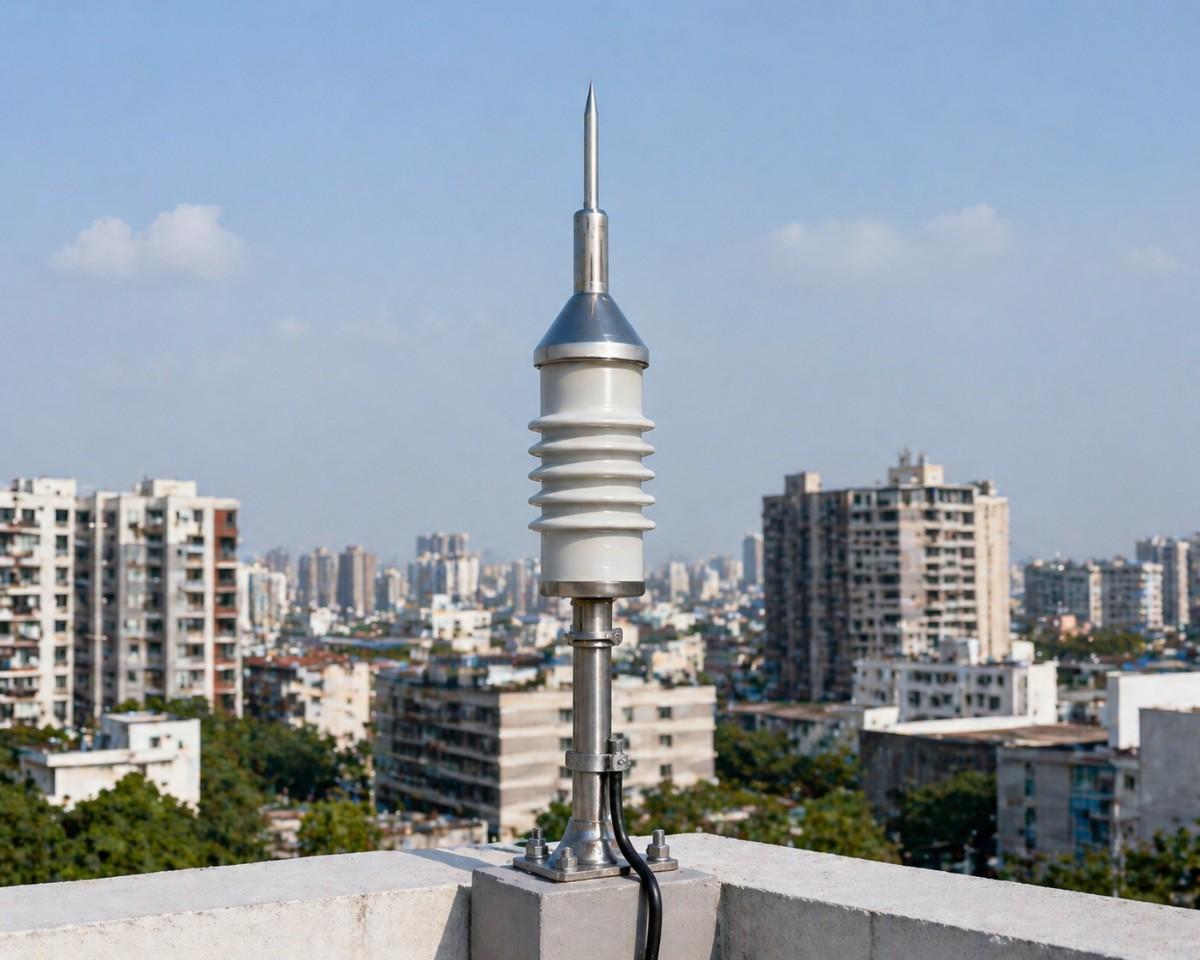
Lightning Arrester for Building: How Lightning Protection Works and What You Need
When people search for a lightning arrester for a building, they usually mean a complete lightning protection system: a metal air terminal on the roof, down conductors on the walls and an earthing system in the ground. A separate group of products, surge protective devices inside the electrical panel, protect the equipment from the surges that still get in. Both are needed, because lightning damages a building in two ways: by direct strike to the structure and by surge currents that enter through power, data and phone lines.
This guide explains how a lightning protection system for a building works, what its parts are, how it is designed under the international standard IEC 62305 and its Indian counterpart IS/IEC 62305, how to choose the level of protection, and how to install and maintain it. It is written for building owners, architects, facility managers and electrical contractors. For arresters used on power lines and transformers, see our page on lightning arresters.
What Lightning Does to a Building
A lightning strike delivers a peak current that can reach tens of thousands of amperes in a few microseconds. If it hits a building without a proper path to earth, the current seeks its own path through the structure. It can crack masonry, ignite combustible material, damage electrical wiring and cause a fire. People inside and near the building are also at risk from touch and step voltages. Even a strike 100 metres away can induce a surge on cables that damages computers, lifts and air-conditioning controls.
Parts of a Building Lightning Protection System
| Part | Function |
|---|---|
| Air termination (rods, mesh or conductors) | Intercepts the lightning strike at the roof |
| Down conductors | Carry the current from the roof to the ground |
| Earth termination system | Spreads the current into the soil |
| Equipotential bonding | Joins metal parts so that no dangerous voltage exists between them |
| Surge protective devices (SPDs) | Protect electrical and electronic equipment against surges |
Air Termination: Catching the Strike
Air terminals are placed at the highest and most exposed points, such as roof edges, corners and tall structures. Designers use three methods. The rolling sphere method imagines a sphere rolling over the building. Every point the sphere touches needs an air terminal. The protection angle method draws a cone of protection under a rod, which is narrower for taller rods. The mesh method covers a flat roof with a grid of conductors. In all methods, the minimum size of the conductor is set by the standard: copper of 35 mm squared, aluminium of 70 mm squared or steel of 50 mm squared.
Down Conductors: Carrying the Current
At least two down conductors are placed on opposite corners of a building. For taller or wider buildings, more are added at regular intervals, which the standard sets from 10 to 20 metres around the perimeter depending on the protection level. They run in a straight, direct line from the roof to the earth. Sharp bends are avoided because lightning current does not like to turn corners, and a sharp bend can cause a spark to jump to nearby metal. A test joint at about 1.5 metres above the ground allows the earth resistance to be measured.
Earthing: Where the Current Goes
The earth termination spreads the current into the soil. It may use vertical rods, horizontal conductors or a ring around the building. Each down conductor gets its own earth electrode, and all electrodes are joined together and to the building's main earth, so that no voltage difference appears during a strike. The usual target for the combined resistance is 10 ohms or lower, but a low-resistance electrode is not the only aim. A well-connected ring earth with low impedance matters more for fast surges. For details on electrode types, read our guide to earthing electrodes.
Levels of Protection
IEC 62305 sets four protection levels, from I to IV, depending on the risk. A risk assessment decides the level using building height, location, use, contents and the local lightning density. The higher the building's importance or the danger from a strike, the higher the level.
| Protection level | Rolling sphere radius | Down conductor spacing | Typical building |
|---|---|---|---|
| I | 20 m | 10 m | Explosive, hazardous or critical sites |
| II | 30 m | 10 m | Hospitals, data centres, large public buildings |
| III | 45 m | 15 m | Offices, hotels, residential towers, schools |
| IV | 60 m | 20 m | Ordinary low-risk buildings |
Materials and Minimum Sizes
| Material | Minimum cross-section (air terminals and down conductors) | Notes |
|---|---|---|
| Copper | 35 mm squared | Long life, higher cost and theft risk |
| Aluminium | 70 mm squared | Not to be buried in soil or concrete |
| Hot-dip galvanised steel | 50 mm squared | Common in India, check zinc coating thickness |
| Stainless steel | 50 mm squared | Good for coastal sites |
Joints between different metals, for example aluminium and copper, must be protected against galvanic corrosion with bimetallic connectors. Conductors should be fixed with clamps made for the purpose, not with tie wire.
Rolling Sphere Example for a Tall Building
Consider a 60-metre office tower designed for protection level III, which uses a rolling sphere of 45 metres radius. For the upper part of the building, the sphere touches the roof edges and the corners, so air terminals must be placed along the roof perimeter and on any tall rooftop equipment. Since the building is taller than 45 metres, the sphere can also touch the sides of the building above 45 metres from the ground. The standard therefore requires protection of side flashes on the upper floors, usually by connecting the facade metalwork or adding conductors at intervals. This is the reason why a simple rod on the roof is not enough for a tall building, and why design by a competent engineer matters.
Rooftop Solar, Antennas and Plant
Modern roofs are full of equipment: solar panels, mobile antennas, cooling towers, lift motor rooms and water tanks. Each item is a possible strike point and a route for surges into the building. The design must keep a safe separation distance between the lightning conductors and the equipment, or bond the equipment to the system if the separation cannot be kept. Solar arrays need DC-side SPDs and their frames bonded to the earth. Mobile antennas bring cable runs into the building, so the cable shields and the antenna mast must be bonded, with coaxial surge protectors at the entry. A rooftop that has been changed after the original system was installed often has gaps that nobody noticed, so a fresh survey is wise after any big addition.
Homes and Small Buildings
For a house or a small shop, a simple but properly designed system is enough. It usually consists of one or two air terminals on the roof, two down conductors, an earth electrode for each, and an SPD at the main board. The key is to follow the same principles at a smaller scale: a direct path to earth, good bonding and surge protection for the electrical system. A single rod with a thin wire into a pit is rarely enough. A trained contractor can design a low-cost system that meets the intent of the standard.
Conventional Rods and Early Streamer Emission Terminals
You may be offered an early streamer emission (ESE) terminal, which is marketed as covering a large radius from a single rod. ESE devices are not covered by the IEC 62305 series, which is the basis for most national standards, and their claimed radius is debated by researchers. Some projects accept them under a separate national code. If your project requires compliance with IEC 62305 or an insurer's rules, use conventional terminals designed by the rolling sphere or mesh method. Ask the supplier which standard the design follows and for the calculation.
Surge Protective Devices for the Electrical System
Even with a good external system, surges travel into a building along incoming power and signal lines. SPDs divert them before they reach the equipment. They are installed in stages:
- Type 1 SPD at the main incomer, able to handle direct lightning current.
- Type 2 SPD at sub-distribution boards, handling induced surges and switching surges.
- Type 3 SPD close to sensitive equipment such as servers and medical devices.
Each SPD needs a short connection to earth and a backup fuse or breaker as the data sheet specifies. These devices are the building-level equivalent of the arresters we describe in our guide to the lightning arrester in a transformer.
How to Plan Protection for a New or Existing Building
- Carry out a risk assessment under IEC 62305-2, using height, area, location, use and the number of occupants.
- Decide the protection level and design the air termination, down conductors and earthing to match.
- Bond all large metal items, including pipes, cable trays, lift rails and the electrical earth, to the lightning earth.
- Choose and place the SPDs for power, data and phone lines.
- Install the system as per the design, using tested components of the right size and material.
- Test the earth resistance and continuity, and keep the report.
- Schedule an inspection at least once a year, and after any known strike.
Our page on lightning arrester installation gives practical installation tips that apply to buildings as well.
Maintenance Checklist
- Check the air terminals, joints and clamps for corrosion, damage and looseness.
- Inspect the down conductors for breaks, theft and damage by repair work or painting.
- Measure the earth resistance each year, ideally at the end of the dry season.
- Test SPDs and replace those that show a failed indicator.
- Update the design if the building gets an extension, a new rooftop plant or a mobile antenna.
Common Mistakes
- Installing a single rod with no risk assessment or design.
- Using thin wire or painted conductors that corrode and break.
- Connecting down conductors to the water pipe or to the electrical earth without proper bonding.
- Skipping SPDs and then blaming the lightning system when equipment fails.
- Never testing the earth after commissioning.
Lightning Protection Equipment From SPKN India
SPKN India is a Faridabad-based manufacturer of high-tension electrical equipment, including lightning arresters and earthing products. Send us the building type, height, location and the level of protection you need, and we will advise on suitable equipment and prepare an offer. You can also call +91 9999501843.