Overhead Line Insulators: Types, Selection and Maintenance for Distribution Lines
On a distribution line, the insulator is a small part that does a big job. It holds a live conductor a safe distance from a wooden, concrete or steel pole, and it does so in rain, dust, heat and cold for many years. When one fails, the line trips, a fuse blows or, in the worst case, a conductor falls. Because a typical 11 kV feeder carries hundreds of insulators, the choice of type and quality adds up to real differences in reliability and in the cost of running the network.
This guide covers insulators for overhead distribution and sub-transmission lines from 415 V up to 66 kV: the types in use, how to select them by voltage, pollution and load, how to install and maintain them, and what faults to watch for. It is written for utility engineers, contractors and maintenance teams. For high-voltage transmission strings, read our companion guide on transmission line insulators.
What an Overhead Line Insulator Does
An insulator has three jobs. It supports the conductor against its weight, wind and the pull of the line. It insulates the conductor from the pole, so that current does not leak to earth. And it withstands surges, from lightning and from switching, without flashing over or breaking down. A good insulator does all three for the life of the line.
Main Types for Distribution Lines
| Type | Where used | Notes |
|---|---|---|
| Shackle (spool) insulator | 415 V low-tension lines, service connections, stays | Small and simple, fixed with a strap or bolt, can be used in any direction |
| Pin insulator | 11 kV and 33 kV straight runs | Mounted on a pin on the cross-arm. For 33 kV, tall multi-shed units are used. |
| Post insulator | 11 kV to 66 kV lines on steel poles or compact designs | Fixed on the pole or cross-arm, with a clamp at the top |
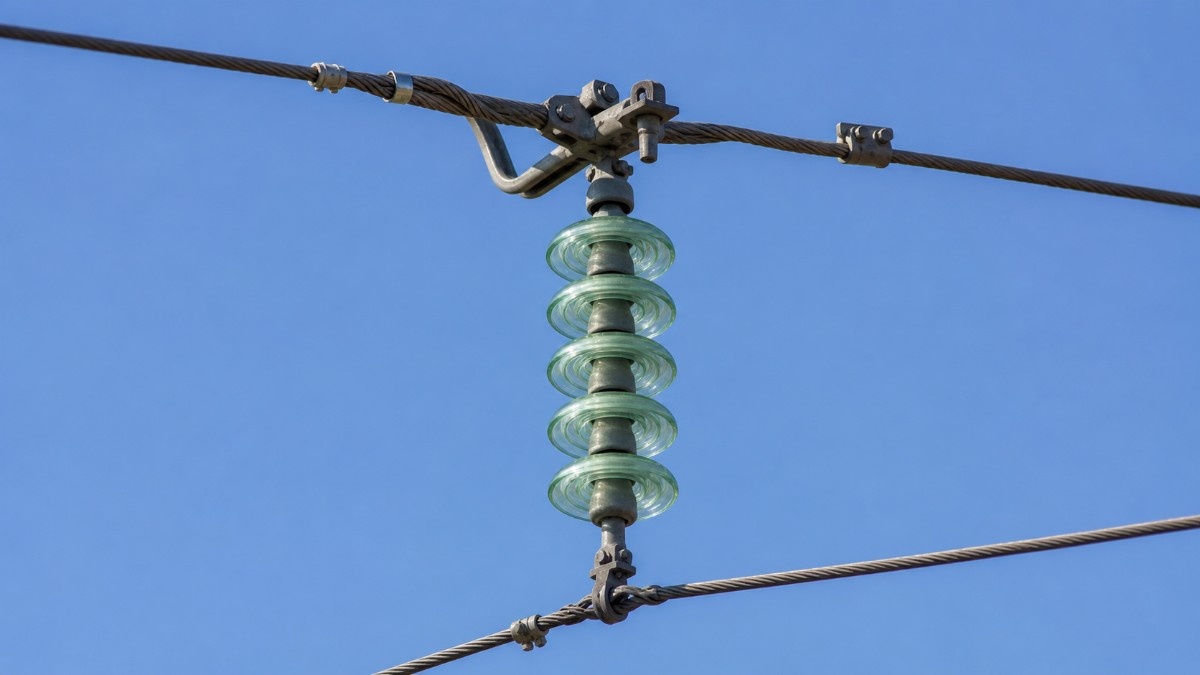
| Suspension or disc string | 33 kV and above, at angles and dead ends | Discs in series, one or two for 11 kV tension, three or more at 33 kV |
| Strain insulator | Line ends, angles, heavy tension | Takes the full pull of the conductor |
| Stay insulator | Stay wires near live lines | Breaks the stay into insulated lengths |
Material Choices
Porcelain
The traditional and still common choice. It is strong, ages well and is reliable. Heavy, brittle and prone to flashover in polluted areas unless the creepage is extended. See our page on porcelain electrical insulators for details.
Glass
Toughened glass discs are used on 33 kV and higher strings. A failed disc shatters, so faults can be seen from the ground. They are less common for pin insulators in India.
Polymer (silicone rubber)
Light, impact resistant and water repellent. They are now the standard for many new 11 kV and 33 kV lines, particularly in polluted areas and on difficult routes. Read our guide to the 11 kV polymer pin insulator and the main polymer insulators page.
How to Choose the Right Insulator
1. Voltage class
Use the highest system voltage: 12 kV for 11 kV, 36 kV for 33 kV and 72.5 kV for 66 kV. Match the power frequency and lightning impulse withstand levels to the standard for that class.
2. Pollution level
Choose creepage in millimetres per kV. A light-pollution site can use about 16 mm per kV, medium about 20, heavy about 25 and very heavy about 31 mm per kV of highest voltage. At 12 kV, these give about 190, 240, 300 and 370 mm for light to very heavy pollution, and utilities often add a margin above these values. Coastal, desert, brick kiln, cement and chemical areas usually need the higher classes or a polymer insulator.
3. Mechanical strength
Check the rated cantilever strength of pin and post insulators, and the tensile rating of disc strings against the conductor tension and wind load. Corner poles and line ends need stronger units than straight runs.
4. Conductor size and tie method
The top groove and tie or clamp should suit the conductor. A tie wire that is too hard can damage aluminium strands, and sharp edges can cut silicone rubber.
5. Fitting details
The pin thread, the bolt circle and the stud size must match the cross-arm, bracket or pole fitting. Mismatches lead to poor fixing and loosening.
6. Quality evidence
Ask for type test and routine test reports. For ceramic pin and post insulators, IS 731 and IEC 60383 are the usual standards. For composite insulators, IEC 61109 applies.
Typical Choice by Application
| Application | Common insulator |
|---|---|
| LT line, village or street | Shackle insulator or bunched cable fittings |
| 11 kV straight run, clean area | Porcelain or polymer pin insulator |
| 11 kV straight run, polluted area | Polymer pin insulator with extra creepage |
| 11 kV angle or dead end | One or two disc insulators, or a polymer strain insulator |
| 33 kV straight run | Tall pin or post insulator, or a three-disc suspension string |
| 33 kV angle or dead end | Three or four disc strain string, or polymer strain insulator |
Worked Example: Choosing Creepage for an 11 kV Feeder Near a Cement Plant
An 11 kV feeder passes through a belt of cement and brick kilns, where dust coats insulators every dry season and turns into a conductive paste in the first rain. The highest system voltage is 12 kV. For heavy pollution, a specific creepage of 25 mm per kV gives 12 times 25, which is 300 mm. Many utilities add a margin on practical grounds, and in this case a polymer pin insulator with a creepage of 400 to 450 mm is chosen. Existing porcelain pin insulators on the line, with a creepage of about 230 mm, had been flashing over at the start of every monsoon. After replacement, the number of trips in the first season fell sharply, and the utility could stop the yearly washing of this section. The cost of the polymer insulators was recovered in a few seasons through fewer outages and no washing crews. The lesson is that matching creepage to the real site matters more than picking the insulator material in the abstract.
Insulators for Special Situations
- Coastal lines: use polymer insulators or porcelain with extra creepage, and stainless or heavily galvanised hardware.
- Hill and forest lines: use polymer insulators for easy carrying, with covered conductors where trees come close.
- Areas with many birds: use insulator covers, bird guards and cross-arm designs that stop birds from bridging the gap.
- Heavy lightning areas: use higher impulse levels, plus arresters on key poles.
- High altitude: add insulation above 1,000 metres, because thin air reduces its strength.
- Railway and road crossings: use double strings or stronger units to improve reliability.
Installation Practice
- Check each insulator for chips, cracks and thread damage before you take it up the pole.
- Screw pin insulators onto the pin by hand until firm, and avoid cross-threading.
- Tie the conductor to the top groove with the right tie wire, or use a clamp for polymer units.
- Keep the same make and type on all three phases of a pole.
- Check phase-to-phase and phase-to-pole clearances after the conductor is tied.
- Do not over-tighten bolts on disc strings or end fittings.
Faults and Their Causes
| Fault | Typical cause | Remedy |
|---|---|---|
| Flashover in fog or drizzle | Pollution layer, too little creepage | Wash, increase creepage or use polymer |
| Cracked or broken porcelain | Stone throwing, mishandling, overload | Replace and review handling |
| Puncture of the body | Manufacturing defect or severe surge | Replace and review surge protection |
| Tracking on polymer rubber | Poor material or high leakage current | Replace with a better-quality unit |
| Loose insulator on pin | Poor fitting or vibration | Re-fit with correct hardware |
| Bird damage or contamination | Roosting birds | Fit bird guards or covers |
Maintenance
- Patrol each feeder before every monsoon and after major storms.
- Replace damaged insulators immediately.
- Wash porcelain insulators in heavily polluted sections on a regular schedule, using approved live-line or shutdown methods.
- Check the hardware, including pins, nuts and tie wires, for rust and looseness.
- Use thermal imaging or corona cameras to find units with abnormal heating on important feeders.
Protecting Insulators From Surges
The impulse level of an 11 kV insulator is only about 75 kV, so nearby lightning often exceeds it. When a surge flashes over an insulator, the power arc that follows can burn the conductor and damage the insulator. Arresters at transformers, cable ends and exposed spots reduce this risk. Our guides on the 11 kV lightning arrester and the overhead electrical line explain where they are fitted.
Managing Insulators Across a Whole Network
A distribution company may own hundreds of thousands of insulators, and it cannot inspect each one every year. Practical programmes focus on the worst-performing feeders first. The control room reports which feeders trip most in fog, rain and storms, and the maintenance team patrols those sections for flashover marks and damaged units. Data from the patrols goes into a register with the make, batch, age and location of each insulator type. Over a few seasons, the register shows which types and batches perform best, and the utility can write that into its purchase specification. This approach turns insulator management from a reaction to trips into a planned programme, and it helps to justify the investment in better insulators for the most trouble-prone feeders.
Common Mistakes
- Choosing by voltage only, and ignoring pollution and mechanical strength.
- Using the same insulator at corners as on straight runs.
- Mixing porcelain and polymer types on one cross-arm without checking the clearances.
- Reusing old pins or fittings that are bent or rusted.
- Not recording the make and batch of insulators in the network register.
Insulators From SPKN India
SPKN India is a Faridabad-based manufacturer of high-tension electrical equipment. See our porcelain insulators and polymer insulators pages for the range. Send us your voltage, creepage, strength and quantity, and we will prepare an offer. You can also call +91 9999501843.