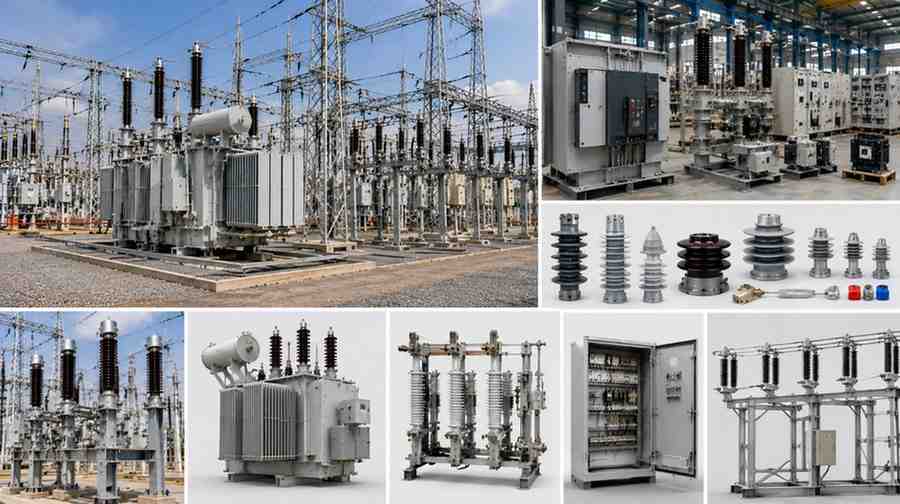
India is currently building and upgrading substations at an unprecedented rate. The Revamped Distribution Sector Scheme (RDSS), with a ₹3.03 lakh crore outlay, and ongoing transmission expansion under PGCIL and state transmission utilities are driving substation equipment procurement of enormous scale across every Indian state.
What Is Electrical Substation Equipment?
A high-voltage electrical substation is an assembly of equipment that performs three core functions: voltage transformation (stepping up or down), protection (detecting and clearing faults), and switching (connecting or isolating circuit elements). The equipment performing these functions is classified as primary equipment (directly in the high-voltage power circuit) and secondary equipment (protection, control, metering, and communication systems).
Primary Substation Equipment — Full List
Power Transformers
The power transformer is the heart of any substation. It transforms voltage from one level to another — for example, from 132kV to 33kV at a grid receiving station, or from 33kV to 11kV at a primary substation. Transformers are rated in MVA (megavolt-ampere) and specified by voltage ratio, vector group, cooling type, and impedance. In India, power transformers must comply with IS 2026.
Circuit Breakers
Circuit breakers automatically interrupt fault and overload currents to protect the network. Modern HV substations use SF6 gas-insulated circuit breakers (GCB) or vacuum circuit breakers (VCB) at 11kV–33kV. They operate within 3–5 cycles (60–100 ms) on receiving a trip signal from the protection relay. IS 13118 governs HV circuit breakers in India.
Isolators and Disconnectors
Isolators are no-load switching devices providing a visible open-gap isolation point for safe maintenance. Every circuit breaker in a substation is flanked by isolators on both the bus side and the line side. Earthing switches are typically integral to the isolator assembly. Isolators must comply with IS 9921 (IEC 62271-102). SPKN India specialises in manufacturing IS 9921-compliant electrical isolators and air break switches for all substation voltage levels.
Lightning Arresters (Surge Arresters)
Lightning arresters protect substation equipment from voltage surges caused by lightning strikes on overhead lines or switching transients. They provide a low-impedance path to earth for surge voltages while blocking normal power frequency current. Modern metal oxide surge arresters (MOSAs) are used in all new Indian substations. IS 3070 (Part 3) governs surge arresters.
Current Transformers (CTs) and Voltage Transformers (VTs/PTs)
Instrument transformers step down the high-voltage, high-current signals in the main circuit to safe levels for protection relays and metering equipment. CTs provide current signals (typically 1A or 5A secondary); VTs (or PTs — potential transformers) provide voltage signals (typically 110V secondary). Accuracy class, burden, and knee-point voltage are critical CT specifications.
Busbars and Substation Connectors
Busbars are the main current-carrying conductors that interconnect all equipment in a substation bay. They are typically made of high-conductivity aluminium (ACSR, AAAC, or tubular aluminium) or copper. Connectors, clamps, and terminal fittings must ensure low-resistance joints to prevent hotspot formation. SPKN India also manufactures a range of substation connectors and clamps for HV installations.
Secondary Equipment — Protection and Metering
Secondary or auxiliary substation equipment includes: numerical protection relays (distance, differential, overcurrent, earth fault), SCADA RTU (remote terminal unit) and communication equipment, metering units and energy meters, DC battery and charger systems, and control panels and marshalling kiosks. While these do not carry high-voltage power directly, they are equally critical for safe and reliable substation operation.
Substation Equipment Standards in India
| Equipment | Indian Standard | IEC Equivalent |
|---|---|---|
| Power Transformers | IS 2026 | IEC 60076 |
| Circuit Breakers (HV) | IS 13118 | IEC 62271-100 |
| Isolators / Disconnectors | IS 9921 | IEC 62271-102 |
| Lightning / Surge Arresters | IS 3070 Pt.3 | IEC 60099-4 |
| Current Transformers | IS 2705 | IEC 61869-2 |
| Voltage Transformers | IS 3156 | IEC 61869-3 |
Equipment Checklist for a 33kV Substation
For a standard 33/11kV distribution substation with 2 incoming feeders and 4 outgoing feeders, the primary equipment checklist typically includes:
- Power transformer: 33/11kV, 10/16/20 MVA (as designed)
- 33kV circuit breakers: one per incoming feeder bay
- 33kV isolators with earthing switches: 3 per bay (Bus 1, Bus 2, line side)
- 33kV current transformers: 1 set per bay
- 33kV voltage transformers: 1 set on busbar
- 33kV lightning arresters: 1 set per incoming line
- 11kV vacuum circuit breakers: 1 per outgoing feeder
- 11kV current transformers and metering
- Bus coupler CB and isolators
- Protection relay panels for each bay
- SCADA RTU and communication equipment
- DC battery and charger (110V or 220V DC)
- Earthing mat and structure earthing
How to Source Substation Equipment in India
Sourcing substation electrical equipment in India typically follows one of these routes: Utility / DISCOM tender: Equipment is procured through open or limited tender processes with specific make-approved vendor lists and IS compliance requirements. EPC contract: The EPC contractor aggregates all substation equipment from a mix of approved manufacturers based on the project's technical specification. Direct procurement: Industrial clients and renewable energy developers often procure directly from manufacturers for faster lead times and better pricing.
Regardless of procurement route, it is critical to verify that each equipment supplier has the appropriate IS certification, type test certificates from accredited labs, and a proven track record with similar projects.
SPKN India — Your Substation Equipment Partner
SPKN India Isolators Pvt. Ltd. is a specialist manufacturer of HV substation switching and isolation equipment — including electrical isolators, air break switches, lightning arresters, and substation connectors. We supply to DISCOMs, state transmission utilities, EPC firms, and industrial clients across India.
Our products are manufactured to IS 9921, IS 3070, and applicable IS standards, with type test certification from NABL-accredited laboratories. We offer competitive lead times, full technical documentation, and support through the inspection and commissioning process.
Planning a new substation or upgrading existing substation electrical equipment? SPKN India is a trusted manufacturer and supplier of HV isolation equipment — isolators, air break switches, lightning arresters, and substation connectors — for projects across India. Our products are IS-compliant, type-tested, and competitively priced with fast delivery. Send us your project specification, single-line diagram, or equipment schedule — our technical team will respond with a detailed proposal within 48 hours.