That is why understanding the types of transmission line conductors is so important. Different conductors are designed for different environments, voltage levels, and transmission requirements. What works perfectly in a coastal region may not perform well in a dry industrial zone or mountainous terrain.
At SPKN India, we understand how critical conductor performance is for maintaining reliable electrical infrastructure across utility, industrial, and transmission systems.
What Are Transmission Line Conductors?
Transmission line conductors are materials used to carry electrical power from generating stations to substations and distribution systems. These conductors are installed on transmission towers or poles and form the primary path for electrical current flow.
An ideal conductor should provide:
- High electrical conductivity
- Excellent mechanical strength
- Resistance to corrosion
- Long operational life
- Low maintenance requirements
No conductor is universally perfect. Engineers select conductors based on environmental conditions, transmission voltage, span length, and power demand.
Why Transmission Conductors Matter
Conductors directly affect:
- Power transmission efficiency
- Voltage stability
- Energy losses
- Maintenance requirements
- Safety and reliability
Poor conductor selection can increase operational problems and reduce transmission efficiency over time.
In my experience, many long-term transmission issues begin with improper conductor selection rather than major equipment failure. Small environmental factors can create huge maintenance challenges later.
According to the International Energy Agency, transmission infrastructure modernization is becoming increasingly important as global electricity demand continues rising and renewable integration expands.
Main Types of Transmission Line Conductors
Several conductor types are commonly used in overhead power transmission systems. Each has unique characteristics and applications.
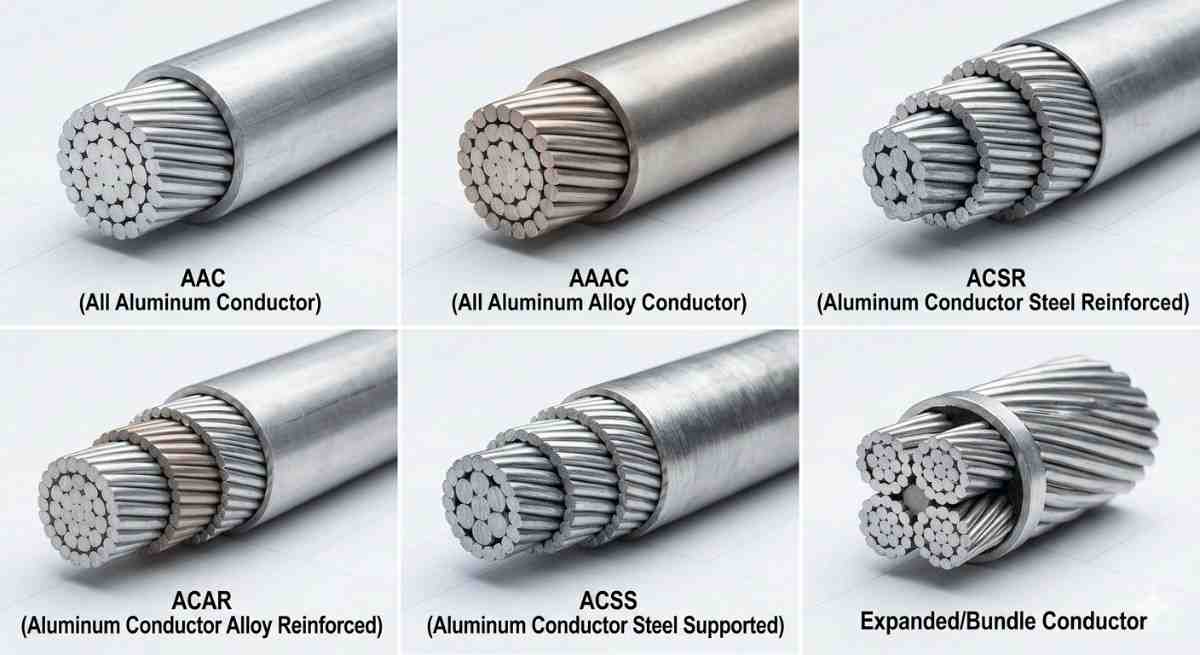
AAC Conductor
AAC stands for All Aluminum Conductor.
This conductor consists entirely of aluminum strands.
Features of AAC Conductors
- High electrical conductivity
- Lightweight design
- Good corrosion resistance
- Flexible structure
Common Applications
AAC conductors are often used in:
- Urban distribution systems
- Short-distance transmission lines
- Areas with lower mechanical stress
Advantages
- Easy installation
- Good current carrying capability
- Economical for shorter spans
However, AAC conductors have relatively lower tensile strength compared to reinforced conductor types.
When I observed a local utility upgrade project, AAC conductors were selected because the transmission spans were relatively short and environmental conditions were moderate.
ACSR Conductor
ACSR means Aluminum Conductor Steel Reinforced.
This is one of the most widely used transmission conductors worldwide.
Construction of ACSR Conductors
- Aluminum strands carry electrical current
- Steel core provides mechanical strength
Why ACSR Conductors Are Popular
The steel reinforcement allows:
- Longer transmission spans
- Better sag control
- Higher mechanical durability
Common Applications
ACSR conductors are commonly used in:
- 132 kV transmission lines
- 220 kV systems
- 400 kV overhead lines
- River crossing transmission projects
Key Benefits
- Excellent strength-to-weight ratio
- Reliable long-distance performance
- Suitable for heavy electrical loads
I've noticed that utilities continue preferring ACSR conductors for extra high voltage systems because they provide dependable performance under demanding operating conditions.
AAAC Conductor
AAAC stands for All Aluminum Alloy Conductor.
Instead of pure aluminum, this conductor uses aluminum alloy strands.
Advantages of AAAC Conductors
- Better corrosion resistance
- Improved mechanical strength
- Lightweight structure
- Longer operational lifespan
Best Applications
AAAC conductors perform especially well in:
- Coastal environments
- Industrial zones
- Humid climates
Their corrosion resistance makes them highly effective in polluted environments.
ACAR Conductor
ACAR stands for Aluminum Conductor Alloy Reinforced.
It combines aluminum strands with alloy reinforcement.
Features of ACAR Conductors
- High conductivity
- Strong mechanical performance
- Improved current carrying capacity
- Reduced line losses
Common Uses
ACAR conductors are often installed in:
- High-capacity transmission systems
- Long-span overhead networks
- Utility grid infrastructure
They provide a strong balance between conductivity and durability.
Copper Conductors
Copper conductors were once dominant in electrical transmission systems.
Even today, copper remains highly respected because of its conductivity.
Benefits of Copper Conductors
- Excellent electrical conductivity
- Strong thermal performance
- High corrosion resistance
Limitations
Copper conductors are:
- Heavier than aluminum
- More difficult for large spans
- Less practical for extensive overhead transmission systems
Because of weight considerations, copper is now more commonly used in specialized electrical applications.
HTLS Conductors
HTLS stands for High Temperature Low Sag Conductors.
These advanced conductors are designed for modern high-capacity transmission systems.
Key Advantages
- Operate at higher temperatures
- Reduced sag under load
- Increased transmission capacity
- Improved thermal performance
Why Utilities Use HTLS Conductors
HTLS conductors help utilities:
- Upgrade existing transmission corridors
- Increase capacity without building new towers
- Improve grid reliability
In my experience, HTLS technology is becoming increasingly important as electricity demand rises faster than infrastructure expansion.
Galvanized Steel Conductors
Steel conductors are mainly used where mechanical strength matters more than electrical conductivity.
Common Applications
- Ground wires
- Shield wires
- Lightning protection systems
These conductors help protect transmission lines against lightning strikes and external damage.
Comparison of Common Transmission Conductors
| Conductor Type | Conductivity | Mechanical Strength | Corrosion Resistance | Common Application |
|---|---|---|---|---|
| AAC | High | Moderate | Good | Short-distance lines |
| ACSR | High | Excellent | Moderate | Long-distance transmission |
| AAAC | Good | Good | Excellent | Coastal regions |
| ACAR | Very Good | High | Good | High-capacity systems |
| HTLS | High | Excellent | Good | Modern high-load networks |
Factors Considered While Selecting Conductors
Engineers carefully evaluate multiple factors before choosing a transmission conductor.
Voltage Level
Higher voltage systems require conductors capable of handling increased electrical stress.
Transmission Distance
Longer distances require stronger conductors with controlled sag characteristics.
Environmental Conditions
Coastal, industrial, and desert regions each create unique challenges.
Current Carrying Capacity
Conductors must safely handle expected electrical load.
Mechanical Strength
Wind load, ice accumulation, and span length affect conductor selection.
Maintenance Requirements
Utilities often prioritize conductors with longer lifespan and lower maintenance needs.
Importance of Sag Control
Sag refers to the downward curve formed by conductors between towers.
Excessive sag can:
- Reduce safety clearance
- Increase mechanical stress
- Create operational hazards
ACSR and HTLS conductors are often preferred where sag control is especially important.
When I visited a high-voltage transmission site, engineers spent significant time monitoring conductor sag because even small changes can affect line safety and reliability.
Corona Effect in Transmission Conductors
High-voltage conductors can create corona discharge when surrounding air becomes ionized.
Effects of Corona
- Energy loss
- Audible noise
- Radio interference
- Reduced efficiency
Methods to Reduce Corona
Utilities reduce corona effects by:
- Using bundled conductors
- Increasing conductor diameter
- Optimizing conductor spacing
Extra high voltage systems like 400 kV transmission lines commonly use bundled conductors for this reason.
Maintenance of Transmission Conductors
Regular inspection helps maintain reliable performance.
Common Maintenance Activities
- Thermal inspection
- Corrosion checks
- Vibration monitoring
- Conductor tension testing
- Hardware replacement
Modern utilities increasingly use:
- Drones
- Infrared imaging
- AI-based predictive systems
When I observed a drone inspection demonstration, it was impressive how quickly tiny conductor defects could be identified without shutting down the line.
Role of Conductors in Renewable Energy Transmission
Renewable energy projects depend heavily on efficient transmission conductors.
Solar parks and wind farms are often located far from urban centers. Conductors must transfer bulk electricity efficiently over long distances.
Advanced conductor technologies help:
- Reduce transmission losses
- Improve grid stability
- Support renewable integration
India's renewable energy expansion is increasing demand for stronger and more efficient transmission infrastructure.
Common Problems Faced by Transmission Conductors
Corrosion
Environmental exposure gradually damages conductors over time.
Thermal Expansion
High temperatures increase conductor sag.
Vibration Fatigue
Wind-induced vibration weakens conductor strands.
Pollution Deposits
Industrial contamination affects electrical performance.
Mechanical Wear
Continuous stress reduces structural integrity.
SPKN India recognizes the growing need for reliable electrical infrastructure components designed to withstand demanding operating conditions.
Future Trends in Transmission Conductors
Transmission conductor technology continues evolving rapidly.
Composite Core Conductors
Advanced composite materials improve strength while reducing weight.
Smart Monitoring Systems
Modern conductors increasingly support digital monitoring technologies.
Higher Capacity Networks
Utilities are upgrading conductors to meet rising electricity demand.
Environmentally Optimized Systems
New conductor designs focus on reducing energy loss and improving sustainability.
I've noticed that utilities are now investing more in predictive maintenance and advanced materials instead of waiting for aging systems to fail.
Final Thoughts
Understanding the types of transmission line conductors helps you appreciate the engineering decisions behind reliable power transmission systems. Every conductor type is designed to meet specific electrical, mechanical, and environmental requirements.
From AAC and ACSR conductors to modern HTLS technologies, each plays a critical role in supporting stable and efficient electricity transmission. As power demand continues growing and renewable energy projects expand, advanced conductor systems will remain central to building stronger and smarter electrical infrastructure.
SPKN India continues supporting the transmission and electrical infrastructure sector with a strong understanding of dependable high-voltage system requirements.