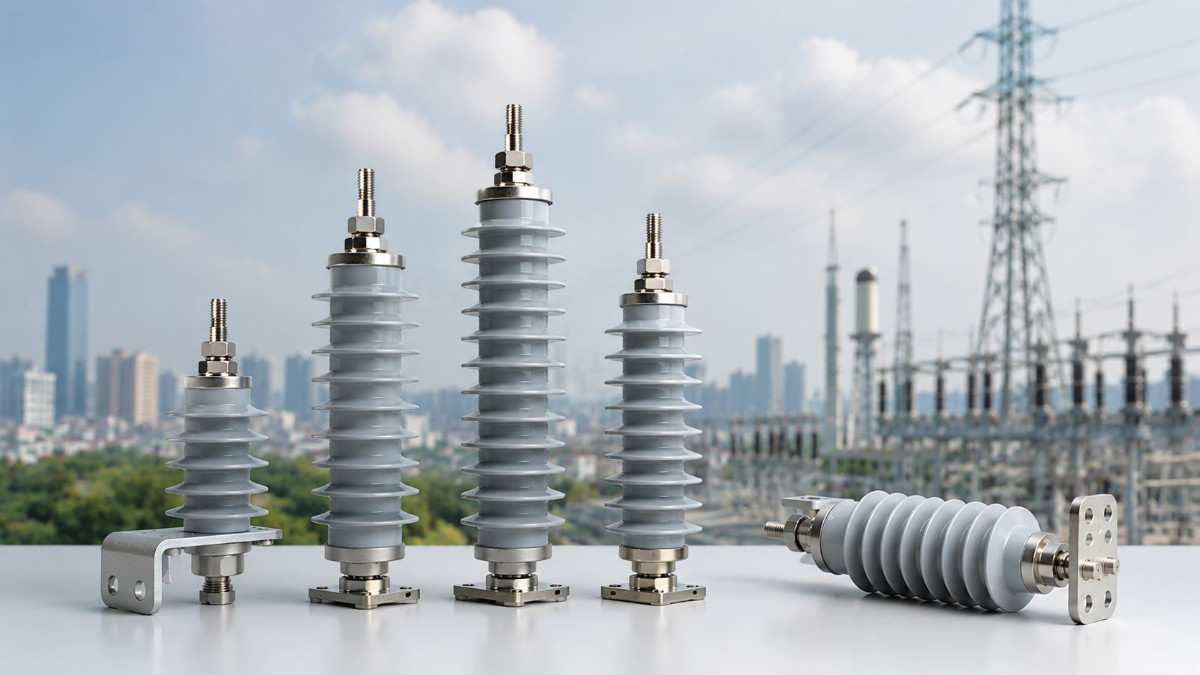
Lightning Arrester Price in Bangalore: What Decides the Quote
Quick answer: The lightning arrester price in Bangalore depends on the system voltage, the discharge current rating, the housing material and the standard the arrester is tested to. Two arresters that look the same can differ a lot in price because the metal oxide blocks inside are different. Compare ratings and test reports first, and the rupee figure second.
Bangalore has a very mixed electrical load. IT campuses, hospitals, metro and rail supply, factories in Peenya, Bommasandra and Hoskote, and fast-growing 11 kV and 33 kV networks all share the same sky. Lightning and switching surges reach each of them. A lightning arrester takes that surge to earth before it damages a transformer, an isolator or a cable termination. When buyers search for the lightning arrester price in Bangalore, they usually want one clear number. In practice, that number comes from six or seven technical choices, and it is far easier to compare quotations once you know what those choices are.
This guide explains what a lightning arrester does, what drives its price, how to read two quotations side by side, and what to check after installation. It is written for plant engineers, electrical contractors and purchase teams in and around Bangalore.
What a Lightning Arrester Does in a Power System
A surge is a short, very high voltage that travels along a line. It can come from a direct or nearby lightning strike, or from switching operations in the network. Normal insulation is built for the system voltage, not for a surge many times higher. An arrester sits between the line and the earth. At normal voltage it behaves like an insulator and passes only a tiny leakage current. When a surge arrives, its resistance drops sharply, it carries the surge current to earth, and then it returns to the insulating state.
The result is that the voltage seen by the protected equipment is limited to a safe value, called the protective level. The lower and steadier that protective level, the better the protection. This is why the quality of the arrester inside matters more than how it looks outside.
Factors That Set the Price of a Lightning Arrester
1. System voltage and rated voltage
An arrester for an 11 kV line is a small unit. One for 33 kV, 66 kV or 132 kV uses more metal oxide discs, a longer housing and heavier end fittings, so price rises with voltage class. Two ratings matter here. The rated voltage (Ur) is the highest voltage at which the arrester can operate correctly. The maximum continuous operating voltage (MCOV) is the highest voltage it can hold continuously. Picking a lower rating to save money can make the arrester run hot and fail early, especially on networks with temporary overvoltages.
2. Nominal discharge current
Distribution arresters are commonly rated 5 kA or 10 kA. Substation and line-entry arresters are often 10 kA or 20 kA. A higher class costs more but copes with severe surges, which is why it is chosen for exposed overhead lines and at the incoming bay of a substation. Bangalore has a long pre-monsoon and monsoon storm season, so exposed 11 kV and 33 kV lines on the city edge deserve a closer look at this rating.
3. Gapped or gapless design
Older gapped silicon carbide arresters are still seen in some old networks. Modern installations mostly use gapless zinc oxide (metal oxide) arresters because they respond faster and hold the voltage lower during a surge. The quality of the metal oxide block is the biggest hidden cost inside the unit and the main reason for price gaps between suppliers.
4. Housing: porcelain or polymer
Porcelain housing is rigid and long established. Polymer (silicone rubber) housing is lighter, easier to handle on site and safer in a fault because it does not shatter. Polymer is often chosen for polluted, coastal or high-vibration locations. Neither is best everywhere, and the price difference depends on voltage class and length. Our pages on porcelain insulators and polymer insulators explain the same material trade-off for line hardware.
5. Standards and test reports
Ask which standard the arrester is made and tested to. Metal oxide arresters are covered by IS 3070 and IEC 60099-4. A supplier who can share routine test and type test reports is giving you something you can verify. A very low price with no reports is a warning sign, because the unit may not hold its rating over the years.
6. Quantity, delivery and fittings
One arrester costs more per piece than a batch. Mounting brackets, line and earth terminals, a discharge counter and a disconnector add to the total. Delivery to a Bangalore site, packing and GST should be written in the quotation so the comparison is fair.
7. Brand, lead time and support
A manufacturer with its own production can usually quote a firm delivery date and answer technical questions. A trader may be quicker for stock items but may not control the quality. Both can be right depending on the job, as long as the paperwork is in order.
Which Rating Is Usually Chosen for Which Use
| Application | Common voltage class | Typical discharge current |
|---|---|---|
| Distribution transformer on a feeder | 11 kV | 5 kA or 10 kA |
| Cable termination or pole-mounted switch | 11 kV to 33 kV | 5 kA or 10 kA |
| Substation incoming or outgoing bay | 33 kV or 66 kV | 10 kA |
| Transformer terminals at a grid substation | 66 kV or 132 kV | 10 kA or 20 kA |
This is a general guide, not a design. The final choice depends on your system earthing, fault level and the exposure of the line. Always confirm with your design engineer.
Where Lightning Arresters Are Used in Bangalore
- Distribution transformers on 11 kV feeders in residential and commercial areas.
- Substations at 33 kV, 66 kV and 110 kV incoming and outgoing bays, next to the 33 kV isolators and breakers they protect.
- Industrial plants where one surge can stop production and damage motors and drives.
- Solar and wind interconnection points on the grid side.
- Railway and metro traction supply where long cable and line runs are exposed to surges.
To see how an arrester is connected beside a transformer, read our guide on the lightning arrester in a transformer. For a simple look inside one older type, read 7 key parts of a horn gap lightning arrester. Our lightning arresters page lists the range we supply.
How to Compare Two Quotations Properly
- Match the rated voltage, MCOV and discharge current line by line.
- Confirm the housing material and creepage distance for your pollution level.
- Ask for the test standard and the latest routine test report.
- Check what is included: terminals, bracket, counter, disconnector.
- Note the delivery time to Bangalore, the GST treatment and the warranty terms.
A quotation that fills all five points can be compared fairly. If one supplier leaves them blank, the lower price may simply mean fewer inclusions or a lower grade of metal oxide block.
Common Mistakes When Buying an Arrester
- Buying by voltage class only. Rated voltage and MCOV must suit the actual system, including how it is earthed.
- Ignoring the lead length. A long connecting lead adds voltage at the equipment during a surge. Keep the line and earth leads as short and straight as possible.
- Skipping the earth test. A good arrester on a poor earth still lets a high voltage appear at the equipment.
- Mixing old and new units. Replacing one arrester of a three-phase set with a different type can leave the set unbalanced.
- Taking a price without a rating. A figure without Ur, MCOV and kA cannot be compared.
What the Test Reports Should Show
A test report turns a claim into evidence, so it is worth knowing what to look for. The routine test report should list the reference voltage, the residual voltage at the rated discharge current, and the partial discharge or leakage current at the continuous operating voltage. The type test report should confirm that the design passed the long-duration current impulse test, the operating duty test and the pressure relief or short-circuit test where it applies. If a supplier gives you a report for a different rating or a different model, ask for the correct one. Reports from a recognised laboratory carry more weight than a self-declared datasheet.
It is also reasonable to ask how long the supplier keeps spares for the model you buy, and whether the arrester has a marked serial number that links back to its test record. These small details decide how easy it is to deal with a fault in the third or fifth year, when the original purchase team may have moved on.
A Good Arrester Needs a Good Earth
An arrester only works as well as the earthing behind it. A high-resistance earth pit lets the surge voltage rise at the equipment even when the arrester operates correctly. Bangalore's ground varies from red laterite to rock, so earth resistance must be measured after installation and again after the dry season. Our guide to earthing electrodes covers how to choose and install them. For the full layout of a yard, see power substation.
Installation and Maintenance Tips
Mount the arrester as close as practical to the equipment it protects. Use the connectors and clamps recommended for the conductor size, and check them against the range on our substation connectors page. After commissioning, inspect the housing for cracks or tracking marks, check the discharge counter if one is fitted, and have the leakage current measured as part of routine maintenance. A rising leakage current is an early sign that the metal oxide blocks are ageing. Replace such a unit before the next storm season, not after it. Our page on lightning arrester installation gives the full step-by-step method.
Get a Lightning Arrester Quotation for Bangalore
SPKN India is a Faridabad-based manufacturer of high-tension electrical equipment and supplies customers across India, including Bangalore. Share your voltage class, discharge current, housing preference and quantity, and we will send a clear, itemised quotation. You can also call +91 9999501843.