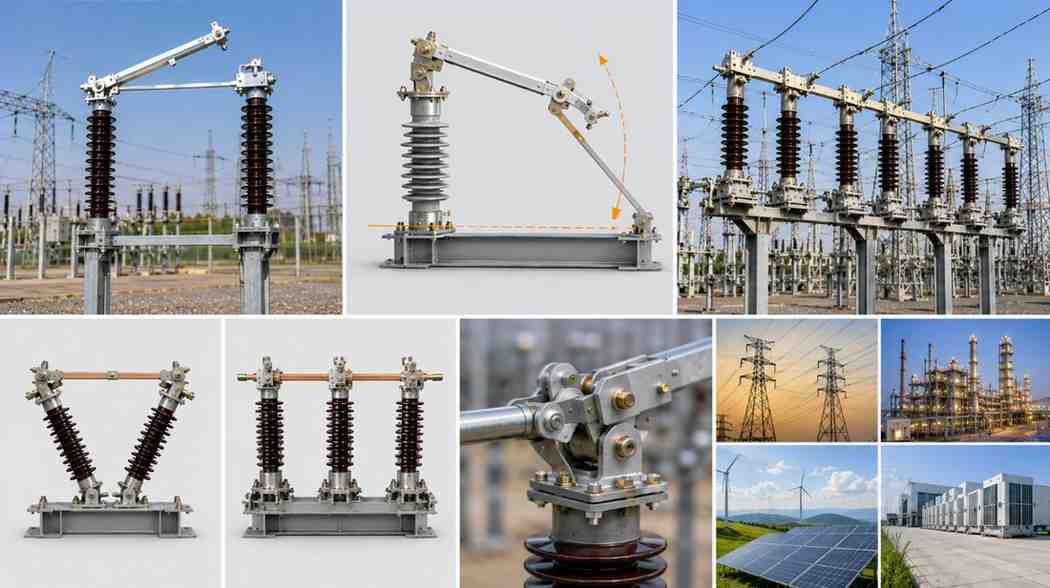
An electrical isolator is a mechanical switching device installed in high-voltage (HV) power systems to create a safe, visible open gap in an energised circuit. Its sole purpose is to confirm that a section of the network is fully de-energised before maintenance personnel work on it. The visible break — often seen as a physically separated blade or contact arm — is a non-negotiable safety requirement in every substation worldwide.
Electrical isolators are among the most fundamental components in India's power infrastructure. With over 7,000 substations at 33kV and above operated by state DISCOMs, power transmission companies, and industrial captive users, reliable isolator performance directly affects grid safety and continuity of power supply.
What Is an Electrical Isolator?
An electrical isolator — also called a disconnector, disconnecting switch, or simply an isolator — is defined under IS 9921 (India) and IEC 62271-102 (international) as a "mechanical switching device which, in the open position, provides an isolating distance in accordance with specified requirements."
In practical terms, this means an isolator: opens and closes under no-load or negligible charging current conditions only, provides a physically visible confirmation of the open-circuit state, prevents re-energisation of the circuit until deliberately closed again, and is always operated in sequence with an associated circuit breaker or load break switch.
Working Principle of an Electrical Isolator
The working principle of an electrical isolator is based on mechanical contact separation. When the isolator is operated to the open position, its moving contact (blade, arm, or pantograph mechanism) physically separates from the fixed contact, creating an air gap of specified clearance between live and dead conductors.
This air gap provides the isolating distance. The gap must be large enough to withstand the system's rated lightning impulse voltage, switching impulse voltage, and power frequency withstand voltage — all defined in the relevant IS/IEC standard. For a 33kV system, the required phase-to-earth isolating distance is typically 320mm or greater. For 220kV, it exceeds 1,600mm.
Because the isolator operates only under no-load (or very small charging current) conditions, the arc formed on opening is negligible and extinguishes naturally in air. This is what distinguishes an isolator from a circuit breaker, which must interrupt full load current and fault current using advanced arc-quenching media such as SF6 gas or vacuum.
Key Functions of an Electrical Isolator
The primary functions of an electrical isolator in a power system include:
- Safety isolation: Creating a visible open gap to confirm de-energisation of equipment before maintenance, inspection, or testing.
- Circuit configuration changes: Rerouting power flows by connecting or disconnecting busbars, feeders, or transformers in a substation — enabling planned bus switching without supply interruption.
- Earthing: Many isolators are fitted with integral earth switches that ground the isolated section for maximum personnel safety.
- Transfer bus operation: In double-bus or 1.5-breaker substations, isolators allow feeders to be transferred between buses without de-energising customers.
Types of Electrical Isolators
Electrical isolators are broadly categorised by their operating mechanism and position in the substation. The main types include:
- Single break isolator: One open gap per phase. Used at 11kV–33kV. Compact and cost-effective.
- Double break isolator: Two open gaps per phase. Standard at 66kV and above. Higher reliability and insulation integrity.
- Centre-rotating (knee-type) isolator: Blade rotates horizontally about its centre. Most common type in Indian AIS substations.
- Pantograph isolator: Vertical contact movement; ideal for compact EHV substations at 132kV–400kV.
- Vertical break isolator: Blade rotates upward. Highly visible open position; used at 11kV–66kV.
For a detailed breakdown of each type with a full comparison table, see SPKN India's guide to types of electrical isolators.
Essential Specifications to Know
When procuring an electrical isolator, the following specifications must be confirmed against the project's system parameters and the applicable utility standard technical specification (STS):
| Parameter | Typical Values | Standard Reference |
|---|---|---|
| Rated voltage | 12 / 36 / 72.5 / 145 / 245 kV | IS 9921 / IEC 62271-102 |
| Rated current | 400 / 630 / 800 / 1250 / 1600 A | IS 9921 |
| Short-time withstand current (1s) | 16 / 25 / 31.5 / 40 kA | IS 9921 |
| Lightning impulse withstand | 75 / 170 / 325 / 650 kV peak | IS 9921 Table 1 |
| Power frequency withstand (wet) | 28 / 70 / 140 / 275 kV RMS | IS 9921 Table 1 |
| Mechanical endurance | M0: 1,000 ops / M1: 2,000 ops | IS 9921 Cl. 6.103 |
Electrical Isolator vs Circuit Breaker
One of the most common questions from junior engineers and procurement teams is whether an isolator can replace a circuit breaker. The answer is unequivocally no. The two devices serve fundamentally different purposes and must always be used together.
The circuit breaker's role is to detect abnormal conditions (faults, overloads) and automatically interrupt current — even fault current of tens of kiloamperes — within milliseconds. The isolator's role is to mechanically confirm isolation after the breaker has operated, providing the visible break that allows safe human access. Remove either device and the protection scheme is incomplete.
Applications Across India's Power Sector
Electrical isolators are present in virtually every segment of India's power sector:
DISCOMs and state transmission utilities: Every 33/11kV, 66/11kV, 132/33kV, and 220/132kV substation bay requires isolators on the busbar side, line side, and transformer HV/LV side. India's Revamped Distribution Sector Scheme (RDSS), which aims to upgrade 10,000+ distribution substations, is driving significant isolator procurement across all states.
EPC contractors: Project developers building new substation infrastructure for renewable energy projects, industrial clients, and grid expansion programmes specify IS 9921-compliant electrical isolators in their bill of materials.
Wind and solar power plants: Grid interconnection substations for wind farms (33kV collector system + 132kV or 220kV grid interconnection) require isolators at multiple voltage levels. With India targeting 500 GW of renewable capacity by 2030, this represents one of the fastest-growing markets for HV isolation equipment.
Industrial and mining: Steel plants, cement factories, aluminium smelters, and large process industries maintain captive HV substations that require regular isolator procurement and replacement.
SPKN India's Electrical Isolators
SPKN India Isolators Pvt. Ltd. designs and manufactures electrical isolators for the full range of Indian power system voltage levels. Our isolators are constructed with high-grade aluminium alloy current-carrying parts, triple-shed polymer or porcelain insulators, and hot-dip galvanised structural steel frames for long outdoor service life.
All SPKN India isolators undergo: dimensional inspection, contact resistance measurement, power frequency withstand test, and mechanical operations testing — before leaving our facility. Type test certificates from NABL-accredited laboratories are available for all standard ratings.
Looking for high-quality electrical isolators for your substation project? SPKN India manufactures IS 9921-compliant isolators from 11kV to 220kV, backed by NABL-accredited type test certificates and fast delivery across India. Our technical team works directly with DISCOMs, EPC contractors, and industrial clients to ensure the right specification every time. Submit your project requirements or RFQ to SPKN India today — technical support and competitive pricing guaranteed.