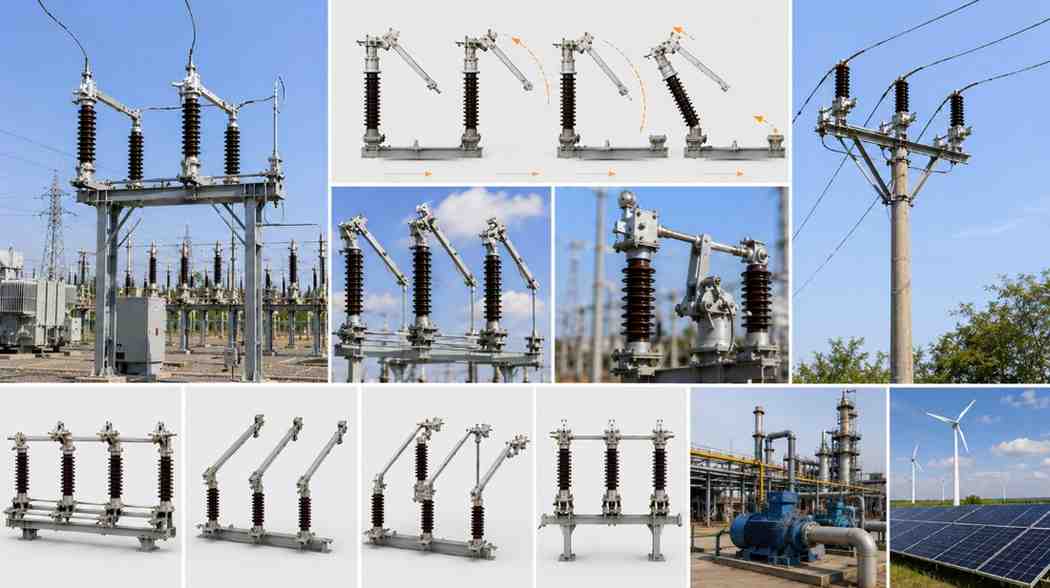
An air break switch (ABS) is a high-voltage switching device used in electrical substations to isolate circuits from the power supply, using air as the arc-interrupting medium. It operates under no-load or minimal-load conditions, creating a visible open gap that confirms a de-energised state — a critical safety requirement in high-voltage (HV) power systems.
In India's rapidly expanding power infrastructure, air break switches are fundamental components in 11kV, 33kV, 66kV, 132kV, and 220kV substations operated by DISCOMs, state utilities, industrial plants, and renewable energy projects. According to India's Central Electricity Authority (CEA), the country added over 36 GW of generation capacity in FY2023–24 alone — all of which requires robust switching and isolation equipment at the substation level.
This guide covers everything electrical engineers, procurement managers, and EPC contractors need to know about air break switches: working principle, types, specifications, and how to select the right unit for your substation.
What Is an Air Break Switch?
An air break switch is a manually or motor-operated device designed to open or close a high-voltage circuit. Unlike a circuit breaker, an air break switch is not designed to interrupt fault current — it is used to isolate de-energised sections of a network for maintenance, testing, or configuration changes.
The term "air break" refers to the fact that the electrical arc formed when the contacts separate is quenched in open air, without the use of SF6 gas, oil, or vacuum. This makes air break switches simpler in construction, lower in cost, and easier to maintain compared to gas-insulated alternatives.
Air break switches are also commonly referred to as air break isolators or disconnect switches in international terminology.
How Does an Air Break Switch Work?
The operating principle of an air break switch centres on the physical separation of conductive contacts within an open-air environment. When the switch opens, the contacts draw apart, stretching the electrical arc across the air gap between them. The arc is then extinguished naturally as the gap widens beyond the arc's sustaining voltage threshold.
Arc Interruption Mechanism
In conventional isolators, arc interruption at no-load voltages is straightforward because the charging current of connected busbars and cables is minimal (typically under 1 A). However, in gang-operated air break switches designed for line-charging or transformer-magnetising currents, arc horns, arc chutes, or whip-type auxiliary contacts are integrated to ensure reliable arc extinction.
The arc interruption process in an ABS follows these steps: contacts begin to separate → a small arc is initiated → the arc elongates as the gap increases → air cooling and elongation quench the arc → the circuit is fully open with a visible gap.
Operating Sequence
A standard operating sequence requires the associated circuit breaker to trip and de-energise the circuit before the air break switch is opened. The ABS then provides mechanical isolation and a visible open-gap confirmation. This sequence is a fundamental HV safety procedure mandated under IS 9921 (the Indian standard for HV AC disconnectors).
Types of Air Break Switches
Air break switches are classified by several parameters including the number of break points, mounting arrangement, and operation mechanism. Choosing the correct type depends on the voltage level, available space, and operational requirements of the substation.
By Number of Break Points
| Type | Break Points | Typical Voltage | Best For |
|---|---|---|---|
| Single Break ABS | 1 per phase | 11kV – 33kV | Distribution substations, compact layouts |
| Double Break ABS | 2 per phase | 66kV – 220kV | Transmission substations, higher reliability requirement |
Double break switches divide the switching duty across two gaps per phase, improving arc interruption performance and overall reliability at higher voltage levels.
By Operation Mechanism
Manually operated: Operated via an insulating operating rod or handle by a linesman. Common in smaller 11kV–33kV distribution substations.
Motor-operated (MOAS): Fitted with a motor-drive mechanism for remote or SCADA-controlled operation. Standard in modern 132kV and 220kV grid substations operated by PGCIL and state utilities.
Gang-operated: All three phases operated simultaneously by a single mechanism, ensuring balanced three-phase switching.
Key Specifications & Ratings
Air break switches are specified by several electrical and mechanical parameters defined under IS 9921 / IEC 62271-102. The key ratings to review during procurement include:
- Rated voltage (kV): The maximum system voltage the switch is designed for (e.g. 12kV, 36kV, 72.5kV, 145kV, 245kV)
- Rated normal current (A): Continuous current-carrying capacity (typically 400A, 630A, 800A, 1250A, 1600A, 2000A)
- Short-circuit withstand current (kA): The peak and RMS short-circuit current the closed switch can withstand without damage
- Short-time withstand current duration: Usually 1 second or 3 seconds
- Insulation level (kV peak): Lightning impulse withstand voltage and power frequency withstand voltage
- Mechanical endurance: Number of operating cycles (Class M0: 1,000 cycles; Class M1: 2,000 cycles)
- IP rating: Protection class for outdoor installations (typically IP23 or IP44)
SPKN India manufactures air break switches tested and certified to IS 9921 standards across voltage ratings from 11kV to 220kV.
Applications in Power Systems
Air break switches serve critical isolation and switching functions across every segment of India's power network:
Distribution substations (11kV / 33kV): Isolating transformer feeders and outgoing distribution circuits for maintenance. ABS units are standard equipment in 33/11kV substations across all DISCOMs.
Grid substations (66kV – 220kV): Bus coupler isolation, transformer HV side isolation, line isolators on incoming transmission feeders.
Industrial substations: Steel plants, cement factories, refineries, and large manufacturing units use ABS for load and feeder isolation within captive HV systems.
Renewable energy plants: Wind farms and solar power plants require air break switches at the 33kV collection system level and at the grid interconnection substation. India's renewable capacity is projected to reach 500 GW by 2030, driving sustained demand for ABS units in green energy projects.
Railway electrification: Indian Railways' 25kV AC traction system uses specialised air break switches for catenary sectioning and maintenance isolation.
Air Break Switch vs Isolator vs Circuit Breaker
| Feature | Air Break Switch | Isolator | Circuit Breaker |
|---|---|---|---|
| Interrupts fault current | No | No | Yes |
| Arc interruption medium | Air | Air | SF6 / Vacuum / Oil |
| Load switching capability | Limited (line charging) | No | Full |
| Visible open gap | Yes | Yes | No (enclosed) |
| Operating speed | Slow (manual / motor) | Slow | Fast (auto) |
| Typical voltage range | 11kV – 220kV | 11kV – 800kV | 11kV – 800kV |
| Cost | Low – Medium | Low | High |
In practice, an air break switch and a plain isolator are often treated synonymously in Indian utility specifications. The key distinction is that some ABS designs include limited current-switching capability, whereas standard isolators are strictly no-load devices.
Why Choose SPKN India for Air Break Switches?
SPKN India Isolators Pvt. Ltd. has supplied air break switches and isolators to DISCOMs, EPC contractors, and industrial clients across India. Our manufacturing process adheres to IS 9921 and IEC 62271-102 standards, with every unit undergoing rigorous type testing and routine testing before dispatch.
We offer air break switches in voltage ratings from 11kV to 220kV, in single-break and double-break configurations, with manual, motor-operated, and gang-operated variants. Customisation for specific utility specifications and project drawings is available. Short lead times, competitive pricing, and responsive after-sales support make SPKN India a preferred supplier for time-critical project schedules.
SPKN India Isolators Pvt. Ltd. manufactures IS 9921-compliant air break switches in 11kV to 220kV ratings, available in single-break, double-break, and gang-operated configurations. Whether you're specifying for a new substation, a DISCOM upgrade programme, or an industrial captive power project, our technical team can help you select the right unit and meet your project schedule. Send your technical specification or drawing to our enquiry team today — we respond within 24 hours.