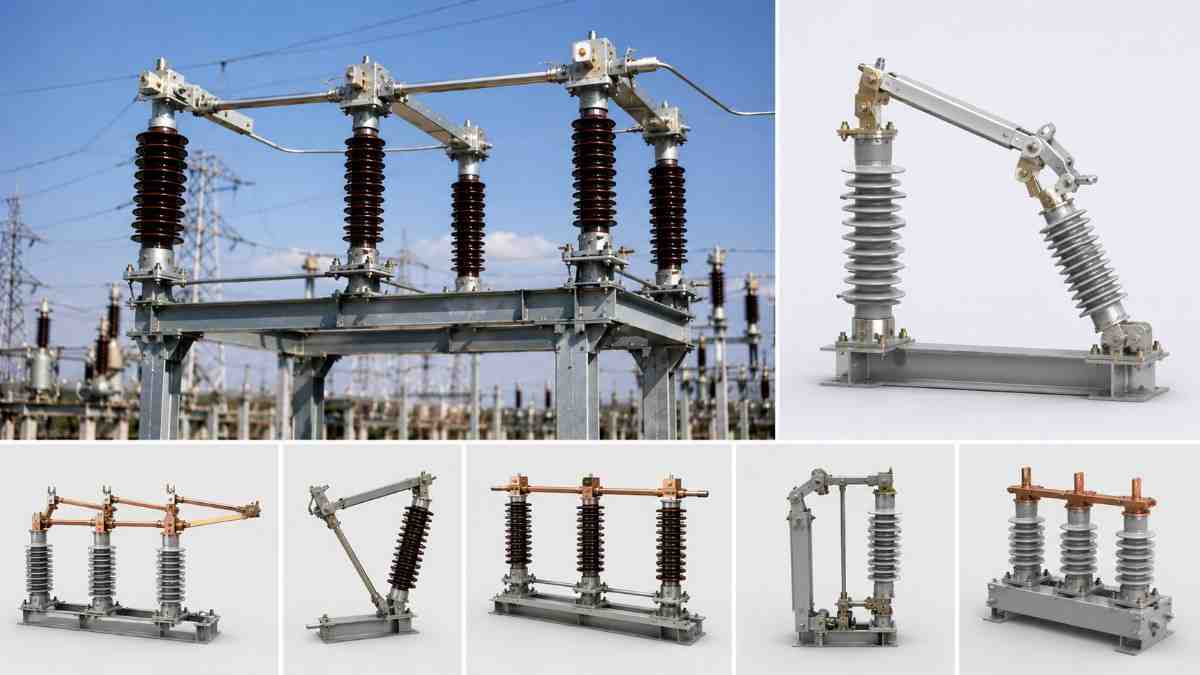
Isolators are also known as disconnectors, disconnecting switches, or isolating switches. In India, the term "isolator" is universally used across all power sector organisations — from DISCOMs and PGCIL to EPC contractors and equipment manufacturers.
An isolator in electrical engineering is a mechanical switching device used in high-voltage power systems to physically disconnect a section of circuit from the power supply, creating a visible open gap that confirms the circuit is de-energised. Isolators operate only under no-load conditions — they cannot interrupt fault or load current. They are mandatory safety devices in every HV substation, rated from 11kV to 800kV.
Isolator Definition
The formal definition of an isolator under IS 9921 (the Indian standard aligned with IEC 62271-102) is: "A mechanical switching device which, in the open position, provides an isolating distance in accordance with specified requirements."
In plain English: an isolator is a switch that, when open, guarantees a safe physical gap between a live conductor and the section being maintained. This gap must be large enough to prevent any electrical breakdown across it under the system's rated voltage and transient overvoltage conditions.
What Does an Isolator Do?
The isolator performs several critical functions in a power system:
- Safety isolation: Creates a visible, verifiable open gap so maintenance teams can confirm equipment is de-energised.
- Circuit configuration: Allows substation operators to reconfigure bus connections — connecting or disconnecting feeders, transformers, and bus sections.
- Earthing facilitation: Provides the isolation point after which an earthing switch can be closed to safely earth the isolated conductor.
- Sequence protection: Works in interlock with the associated circuit breaker — the isolator can only be opened after the breaker has tripped, preventing dangerous on-load switching.
Isolator Kya Hota Hai?
Hindi-speaking engineers often search for "isolator kya hota hai" — here is a concise explanation: Isolator ek high-voltage switching device hai jo bijli ke circuit ko physically disconnect karta hai jab circuit de-energised ho. Yeh ek visible open gap create karta hai jo confirm karta hai ki equipment safe hai maintenance ke liye. Isolator circuit breaker ki tarah fault current interrupt nahi kar sakta — yeh sirf no-load condition mein operate hota hai. Har electrical substation mein isolator mandatory hota hai, chahe 11kV ho ya 220kV.
Types of Isolators — Quick Overview
Isolators are available in several types based on their mechanism and application:
| Type | Description | Common Voltage Range |
|---|---|---|
| Single Break | One contact gap per phase | 11kV – 33kV |
| Double Break | Two contact gaps per phase | 66kV – 400kV |
| Centre-Rotating | Blade rotates horizontally at centre | 11kV – 400kV |
| Pantograph | Vertical-rising contact mechanism | 132kV – 400kV |
| Vertical Break | Blade rotates upward from base | 11kV – 66kV |
For a detailed explanation of each type, see SPKN India's comprehensive guide to types of electrical isolators.
What Is the Difference Between an Isolator and a Circuit Breaker?
This is the most frequently asked question about isolators. The key differences are:
Circuit breaker: Automatically interrupts fault and load current. Can operate under full short-circuit conditions. Operates in milliseconds. Has no visible external open gap (contacts are enclosed). More expensive.
Isolator: Cannot interrupt fault or load current — must only operate after the circuit breaker has already opened. Provides a visible, external open gap. Operates slowly (manually or via motor). Less expensive.
In a properly designed substation, the correct operating sequence is always: circuit breaker opens first → isolator opens second. Reversing this sequence — attempting to open an isolator under load — causes severe arcing, contact destruction, and arc-flash risk to personnel.
Where Are Isolators Used?
Isolators are used across every segment of India's electrical infrastructure:
- Distribution substations (11kV / 33kV): Every feeder bay, transformer bay, and bus coupler bay in a DISCOM substation contains isolators.
- Grid substations (66kV – 220kV): State transmission utilities and PGCIL install isolators at every circuit breaker position in their EHV switchyards.
- Renewable energy plants: Solar and wind farms use isolators at 33kV collection substations and 132kV/220kV grid interconnection points.
- Industrial captive substations: Factories, refineries, steel plants, and large industrial units maintain HV substations with isolators at each bay.
- Railway electrification: Indian Railways uses specialised isolators in 25kV traction substations for catenary sectioning.
SPKN India manufactures electrical isolators for all of these applications, from 11kV distribution-class single break units to 220kV transmission-class double break isolators with motor-operated earthing switches.
Now that you understand what an isolator is and its critical role in electrical substations, explore SPKN India's range of IS 9921-compliant isolators for 11kV to 220kV applications. Whether you're a DISCOM engineer specifying equipment for a new substation, an EPC procurement manager compiling a bill of materials, or a project developer planning a renewable energy plant, SPKN India can supply the right isolator for your project. Contact our technical team with your voltage and current rating — receive product specifications and pricing within 24 hours.