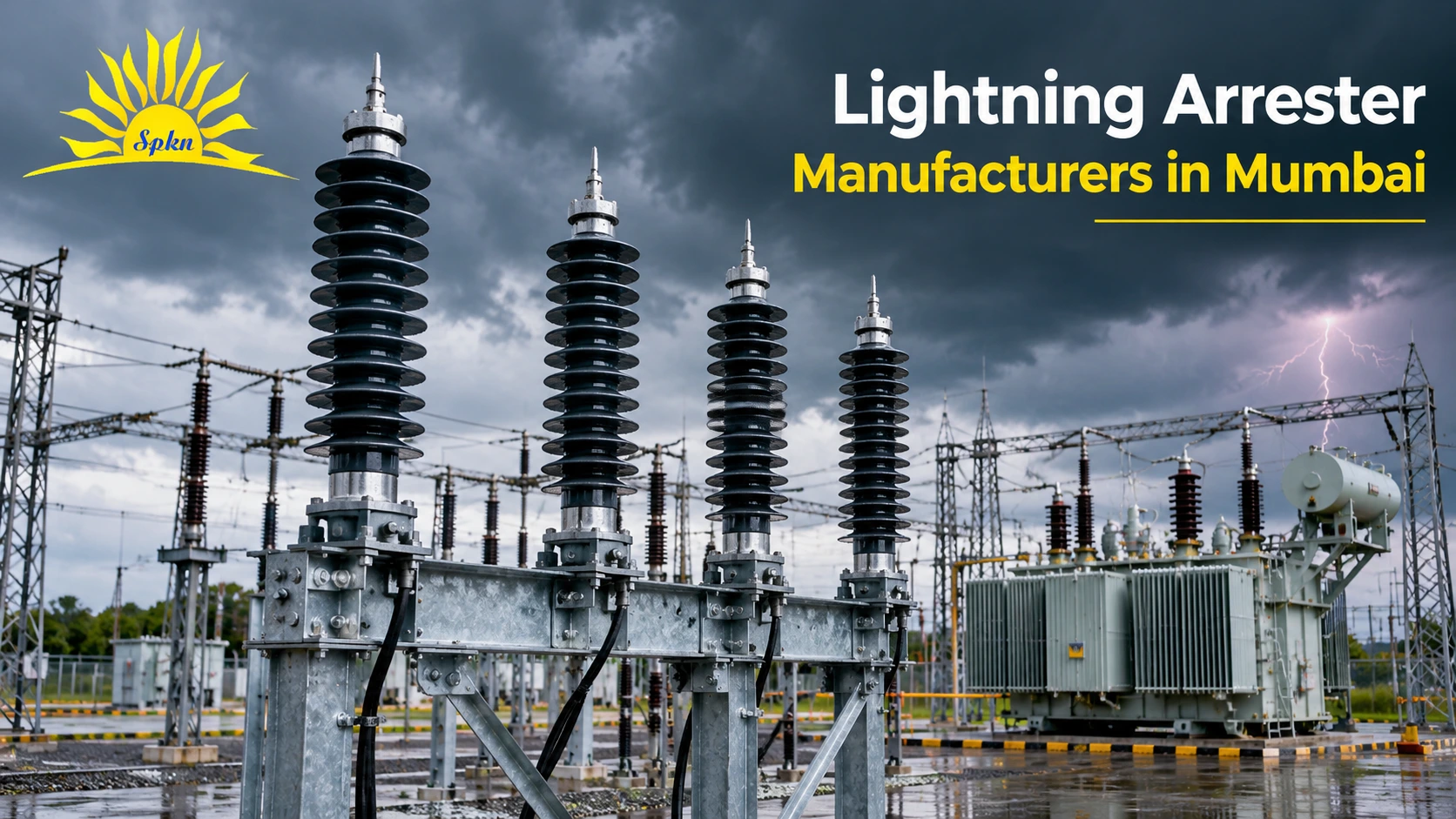
When lightning hits a power line, the surge can reach your transformer in a fraction of a second. The damage is often expensive, and the shutdown that follows can stop work for days. A lightning arrester is the device that prevents this.
SPKN India is one of the lightning arrester manufacturers serving Mumbai and the rest of Maharashtra. We make our products in Faridabad, Haryana, and deliver them to utilities, industrial plants, EPC contractors and substations. We are ISO 9001:2015 certified and have completed more than 1,100 installations across India.
This page explains what a lightning arrester is, how to choose the right one, and how to look after it. You can read it from top to bottom or jump to the section you need.
What Is a Lightning Arrester?
A lightning arrester is a protective device connected between a live conductor and the ground. Its job is to protect your electrical equipment from sudden high-voltage surges.
These surges come from two main sources. The first is lightning, which can strike a line directly or near it. The second is switching, which happens when a large circuit is turned on or off in the network.
How a lightning arrester works
The working idea is simple and happens in four steps:
- Under normal conditions, the arrester does almost nothing. It lets the normal system voltage pass without a problem.
- When a surge arrives, the voltage rises sharply above the normal level.
- The arrester detects the rise and quickly gives the surge a path to the ground.
- Once the surge has passed, the arrester returns to its normal state and waits for the next one.
Think of it as a safety valve on a pressure cooker. It stays closed during normal use and opens only when the pressure becomes dangerous.
Why Mumbai Networks Need Reliable Surge Protection
Mumbai faces several conditions that put electrical equipment at risk.
- Heavy monsoon storms. Thunderstorms in the rainy season bring frequent lightning activity.
- Humid, salty air. Coastal air causes dirt and salt to build up on insulators and housings, which can weaken them over time.
- Dense industrial areas. Zones such as Andheri, Thane-Belapur and Taloja have many connected assets. A surge on one line can travel to many machines.
- Costly downtime. A single outage in a factory or substation can stop production and hurt revenue.
Because of these conditions, a weak or wrongly rated arrester becomes the weakest point in the network. Choosing the right arrester during design costs far less than replacing damaged equipment later.
Lightning Arrester Manufacturers in Mumbai: What to Look For
Not every supplier offers the same quality or support. When you compare lightning arrester suppliers in Mumbai, check these points:
- Quality certification. Look for a recognized quality system, such as ISO 9001:2015.
- Test reports. Ask for test reports for the exact arrester you plan to buy.
- Technical support. A good supplier helps you pick the correct rating instead of simply selling a product.
- Track record. Ask how many installations the company has completed and in which sectors.
- Delivery and after-sales service. Late delivery stops projects, and poor support leaves you alone with problems.
SPKN India meets these needs with ISO 9001:2015 certification, 1,100+ installations and a team that reviews your requirement before you order.
Lightning Arresters From SPKN India
Our lightning arresters protect transmission and distribution systems from surges and lightning strikes. We work across the voltage range we manufacture for, from 11 kV up to 220 kV.
You can use our arresters at these points in a network:
- Substations and switchyards
- Transformer terminals
- Feeder lines and line entry points
- Industrial and manufacturing units
- Wind, solar and hydroelectric installations
- Utility and DISCOM networks
Each order is matched to your system voltage and site conditions. If you do not know the right rating, send us your details and we will guide you.
Common Types of Lightning Arresters
Arresters differ in design and housing. Here are the main types buyers come across:
Metal oxide (gapless) arresters
These use metal oxide blocks, usually zinc oxide, which react very quickly to a surge. They are the most widely used type in modern networks.
Polymer-housed arresters
These have a lightweight outer housing made of polymer. They are often chosen for polluted or coastal areas because they handle dirt and moisture well.
Porcelain-housed arresters
These have a traditional porcelain outer shell. They are common in substations and long-running utility installations.
The right choice depends on your voltage level, pollution level and the standards your utility follows. Our team can help you decide.
Lightning Arresters for Transformer Protection
A transformer is usually the most expensive asset in a power network. It is also very sensitive to surges, because high voltage can damage its winding insulation and cause failure.
If you run a transformer company in Mumbai, or you are comparing a transformer manufacturer in Mumbai for a new project, surge protection should be part of the plan from day one. A correctly rated arrester, installed close to the transformer terminals, lowers the chance of insulation damage and unplanned outages.
SPKN India does not replace your transformer supplier. We provide the protection equipment that works alongside your transformer so it lasts longer and runs safely.
How to Choose the Right Lightning Arrester
Use this checklist before you place an order:
- System voltage. Know your network voltage, such as 11 kV, 33 kV, 66 kV, 110 kV or 220 kV. The arrester’s rated voltage must suit it.
- Nominal discharge current. This shows how much surge current the arrester can handle. Higher-risk or higher-voltage sites need a higher rating.
- Housing material. Choose polymer or porcelain based on pollution, humidity and salt exposure at your site.
- Installation point. The needs differ for a transformer terminal, a line entry and a substation bay.
- Required standards. Your utility or client may ask for compliance with specific standards. Confirm this before ordering.
- Earthing quality. Even the best arrester fails if the earth connection is poor. Plan for a low-resistance earth path.
If any point is unclear, share your single-line diagram with us. Our team will suggest a suitable option.
Installation and Maintenance Tips
Good installation and regular checks keep an arrester working for years.
- Install it close to the equipment. The nearer the arrester sits to the transformer or device it protects, the better the protection.
- Keep the earth lead short and straight. Long or bent connections reduce how well the surge reaches the ground.
- Check earth resistance regularly. Poor earthing is one of the most common reasons protection fails.
- Inspect once a year. Look for cracks, dirt buildup, surface damage, loose bolts and corroded connections.
- Inspect after major storms. A strong surge can weaken an arrester even if it looks fine from outside.
- Replace aged or damaged units. An arrester that has done its job many times may no longer protect as it should.
Common Mistakes to Avoid
- Buying only on price without checking the rating
- Using the same arrester for every voltage level
- Ignoring salt and pollution at coastal sites
- Skipping earthing checks after installation
- Never inspecting arresters after the monsoon
Avoiding these mistakes protects your equipment and your budget.
Complete Substation Equipment From One Supplier
Surge protection works best as part of a complete substation setup. Alongside lightning arresters, SPKN India supplies:
Buying from one source keeps your specifications consistent and makes ordering and delivery easier. You can also see all our lightning arresters on the main product page.
Why Choose SPKN India
- ISO 9001:2015 certified manufacturing and quality processes
- 1,100+ installations across India
- Wide voltage range from 11 kV to 220 kV
- Clear technical guidance before you order
- Clients across the power sector, including utilities, industries and EPC contractors
- Support from enquiry to delivery
Get a Quote From Lightning Arrester Manufacturers in Mumbai
Tell us your system voltage and where the arrester will be installed. Our team will recommend the right option and send you a quote.
Get a Quote | Call +91 9999501843 | Email info@spknindia.com