India's power sector is undergoing its largest infrastructure expansion in decades. The government's National Infrastructure Pipeline (NIP) includes over ₹3.5 lakh crore in transmission and distribution investment, creating sustained demand for substation switchgear — including isolators — across thousands of new and upgraded substations.
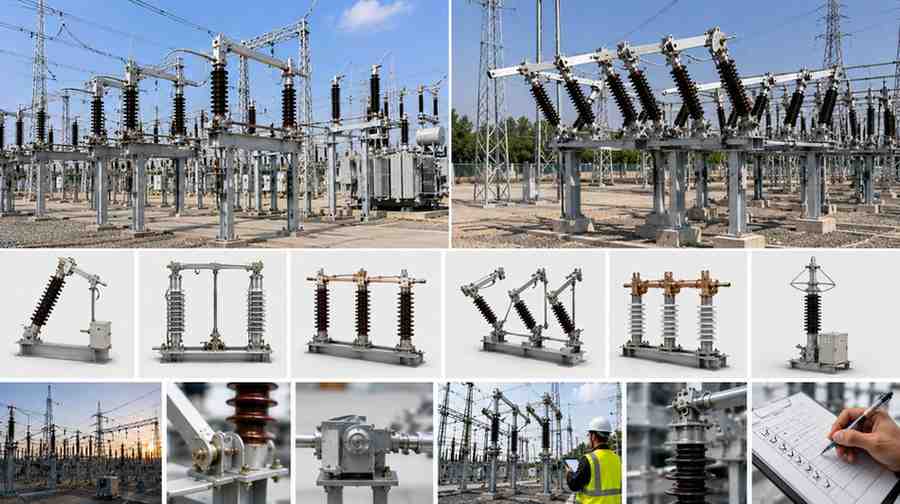
In a typical HV substation, isolators are placed at: (1) bus-side of each circuit breaker to isolate the breaker from the busbar, (2) line-side of each breaker to isolate the feeder or incoming line, (3) transformer HV terminals for transformer isolation, (4) bus coupler position for bus-section switching, and (5) earthing switch positions for safe earthing of isolated conductors.
Why Every Substation Needs Isolators
The fundamental reason isolators in a substation are mandatory is personnel safety. A circuit breaker, even in the open position, does not provide a visible indication of physical conductor separation — its contacts are enclosed within the breaker chamber. An isolator, by contrast, creates a physical, externally visible gap that unambiguously confirms circuit de-energisation.
This visible isolation is a requirement of IS 5216 (Safety Procedures for Electrical Work) and is enforced by every state electricity regulatory authority in India. Before any maintenance work begins on a substation feeder, transformer, or busbar section, the relevant isolators must be opened and locked, and an earth switch applied. No exceptions.
Where Are Isolators Placed in a Substation?
A standard HV substation bay contains multiple isolator positions. The exact number and type depend on the bus arrangement and voltage level, but the following positions are universal:
Bus-Side Isolator (QA1)
Located between the busbar and the circuit breaker. When opened, it isolates the circuit breaker from the live busbar, allowing the breaker to be maintained without de-energising the entire bus. In double-bus substations, separate Bus 1 and Bus 2 isolators allow any feeder to connect to either bus bar independently.
Line-Side Isolator (QA2)
Located between the circuit breaker and the outgoing line or incoming transmission feeder. Opening QA2 isolates the line conductor from the substation — essential when line maintenance teams need to work on the overhead line or cable from the feeder end.
Transformer HV and LV Isolators
Power transformers have isolators on both their HV and LV bushings. These allow the transformer to be isolated from both the incoming HV supply and the outgoing LV busbars independently. Transformer HV isolators are also the point at which earthing switches are applied before transformer maintenance.
Bus Coupler and Bus Section Isolators
In substations with two or more busbars, a bus coupler bay connects the two busbars to allow load transfer. The bus coupler isolators allow this connection to be opened for bus section maintenance. Bus section isolators (on ring bus or segmented bus arrangements) provide similar sectionalising capability.
Isolator Configurations by Substation Type
The number and arrangement of isolators per bay varies by bus scheme:
| Bus Scheme | Isolators per Feeder Bay | Notes |
|---|---|---|
| Single Bus | 2 (1 bus + 1 line) | Simple, low cost; no bus redundancy |
| Double Bus | 3 (2 bus + 1 line) | Bus flexibility; standard for most Indian grid substations |
| Double Bus + Transfer Bus | 4 (2 bus + 1 line + 1 transfer) | High flexibility; allows breaker maintenance without outage |
| 1.5 Breaker | 4–6 per bay | Highest reliability; used in EHV grid and PGCIL substations |
For a typical 33/11kV DISCOM substation with a double-bus arrangement, each incoming 33kV feeder bay requires: 2 bus isolators (Bus 1 and Bus 2) + 1 line isolator + 1 or 2 earth switches = 3–4 isolator units per bay. For a 10-feeder substation, this equals 30–40 isolator units at the 33kV level alone.
Earthing Switches — An Essential Add-On
Most isolators installed in Indian substations are supplied with integral earthing switches (also called earth blades). After the main isolator is opened, the earth switch is closed to connect the isolated conductor to earth. This eliminates any residual charge on the conductor and prevents accidental re-energisation during maintenance.
Earthing switches are classified as either: normal duty (for earthing under no-voltage conditions) or high-speed make earthing switches (HSMES) (capable of closing onto a live, accidentally energised conductor — required for certain transmission applications). The type required depends on the utility specification and the fault level at the installation point.
Key Standards for Substation Isolators in India
Isolators installed in Indian substations must comply with:
- IS 9921: Specification for HV AC disconnectors and earthing switches (Parts 1–5, aligning with IEC 62271-102)
- IS 5216: Safety procedures in electrical work (defines isolation requirements)
- CEA Technical Standards: Central Electricity Authority regulations for installation and operation of meters, protective devices, and switchgear
- Utility STS: State-specific standard technical specifications issued by each DISCOM or state transmission utility — these override or supplement national standards
Common Mistakes in Substation Isolator Specification
Procurement errors in isolator specification are more common than they should be, often causing project delays or commissioning failures. The most frequent mistakes include:
- Underspecifying short-circuit withstand rating: Using an isolator with a lower peak withstand current than the substation's prospective fault level. This can cause isolator deformation or failure during a fault event.
- Wrong bus arrangement: Ordering single bus-side isolators for a double-bus substation layout.
- Neglecting earthing switch type: Specifying normal-duty earth switches where HSMES is required by the utility or by system conditions.
- Ignoring terminal compatibility: Ordering isolators with incompatible conductor terminal sizes or drilling patterns for the project's busbar system.
- Missing type test certificates: Many DISCOM tenders specifically require type test certificates from NABL-accredited labs. Ordering without these causes rejection at inspection.
SPKN India's Range for Substation Applications
SPKN India Isolators Pvt. Ltd. supplies a complete range of substation isolators and earthing switches for 11kV to 220kV applications. Our units are manufactured to IS 9921 with type test support from leading NABL-accredited electrical testing laboratories in India. We supply to DISCOM tender projects, EPC contractors, and direct industrial clients across Rajasthan, Gujarat, Maharashtra, Madhya Pradesh, and other states.
Whether you need centre-rotating double-break isolators for a 132kV grid substation or single-break isolators for a 33kV DISCOM feeder, SPKN India can supply IS 9921-compliant units with the correct earthing switch configuration, terminal arrangement, and operating mechanism for your project.
Procuring isolators for a substation project? SPKN India supplies IS 9921-compliant isolators and earthing switches for 11kV to 220kV substations across India. We work directly with DISCOM tender teams, EPC procurement managers, and industrial electrical teams to supply the right specification, on time and at a competitive price. Type test certificates from NABL-accredited labs are included. Share your substation single-line diagram or bill of materials with our team — we'll provide a detailed technical proposal within 48 hours.