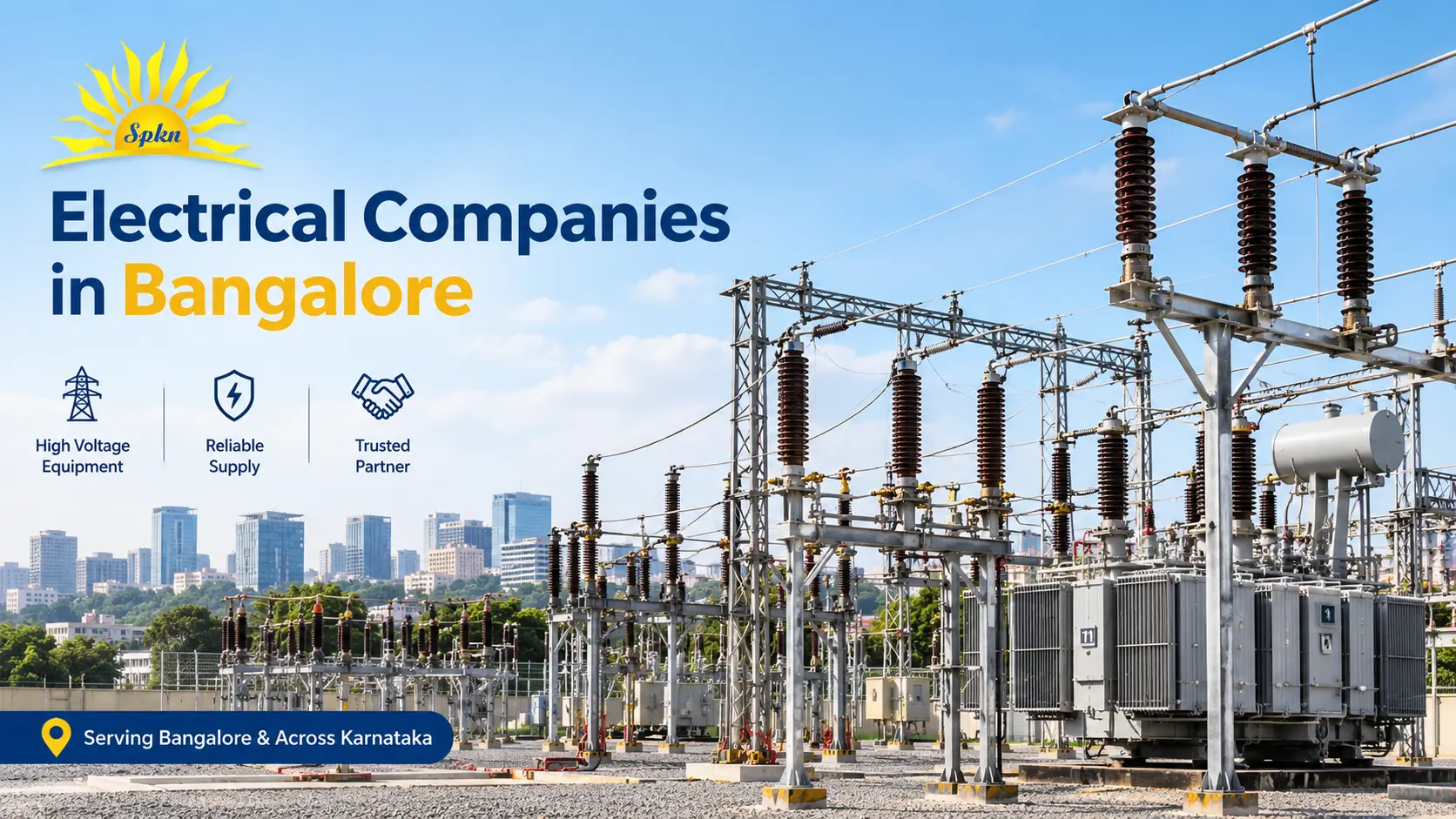
Electrical Companies in Bangalore: Manufacturers, Suppliers and Contractors Compared
Quick answer: When you search for electrical companies in Bangalore, you will find four different kinds of business: equipment manufacturers, traders and distributors, contracting firms and design consultants. Which one you need depends on what you are buying. For high-tension equipment such as isolators, arresters, insulators and substation hardware, a manufacturer with test reports and a clear delivery plan usually gives the best value and accountability.
Bangalore has one of the most varied electrical markets in India. The city has large technology campuses, manufacturing clusters at Peenya, Bommasandra, Hoskote and Whitefield, aerospace and defence units, railways and metro, hospitals, warehouses, and a fast-growing renewable energy sector in the wider state. Each of these buyers needs power equipment and services, and the market has companies of every size to serve them. The difficulty is not finding names. The difficulty is knowing which kind of company fits your job, and how to compare them fairly. This guide sets out the options, the questions to ask and the mistakes to avoid. It is written by SPKN India, a Faridabad-based manufacturer of high-tension electrical equipment that supplies buyers in Karnataka and across the country.
The Four Kinds of Electrical Company
1. Manufacturers
A manufacturer designs and makes the equipment in its own works. Buying direct means you speak to the people who control materials, testing and delivery. You can ask for type test reports and visit the works. The trade-off is that a manufacturer may have a minimum order size and a production lead time. In high-tension equipment, such as isolators, arresters, insulators and connectors, manufacturer quality matters a great deal, because failures are costly and can be unsafe.
2. Traders and distributors
These companies hold stock of common items from several makers and can deliver quickly. They are useful for standard, low-voltage and consumable items. For engineered high-voltage equipment, check who actually made the product, whether it has test reports, and who is responsible if it fails.
3. Electrical contractors
Contractors install, test and commission. They may buy equipment on your behalf or install what you supply. For substations and lines, the licence and experience of the contractor matter, as discussed in our guide to electrical contractors.
4. Consultants and designers
These firms prepare designs, specifications, load studies and tender documents. They are valuable for larger projects, because a good specification lets you compare bids fairly.
Which Type Do You Need?
| Your situation | Best starting point | Why |
|---|---|---|
| Buying isolators, arresters or insulators for a substation | Manufacturer | Test reports, ratings and delivery are controlled at source |
| Need small quantities of standard items quickly | Distributor | Stock and fast delivery |
| New 11 kV or 33 kV connection | Licensed HT contractor | Approvals, erection and testing |
| Large project with many packages | Consultant plus contractor | A written specification and a clear scope |
| Complete project, one point of responsibility | Turnkey firm | Design, supply, erection and commissioning together |
What Bangalore Buyers Usually Purchase
- Isolators at 11 kV, 33 kV, 66 kV and above for safe sectioning in substations. See our range of isolators.
- Lightning arresters to protect transformers and cables from surges. See lightning arresters.
- Insulators, both porcelain and polymer, for lines and yards.
- Substation connectors and clamps that join conductors to equipment, from our connectors range.
- Gantry structures and support steel for outdoor yards, from the gantry structure page.
- Air break switches for overhead line sectionalising, see AB switches.
How to Shortlist Electrical Companies
- Define the need on paper. Write the voltage, current rating, quantity, standards and delivery date. Without this, quotations cannot be compared.
- Identify the type of company. Decide whether you need a manufacturer, a distributor or a contractor, using the table above.
- Ask for evidence. Request test certificates, a list of similar supplies and two references you can call.
- Check capacity. Ask about monthly production, stock and the realistic delivery time to Bangalore.
- Compare line by line. Put ratings, accessories, packing, freight, GST and warranty side by side.
- Confirm after-sales support. Ask who handles faults, spares and replacement, and how fast they respond.
Red Flags to Watch For
- No test reports. If a supplier cannot share routine or type test reports, treat the rating claims with caution.
- Prices far below the rest. The gap usually reflects thinner galvanising, lower grade material or fewer inclusions.
- Vague specifications. A quote that does not state ratings, standards or materials is not a quote you can enforce.
- Promises of delivery without a schedule. Ask for dates tied to your order milestones.
- No physical address or works. A genuine company can tell you where its products are made.
Why Manufacturer-Direct Supply Helps Technical Buyers
With high-tension equipment, small differences in materials and workmanship decide long-term performance. The thickness of galvanising on a structure, the grade of copper or aluminium in a connector, the contact design of an isolator and the quality of metal oxide discs in an arrester are all things only the maker fully controls. Buying direct shortens the chain, so technical questions get a technical answer, and you know who to hold responsible. It also lets you ask for design changes, such as a different terminal, mounting arrangement or length, which a trader cannot easily offer.
Local Conditions That Affect Equipment Choice in Karnataka
Bangalore's climate is mild compared with north India, but the monsoon and pre-monsoon seasons bring heavy lightning. Surge protection deserves attention for exposed lines and transformer yards, and our page on lightning arresters in transformers explains how the protection is arranged. Industrial areas such as Peenya have dust and some chemical pollution, so insulator creepage and cleaning schedules matter. Rocky ground in parts of the region makes it harder to build low-resistance earth pits, so earthing needs to be designed and tested with care. For earthing materials, see the guide to earthing electrodes.
Approvals and Compliance in Karnataka
Most substations and HT connections need approvals from the local distribution company and the electrical inspectorate before they are energised. The process includes submitting drawings and load details, paying the required fees, passing inspection and receiving permission to energise. Delays often come from incomplete documents or from changes to the design after submission, so the equipment list and single-line diagram should be finalised early. A contractor or consultant who has handled these approvals before can save weeks. Ask any company you shortlist how it handles this part, and who is responsible if approval is delayed.
Building a Long-Term Supplier Relationship
Many Bangalore buyers order the same families of equipment year after year: arresters before the storm season, isolators during shutdowns, insulators and connectors for line maintenance. A supplier who keeps your drawings, ratings and past orders on file makes each repeat purchase faster and less error-prone. Share your annual plan with a trusted supplier, so that production can be scheduled and stock held ahead of your shutdowns. Over a few years, this approach tends to deliver better pricing, faster delivery and fewer surprises than shopping around for each single order.
Substation Projects: What to Expect from Supply and Erection
For a new or extended substation, the packages typically include design, civil works, structures, major equipment, cabling, earthing, erection and commissioning. A manufacturer that also offers substation erection services and turnkey projects can reduce the number of parties you manage. Whichever route you choose, insist on a written scope, a schedule, a list of approved makes and a test plan. The more specific the documents, the fewer disputes arise later.
What to Include in an Enquiry
A clear enquiry gets a clear answer. For each item, state the equipment type, the system voltage and rated current, the number of poles or phases, the standard it must meet, the quantity, and the place and date of delivery. Add the mounting arrangement, terminal type and any special need, such as polymer housing, a motor-operated mechanism or a particular creepage distance. Attach a single-line diagram or a sketch if you have one. With this information, a supplier can quote exactly what you need on the first reply, instead of sending several rounds of questions. It also makes it easy to compare two or three quotations against the same description.
Packing, Transport and Delivery to Bangalore
Good packing protects porcelain, galvanised steel and precision parts on a long road journey. Ask how the supplier packs fragile items, whether crates are marked for handling, and how damage in transit is handled. Check the freight terms: whether the price is ex-works or delivered, and who pays for unloading. For large structures, confirm the vehicle size and any access limits at your site. Plan the delivery date to match your erection schedule, so that equipment does not sit exposed on site for weeks. A short delivery plan agreed in writing avoids many arguments later.
Keeping Records for Audits and Insurance
Large buyers and insured plants are often asked for proof of what is installed. Keep a register of each major item with its make, rating, serial number, date of purchase, test report and warranty terms. Store the datasheets and drawings in one place. When an inspector, insurer or new maintenance engineer asks, you will be able to answer within minutes. It also helps you spot ageing equipment before it fails, so that replacements can be planned as part of the budget and not as an emergency.
Talk to SPKN India
SPKN India makes high-tension isolators, lightning arresters, insulators, connectors and gantry structures in Faridabad, and ships to customers in Bangalore and across Karnataka. We offer clear technical advice, itemised quotations and test documents with supply. Browse our products and services, or send your requirement through the enquiry form. You can also call +91 9999501843.