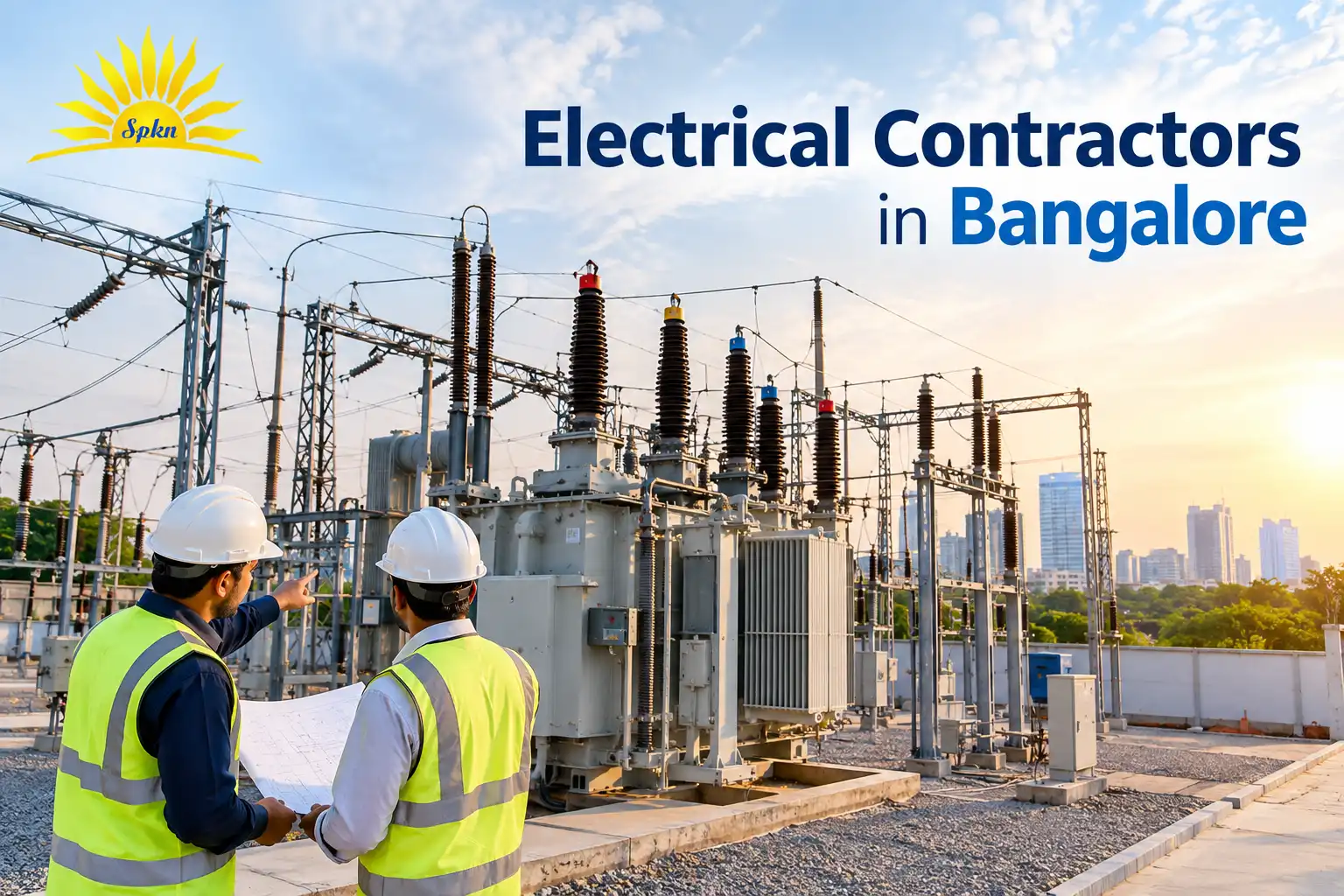
Electrical Contractors in Bangalore: What You Are Really Hiring
Quick answer: Reliable electrical contractors in Bangalore hold a valid licence, field certified supervisors, follow IS and CEA safety rules, give a written scope with test records at handover, and plan work around BESCOM shutdown windows. A low rate means little without these.
Bangalore keeps adding load faster than most Indian cities. Software campuses in Whitefield and Electronic City, factories in Peenya and Bommasandra, new layouts, metro work and data centres all need power connected safely and on time. That demand has produced hundreds of firms that call themselves electrical contractors in Bangalore, and they are far from equal.
The gap shows up on site. One contractor arrives with calibrated test kits, trained jointers and a method statement. Another arrives with a van and a verbal promise. The first costs more on paper and less over the life of the installation. This guide explains how to tell them apart before the work order is signed.
The Types of Electrical Contractors You Will Meet
Wiring and building services contractors
These firms handle low-voltage work: internal wiring, distribution boards, lighting and small power. They suit offices, apartments and retail spaces. Most do not hold the experience needed for 11 kV or 33 kV work, so check the voltage level in their past projects.
HT and substation contractors
High-tension contractors install transformers, isolators, switchgear, cables and earthing, then test and energise the system. Their work needs shutdowns, utility coordination and inspection approvals. If your site draws power at 11 kV or above, this is the category to shortlist, and the HT Electrical Contractor Services page shows what such a scope looks like in practice. SPKN India pairs HT erection with equipment supply, which keeps responsibility for the installation with one team.
Turnkey and EPC contractors
A turnkey contractor takes responsibility for design, supply, erection, testing and handover under one contract. That reduces the number of parties you manage and clarifies who answers for a defect. Read through Electrical Turnkey Projects to see how a single-contract project is usually structured.
What a Good HT Contractor Actually Delivers
Substation erection and commissioning
Erection covers foundations, structures, equipment placement, busbar and conductor work, control wiring and final alignment. Good practice includes a pre-commissioning checklist, insulation resistance tests and a witnessed energisation. Details of a typical scope are covered under Substation Erection Services.
Cable jointing and termination
Cable ends are among the most common failure points, and Bangalore's heavy rain makes sealing important. Heat shrinkable kits seal against moisture and surface tracking while fitting into tight spaces. Compare options from Heat Shrinkable Termination Kit Manufacturers in Bengaluru and make sure a trained jointer follows the kit's instructions exactly.
Earthing, testing and documentation
Earthing design follows IS 3043, and wiring practice follows IS 732 and the National Electrical Code. A competent contractor measures earth resistance, records results and hands over as-built drawings. If a contractor cannot explain its earthing method, treat that as a warning.
Contractors versus electrical companies in Bangalore
Many buyers search for electrical companies in Bangalore when they actually need a contractor. A company may only trade equipment, while a contractor carries the legal and technical responsibility for the installation. A search for electrical contractors near me will surface both kinds side by side, so ask each firm directly whether it executes the work or only supplies material. Decide which one you need before you start comparing prices.
How to Hire Electrical Contractors in Bangalore: A Five-Step Check
- Write the scope first: voltage level, load, drawings available, equipment supplied by you or by the contractor, and the completion date.
- Verify the licence and the supervisor's competency certificate, and ask for copies instead of accepting a verbal assurance.
- Ask for two or three completed projects of a similar voltage and size, then phone the clients and ask about delays and defects.
- Compare quotations line by line against the same bill of quantities, since different scopes make totals meaningless.
- Agree payment milestones linked to inspection and testing, with a retention amount held until the defect liability period ends.
Licences, Standards and Paperwork That Matter
Before any work starts, confirm the paperwork. The list below covers what a serious contractor can show without hesitation.
- A valid electrical contractor licence from the state licensing authority
- Supervisors and wiremen with current competency certificates
- Compliance with the CEA safety regulations and the state Electrical Inspectorate's inspection before energisation
- Reference to IS 3043 for earthing and IS 732 for wiring installations
- Calibrated test instruments with valid calibration certificates
- Workmen insurance and a site safety plan
Why Bangalore Conditions Change the Hiring Decision
Karnataka records a high number of lightning days, and pre-monsoon storms can interrupt outdoor work for hours. Ask how the contractor schedules weather delays and protects open equipment. Lightning protection and surge arresters deserve their own line in the scope.
Traffic and restricted working hours affect transport of heavy items such as transformers and structures. A contractor who plans crane movement and road permits in advance saves days. Shutdowns also need coordination with BESCOM, so ask how many shutdowns the plan assumes and who applies for them.
Finally, space is tight in many sites. Compact layouts, cable trenches shared with other services and underground congestion need careful marking. Request a trench and cable route plan before excavation begins.
Reading a Quotation and Contract
A useful quotation lists quantities, makes of major equipment, taxes, exclusions and the testing included. Look for vague phrases such as "as required" or "at site conditions", because they often turn into variation claims later.
The contract should state the schedule, payment milestones, penalties for delay, warranty period and who supplies power, water and storage on site. Have your engineer or consultant read it before you sign.
Common Mistakes to Avoid
- Hiring on the lowest rate, then paying for rework and delays
- Letting an unlicensed team handle HT work to save money
- Skipping a written scope, so every extra becomes a dispute
- Ignoring earthing tests until the final day
- Accepting poor-quality cable terminations that fail in the first monsoon
- Forgetting as-built drawings, which makes later maintenance harder
Safety on Site
Permit-to-work, lock-out and tag-out, and proper earthing before touching any conductor are non-negotiable. Insist on PPE, insulated tools and a trained person supervising each shutdown. A contractor with a safety record is cheaper than an accident.
A Simple Decision Framework: Licence, Labour, Logistics, Liability
Run each contractor through four checks. Licence: are the permits and supervisor certificates valid? Labour: are the jointers and electricians trained for this voltage? Logistics: can they handle equipment movement, shutdown timing and site access? Liability: who is responsible if something fails during the warranty? A contractor who answers all four clearly is a safer bet than one who offers the lowest figure.
Trends and Future Outlook
Rooftop solar, EV charging, battery storage and data centres are changing what contractors in Bangalore are asked to build. Expect more compact substations, more cable work in congested areas and more interest in monitoring. Contractors who already work with testing records and neat documentation will adapt fastest.
What Drives the Cost of Electrical Contracting
Equipment ratings and makes are the biggest driver, followed by site access, cable length, civil work and the number of shutdowns. Costs also move with copper and aluminium prices, so a quotation should state how long it stays valid. Ask for the price split between supply, erection and testing. That split makes comparisons fair and shows where a saving is real.
A lower total is possible when the owner supplies the major equipment, but responsibility for defects then needs to be clear in the contract. Mixed supply works best when the contractor reviews the equipment datasheets before anything is ordered.
Planning the Project Timeline
Good projects start with drawings and approvals, not with excavation. The usual stages are survey and design, utility approvals, procurement, civil work, erection, testing, inspection and energisation. Transformers and switchgear often set the critical path, so order them early. Ask the contractor for a milestone chart, review it every week, and keep a buffer for heavy monsoon weeks.
Summary
Choosing among electrical contractors in Bangalore is easier when you define the scope, confirm licences and test capability, plan around local weather and shutdowns, and compare quotations on equal terms. Do that, and a hidden-cost surprise becomes much less likely.
Planning an HT project in Bengaluru? Call SPKN India on +91 9999501843 or email info@spknindia.com with your single-line diagram and load details, and the team will respond with a scoped proposal.