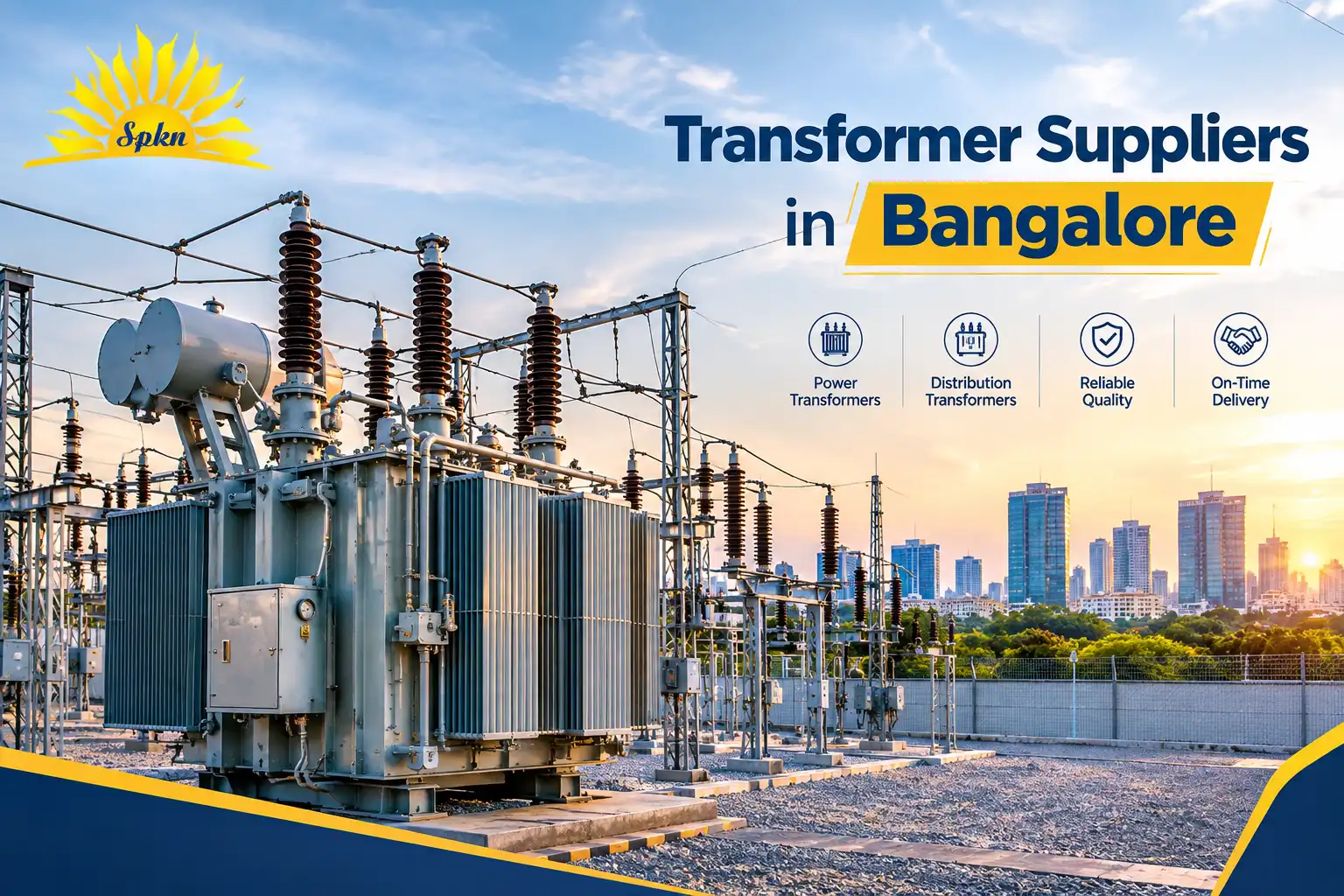
Transformer Suppliers in Bangalore: What You Are Really Choosing
Quick answer: The right transformer supplier in Bangalore sizes the unit to your real load, shares routine and type test reports, names the IS and IEC standards followed, and supports you after commissioning. A kVA figure on a quotation never tells the whole story.
Bangalore's power picture is unusual. Gated communities, software campuses, hospitals, data centres and the factories of Peenya and Bommasandra all run on transformers, yet each of them stresses the equipment differently. A unit that suits a steady factory load can struggle in a building full of servers, lifts and air-conditioning. That is why searches for transformer suppliers in Bangalore return so many offers that look alike on paper and behave differently in service.
People also use several labels for the same search. Someone typing transformer manufacturers in Bangalore may really want a trader with stock, while someone looking for a transformer company in Bangalore may need an installer. Sorting these roles out early saves weeks of mismatched quotations.
How a Transformer Works and Why the Type Matters
A transformer moves electrical energy between circuits through a magnetic core, changing voltage without changing frequency. The core steel, winding material, insulation system and cooling method decide its losses, its noise and how long it lasts. Two units with the same kVA can differ sharply on all four.
Cooling matters most in a warm, humid city. Oil-filled units carry heat away through the oil and radiators, while dry type units rely on air and resin insulation. Each has a place, and the next sections explain where.
The Types Buyers Ask About Most
Distribution transformer manufacturers in India: what to verify
Distribution transformers step 11 kV down to 433 V for buildings and small industry. When you compare distribution transformer manufacturers in India, ask for the loss figures at rated load and at no load, the winding material, the oil quality and the test reports under IS 1180. Lower losses cost more upfront and pay back through electricity savings, especially for transformers that run all day.
Power transformer manufacturers in Bangalore: what to verify
Power transformers sit in substations at 33 kV, 66 kV and above. Look at the impedance, the short-circuit withstand capability, the tap changer type, the cooling class and the factory acceptance test plan. Insist on witnessing the routine tests, and read the design review before manufacturing starts.
Current transformer manufacturers in India: what to verify
Current transformers feed measuring and protection circuits, so accuracy class and burden matter far more than appearance. Check the ratio, the knee point voltage for protection cores and the test reports under IS 2705. If an existing unit has drifted or failed, the CT PT Replacement Services page explains how replacement is usually handled without disturbing the rest of the scheme.
Dry type or oil filled
Dry type units suit basements, malls and hospitals where fire risk and oil handling are concerns. Oil-filled units suit outdoor yards and heavy loads, and they usually cost less per kVA. Pick based on location, fire rules and maintenance capacity instead of price alone.
How to Choose Among Transformer Suppliers in Bangalore: A Five-Step Check
- Calculate the real connected and diversified load, including expected growth over the next five years, before you pick a kVA rating.
- Decide the type: distribution or power, oil filled or dry, indoor or outdoor, and the voltage ratio and vector group your utility needs.
- Ask each supplier for type test reports and routine test reports for the exact rating offered, plus the loss figures in writing.
- Compare the total cost of ownership, which includes losses, installation, spares and warranty, not only the purchase price.
- Speak to two or three existing customers and ask how the supplier handled a fault after delivery.
Standards, Testing and Documents That Matter
Good suppliers name the standards behind each product and provide evidence for them. The common references are:
- IS 1180 for distribution transformers and IS 2026 with IEC 60076 for power transformers
- IS 11171 for dry type transformers
- IS 2705 for current transformers and IS 3156 for voltage transformers
- Type tests such as temperature rise, impulse withstand and short-circuit withstand, along with routine tests on every unit
Ask for the factory test certificate, the guaranteed particulars sheet, the nameplate drawing and the warranty terms before payment. A supplier who hesitates over any of these is telling you something.
Why Bangalore Conditions Change the Buying Decision
Bangalore has a mild climate, but heavy pre-monsoon storms and high lightning activity put real stress on outdoor equipment. Transformers need properly rated lightning arresters on the HV side and sound earthing, and the supplier should be willing to discuss both.
IT-heavy loads bring harmonics from servers and power supplies. Harmonic currents raise winding temperature, so ask about K-factor ratings or derating if your load is electronic. Many buyers discover this only after a unit runs hot.
Delivery is a practical issue too. Congested roads and limited access to older layouts mean a heavy unit may need special transport and a crane slot. Confirm who arranges unloading, positioning and oil filtration at site. Coordinate with BESCOM early so that connection norms and metering are clear before the unit arrives.
Transformer Manufacturers Near Me or National Reach
Many buyers type transformer manufacturers near me and choose the nearest office. Proximity helps with inspection visits and urgent service, yet it should never replace checks on test facilities and past performance. Large transformer manufacturers in India often offer wider ranges and stronger test labs, while a local dealer may react faster. A sensible plan is to buy from a capable manufacturer and keep a local service contact for commissioning and maintenance.
Transformers Do Not Work Alone
A transformer needs switching and protection around it. Isolators let crews work safely on the HV side, and Isolator Manufacturers in Bengaluru lists options by rating. Outdoor feeders often add air break switches, so compare Air Break Switch Manufacturers in Bengaluru before you finalise the layout. Spare contacts and fittings keep outages short, and Isolators Spare Parts Manufacturers in Bengaluru covers what to stock.
SPKN India supplies this switching and protection equipment from Faridabad, which lets a buyer source the surrounding hardware from one manufacturer while the transformer comes from another.
What You Actually Pay For
The purchase price is only the beginning. Core material, copper or aluminium windings, oil volume, cooling accessories, tap changers and test requirements all affect cost. Losses matter as much, since a more efficient transformer can recover its extra price through lower power bills. Ask each supplier to give the loss figures so you can calculate a payback period instead of guessing.
Common Mistakes to Avoid
- Choosing the kVA rating by the connected load without applying a realistic demand factor
- Accepting test reports from a different rating or design
- Ignoring harmonics in IT and commercial buildings
- Skipping lightning arresters and proper earthing
- Forgetting the transport route, crane access and foundation size
- Buying on price alone and paying for losses for the next twenty years
Safety and Maintenance Basics
Only trained, authorised people should work on transformers, and every job should follow lock-out, test-for-dead and earthing steps. A yearly check should cover oil level and colour, breather silica gel, bushings, cable boxes, tap changer position and earth resistance. Dissolved gas analysis on larger units gives early warning of internal faults. Log every reading, because trends reveal problems before alarms do.
A Simple Decision Framework: Rating, Region, Records, Response
When quotations start to blur together, run each supplier through four questions. Rating: does the unit match your real load and growth? Region: is it suited to Bangalore's storms, space limits and utility rules? Records: can the supplier show test reports and past installations? Response: who attends when something goes wrong? Suppliers who answer all four clearly deserve a place on the shortlist.
Trends and Future Outlook
Energy efficiency is becoming a bigger purchase criterion, and more buyers now compare loss figures before they compare price. Rooftop solar, EV charging and data centres are also changing load patterns, which pushes interest toward units with better overload behaviour and online monitoring of oil temperature and load.
Summary
Choosing among transformer suppliers in Bangalore gets easier when you size for the real load, match the type to the site, ask for test evidence and compare lifetime cost instead of the first price. Do that, and the transformer you buy will run quietly for years rather than becoming a recurring problem.
Need switching equipment, isolators or spares to go with your transformer in Bengaluru? Call SPKN India on +91 9999501843 or email info@spknindia.com with your ratings, and the team will send a technical offer.