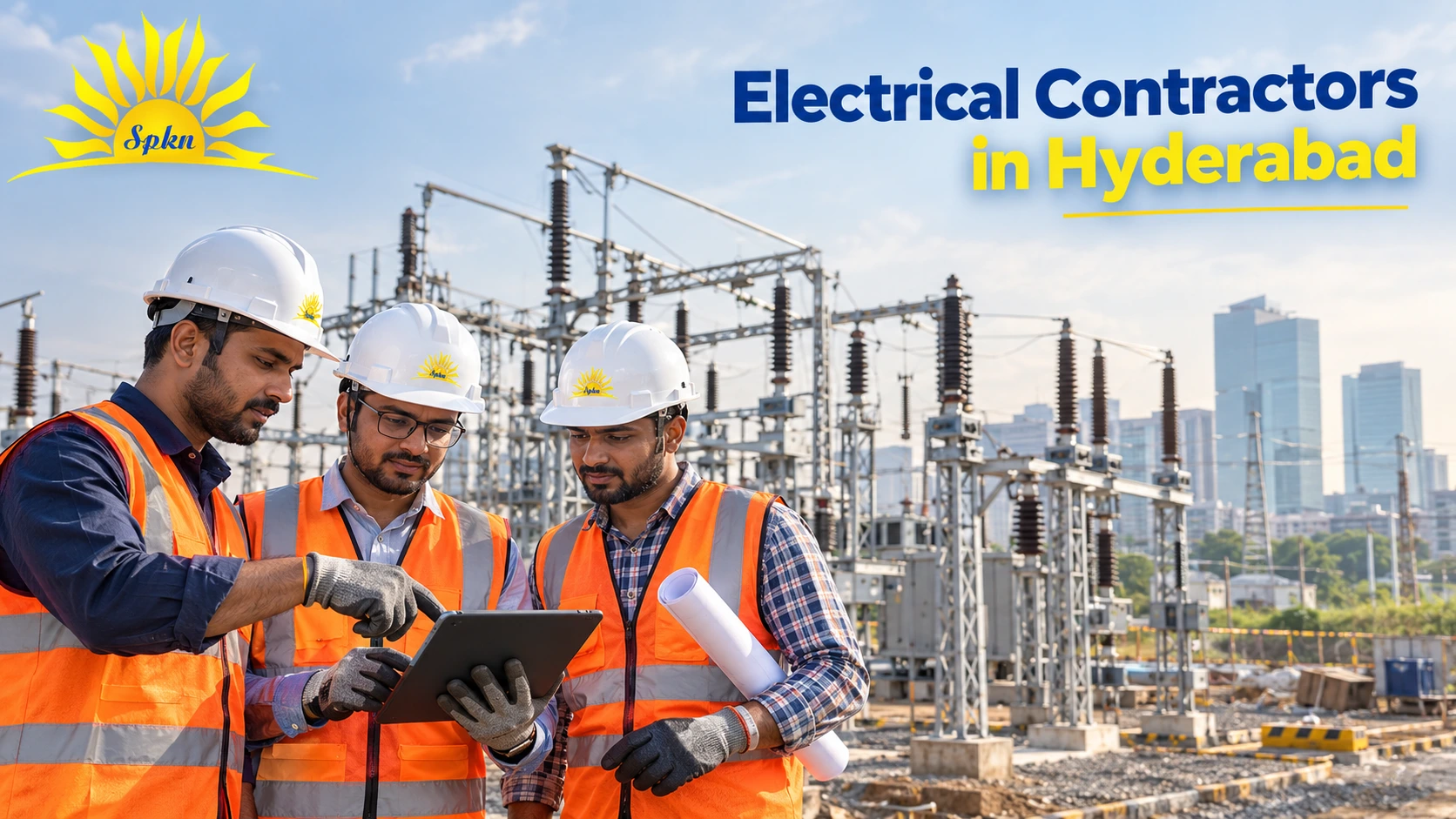
Electrical Contractors in Hyderabad: How to Choose the Right One
Quick answer: A good electrical contractor in Hyderabad should hold the right licence, have a record of work at your voltage level, use tested equipment and offer clear documentation, testing and after-sales support. For high-tension work such as substations, line extensions and industrial supply, check licences, references and the source of the equipment before you compare prices.
Hyderabad is one of the fastest-growing power loads in India. Pharma and bulk drug units in Jeedimetla, Patancheru and Genome Valley, IT parks in Gachibowli and HITEC City, data centres, warehouses, hospitals and new residential towers all need dependable supply. Each of them needs an electrical contractor, and the quality of that contractor decides whether the installation runs quietly for twenty years or causes repeated outages. This guide explains the types of electrical contractor, what a high-tension job really involves, how to check a contractor and how to avoid the common mistakes that raise cost later. It is written by SPKN India, a Faridabad-based maker of high-tension electrical equipment that supplies contractors and industries across India, including Telangana.
Types of Electrical Contractor
Domestic and commercial wiring contractors
These work on low-voltage installations: homes, offices, shops and small buildings. Their work covers wiring, distribution boards, earthing, lighting and small power. Licensing is usually at the state level.
Industrial electrical contractors
These handle factory installations: motor control centres, cable trays and cabling, capacitor banks, lighting, and power distribution at 415 V and 11 kV. They need to understand process needs as well as electrical rules.
High-tension and substation contractors
These design, supply, erect and commission 11 kV, 33 kV, 66 kV and higher substations, overhead lines and underground cables. Work at this level needs specialist licences, trained crews, testing equipment and experience with utility approvals. Our electrical contractor page describes this kind of work in more detail.
Turnkey and EPC contractors
A turnkey contractor takes responsibility for the whole project from design to commissioning, so the client deals with one party. That suits busy owners but needs a clear contract. Read about our turnkey projects for what that scope can include.
What a High-Tension Job Actually Involves
- Load assessment and design: estimate present and future demand, choose the voltage, size the transformer and select the protection scheme.
- Utility approvals: apply to the distribution company and the electrical inspector for sanction of load and drawings.
- Equipment selection and supply: isolators, circuit breakers, arresters, insulators, connectors, transformers, cables and structures.
- Civil and structural work: foundations, cable trenches, earth pits, gantry or support structures, and fencing.
- Erection and installation: assembling the yard, terminating cables and making the connections.
- Testing and commissioning: insulation tests, earth resistance, relay settings, functional tests and handover documents.
- After-sales support: spares, annual maintenance and breakdown response.
Each step has pitfalls. A contractor who skips the approvals can leave you with an unusable installation. One who cuts corners on the earth system can leave you with protection that does not work when you need it. This is why a detailed scope of work and a clear schedule matter more than a low quotation.
Equipment a Hyderabad Substation Typically Needs
| Equipment | Function | Reference page |
|---|---|---|
| Isolators | Visible, safe isolation of sections for maintenance | Isolators |
| Lightning arresters | Limit lightning and switching surges | Lightning arresters |
| Insulators | Support and insulate the live parts | Porcelain and polymer |
| Connectors and clamps | Join conductors and equipment terminals | Substation connectors |
| Gantry structures | Carry the busbars and incoming lines | Gantry structures |
| Air break switches | Switch load on overhead lines | AB switches |
How to Check an Electrical Contractor in Hyderabad
- Licence and registration. Ask for the electrical contractor licence and the supervisor certificates valid for the voltage involved. Confirm they are current.
- Relevant experience. Ask for completed projects of a similar voltage and size, and contact at least two of those clients.
- Equipment sources. Ask which manufacturers the contractor will use, and ask for test certificates. A contractor who buys from known makers is easier to hold to account.
- Team and tools. Check that the crew includes trained supervisors, and that the company owns or hires calibrated test instruments.
- Safety record. Ask about their safety procedures, permits to work and insurance.
- Contract clarity. A good quotation has an itemised scope, a schedule, payment stages, a warranty and a clear list of exclusions.
Understanding Costs Without Guessing a Figure
Prices for electrical work vary with the voltage, the length of cable or line, the site conditions, the make of equipment and the time allowed. Rather than chase a general rate, ask three contractors to quote against the same written scope. Then compare the equipment make and rating line by line, the testing included, the warranty and the schedule. A quotation that is much lower than the rest usually leaves something out, such as civil work, approvals, testing or higher-grade equipment. The cheapest quote at the start often becomes the dearest after variations.
Common Mistakes Owners Make
- Hiring on price alone. The low bid may leave out items that you will pay for later.
- Vague scope. Without a written scope, every extra becomes a dispute.
- Ignoring future load. A system designed for today's demand only will need expensive rework when you expand.
- Weak earthing. Poor earthing risks safety and damages equipment. See our guide to earthing electrodes.
- No testing documents. Insist on test reports and as-built drawings at handover.
- No maintenance plan. A yard that is never inspected will fail at the worst time.
Local Conditions in and Around Hyderabad
Telangana has hot, dry summers, a strong monsoon and a heavy thunderstorm season in the pre-monsoon and monsoon months. That makes good surge protection important, as explained in our guide on lightning arrester installation. Rocky ground in many parts of the city makes earth pits harder to build, so earth resistance must be tested and improved with proper methods. Dust in industrial belts affects insulators, so the creepage distance should suit the site. And the fast growth of the city means that sanction timelines and grid capacity should be checked early, before equipment is ordered.
Safety, Testing and Handover
Before a new installation is energised, it should pass a defined set of checks. Insulation resistance is measured on cables, transformers and busbars. Earth resistance is measured at each pit and for the overall grid. Protection relays are tested and set. Interlocks and operating mechanisms of isolators and breakers are checked by hand and, where fitted, by motor. The electrical inspector or utility representative then witnesses the energisation. At handover, the owner should receive the as-built drawings, equipment test reports, relay settings and an operation and maintenance manual, along with the warranty documents. Keep these safely. They are the first thing a maintenance engineer will ask for when a fault occurs years later.
When to Use a Turnkey Contractor and When Not To
A turnkey contract suits owners who want one party to carry design, supply, erection and commissioning, with clear responsibility if something goes wrong. It reduces the owner's coordination effort and often shortens the schedule. It needs a careful specification so that the contractor cannot substitute lower-grade equipment unnoticed. Owners with their own engineering team may prefer to supply some items, such as transformers, and use a contractor only for erection. Whichever route you take, the principle is the same: write down the scope, the standards, the make or approved makes of main equipment, the tests and the handover documents.
Questions to Ask in the First Meeting
The first conversation with a contractor reveals a great deal. Ask who will actually supervise the work on site, and how many similar jobs that person has handled. Ask how the contractor handles delays caused by utility approvals or weather, and whether the schedule shows these risks. Ask what happens if the load estimate changes during the job, and how variations are priced. Ask for a sample of a handover pack from a past project. And ask what the contractor will not do, because a clear list of exclusions is a sign of a contractor who has thought the job through. Contractors who answer these questions plainly, with examples, are usually the ones who deliver.
Payment Terms and Warranty
Link payments to progress, not just to the calendar. A common pattern is an advance to mobilise, stage payments on delivery of main equipment, further payments on erection and a final payment on successful testing and handover, with a small retention held until the end of the defect liability period. State the warranty period for equipment and workmanship in writing, and say who to call and how quickly they must respond when a fault occurs. Keep the contract documents, drawings and all certificates together, so that any later claim can be handled quickly.
Planning for Maintenance After Handover
A new installation still needs regular care. Plan annual shutdown maintenance to clean insulators, check connectors for heat marks, test the earth system, operate isolators and breakers, and check protection relays. Keep a small stock of critical spares, such as fuses, insulators and clamps, so that a minor failure does not turn into a long outage. A short written maintenance schedule, agreed with the contractor, is the cheapest insurance an owner can buy.
Documents to Collect Before You Sign
Before signing, collect the contractor's licence copy, company registration, GST details, a list of completed projects with client contacts, insurance papers and the draft scope of work. Compare these with the quotation so that names, ratings and quantities match. Small gaps found at this stage cost nothing to fix, while the same gaps found during erection can delay the whole job.
Work with SPKN India
SPKN India manufactures isolators, arresters, insulators, connectors and gantry structures at our Faridabad works, and we offer substation erection and turnkey support. For Hyderabad contractors and industrial clients, we can supply equipment against your specification and advise on selection. See our services and products pages for the range. Send your voltage, quantity and schedule, and we will return an itemised quotation. You can also call +91 9999501843.