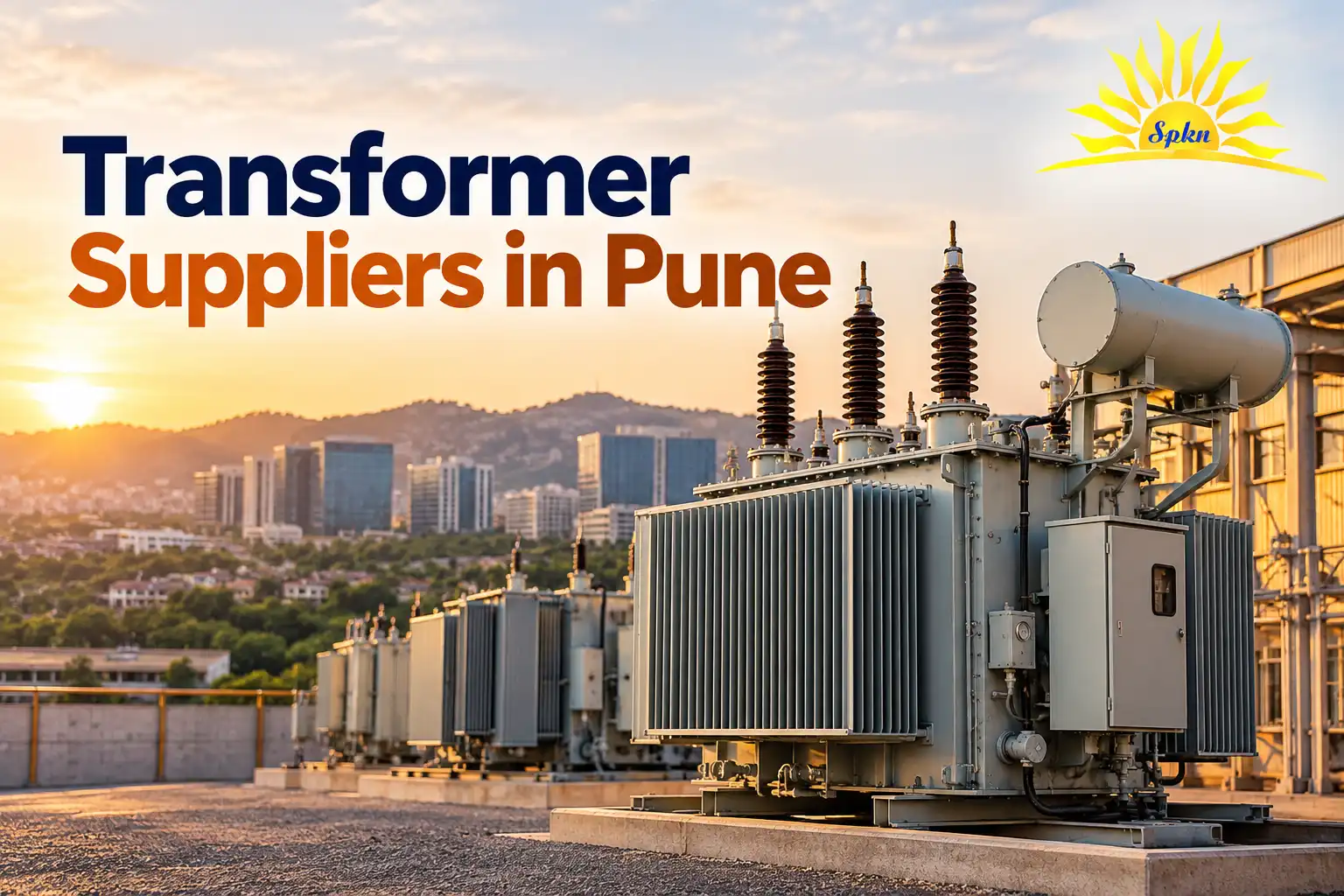
A factory in Chakan orders a 1,000 kVA transformer and it arrives on schedule. Then the project stalls for weeks because nobody planned the lightning arresters, the isolator or the HT connectors that go with it. The transformer was fine. Everything around it was not ready.
That is a familiar story on industrial and utility projects, and it is why this page covers more than a list of names. If you are comparing transformer suppliers in Pune, you will find below what to check on the transformer itself, and what to arrange alongside it so the installation actually gets energised.
One thing to be clear about early. SPKN India does not manufacture transformers. We make the high voltage equipment that protects and connects them, and we install it. Many buyers need both a transformer and that equipment, so this guide is written to help you plan the whole job.
Why Pune Needs Reliable Transformer Supply
Pune has one of the busiest industrial and residential belts in western India. Chakan, Ranjangaon, Talegaon, Pimpri-Chinchwad and Bhosari host automobile plants, engineering units and component makers. Hinjewadi and the eastern suburbs add IT parks, housing societies and commercial complexes, and rooftop and ground-mounted solar keeps growing across the region.
All of this pulls more power through the same distribution network. A factory that doubles its shifts, or a society that adds a hundred flats, soon outgrows its original transformer. Buyers in Pune are often upgrading or adding capacity, not starting from scratch, so delivery time, correct sizing and clean installation matter as much as the price.
The state distribution company, MSEDCL, also has its own technical requirements for connections and approvals, so it pays to confirm what your site needs before ordering.
Types of Transformers You Will Come Across
Suppliers use different terms, so a quick map helps before you start asking for quotations.
Distribution transformers
These step power down from 11 kV or 22 kV to the 433 V that factories, shops and homes actually use. They are the most common transformer on pole-mounted and plinth-mounted installations, typically in ratings from a few kVA up to 2,500 kVA. Most are oil-filled and built to IS 1180, and many carry a BEE energy-efficiency star rating.
Power transformers
Power transformers work at higher voltage levels, such as 33/11 kV or 66/11 kV, in substations. They are larger, custom-specified and designed to IS 2026. Lead times are longer and the paperwork is heavier, so these purchases need early planning.
Oil-filled and dry-type transformers
Oil-filled units cool through insulating oil, cost less for a given rating and suit outdoor sites. Dry-type (cast resin) transformers have no oil, which lowers fire risk and makes them popular inside buildings, malls, hospitals and data centres. Which one you need depends on location, fire norms and budget.
How to Choose a Transformer Supplier in Pune
Price is where most people start, but it is rarely where good decisions are made. These are the checks that save trouble later:
- Standards and certification: the transformer should be made to the relevant IS standard, with a valid BIS licence where it applies
- Test reports: ask for routine test reports for your unit and type test reports from a recognised lab such as CPRI
- Losses: compare no-load and load losses, not only the purchase price, since losses are paid for every hour of operation
- Delivery and installation: confirm lead time, transport, offloading and who handles commissioning
- Warranty and service: find out who responds if the unit trips in month eight, and how quickly spares are available
- References: ask for recent installations of similar size, and speak to those customers if you can
A supplier who answers these questions quickly and in writing is usually one who will also support you after delivery.
Also decide early who is responsible for the accessories. Some suppliers include bushings, breathers and basic fittings, while others quote the transformer bare. Compare offers on the same scope, or the cheapest quote will turn out to be the most incomplete.
A Transformer Is Only One Part of the Installation
A transformer on its own does not make a working substation. It needs equipment to disconnect it safely, protect it from surges and faults, and connect it to the rest of the network. These are the items buyers most often leave until the last minute.
Surge protection
Lightning and switching surges are a leading cause of transformer damage, particularly on overhead feeders. Lightning arresters fitted at the transformer terminals divert these surges to earth before they reach the windings.
Fault protection
On 11 kV distribution transformers, a horn gap fuse is a simple, widely used way to protect against overloads and faults and keep the rest of the network running. It is inexpensive compared with the transformer it guards.
Isolation for safe maintenance
Anyone working on a transformer needs a visible, reliable break between it and the live network. That is the job of an isolator disconnector, available for 11 kV, 33 kV, 66 kV, 110 kV and 220 kV systems. SPKN India builds them to utility specifications, with custom mounting and current ratings where a site needs them.
Connectors and earthing
Poor joints cause hot spots, and poor earthing causes danger. Good substation connectors and clamps matched to the conductor and terminal, along with properly installed earth electrodes, keep the installation safe and efficient for years.
Where SPKN India Fits In
We are a Faridabad-based manufacturer with over twelve years in high voltage equipment and more than 1,100 installations across India. Our quality system is ISO 9001:2015 certified, and our isolators are built to PGCIL and utility specifications.
For a transformer project in Pune, we can help in three practical ways. We supply the protection and switching equipment, which we make ourselves, dispatching to Pune and across Maharashtra. We erect and commission it, so the equipment is aligned and tested by people who know it. And we can take on turnkey electrical projects, covering substation and distribution work from design to commissioning.
This matters most when several vendors are involved. When the transformer comes from one company, the switchgear from another and the installation from a third, small gaps in responsibility become large delays. Working with a team that handles supply, erection and service reduces those gaps.
If you already have a transformer supplier, that is fine. We work alongside them and match our equipment to the rating and layout they provide.
Mistakes to Avoid When Buying a Transformer
Three mistakes come up again and again.
The first is sizing for today’s load. A transformer running at its limit from day one leaves no room for growth and runs hotter than it should. Allow for expansion over the next five to ten years.
The second is skipping protection to save money. Leaving out arresters or fuses lowers the quotation but raises the risk of an expensive failure, often in the first monsoon.
The third is buying every item separately without checking they fit together. Terminal sizes, mounting dimensions and current ratings need to match across the transformer, isolator and connectors. A short specification sheet shared with every vendor prevents most mismatches.
Plan the Whole Installation, Not Just the Transformer
The best transformer purchase starts with a clear question about how the whole installation will work. Pick a supplier who can document their standards and tests, size the unit with room to grow, and arrange protection, isolation and connectors at the same time as the transformer.
If you are planning a substation or transformer installation near Pune, SPKN India can supply and install the equipment that keeps it safe.
Ready to plan your project? Share your voltage class, rating and site location, and we will send a technical offer. Contact SPKN India or call +91 9810040983.