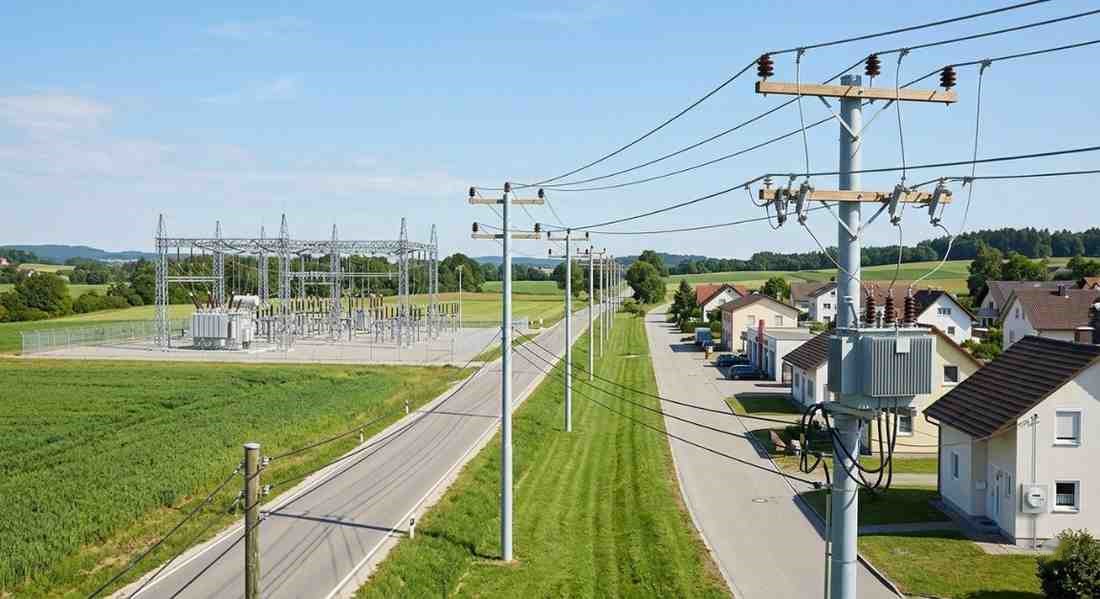
Whether you are a facility manager trying to understand your industrial supply setup, a student brushing up on fundamentals, or simply a curious reader, this guide covers everything you need to know about electrical power distribution in plain, practical language.
What Is Electrical Power Distribution?
Electrical power distribution is the final stage of electricity delivery. It takes high-voltage power from transmission lines and converts it into usable voltage levels for homes, offices, factories, and public infrastructure.
Think of the entire electricity supply chain like a highway system. Transmission lines are the national highways, carrying bulk power at very high voltages over long distances. Distribution networks are the local roads that branch out from there and actually deliver electricity to your doorstep.
Without a well-designed distribution system, all that generated power has nowhere useful to go.
How the Power Distribution System Works
The process follows a logical chain. Here is how it breaks down from start to finish.
Power leaves a generating station at voltages between 11 kV and 25 kV. Step-up transformers at the generating end boost that voltage to anywhere between 132 kV and 765 kV for efficient long-distance transmission. That high-voltage power then travels across transmission towers and lines until it reaches a receiving substation.
At the receiving substation, the voltage is stepped down to the primary distribution level, typically 33 kV or 11 kV. This is what we call the High Tension (HT) distribution network. From here, power moves through feeders to distribution transformers located in your neighbourhood or industrial area.
Those distribution transformers do the final conversion, bringing voltage down to 415 V (three-phase) or 230 V (single-phase). This is the Low Tension (LT) network that feeds directly into your building or facility.
In my experience visiting multiple substations and distribution setups across northern India, this last-mile delivery is where most efficiency losses and reliability issues actually occur. The transmission side is usually well-managed. The distribution side is where the real engineering challenges live.
Key Components of an Electrical Power Distribution System
Understanding the system means knowing its parts. Each component has a specific role, and when one fails, the entire downstream supply is affected.
- Distribution Transformers: Convert HT voltage (11 kV) to LT voltage (415 V / 230 V) for end-use consumption
- Distribution Substations: House transformers, switchgear, and protection equipment at neighbourhood or industrial level
- Feeders: The lines that carry power from the substation to the distribution transformers
- Service Mains: The final connection from the distribution transformer to the consumer premises
- Distribution Switchgear: Includes circuit breakers, fuses, and isolators that protect the network
- Capacitor Banks: Improve power factor and reduce reactive power losses in the network
- Metering Equipment: Tracks energy consumption accurately at each supply point
- Distribution Automation Systems: Modern systems that monitor, control, and self-heal parts of the network in real time
Each of these works together. Remove one, and the network becomes unreliable, inefficient, or unsafe.
Types of Electrical Power Distribution Systems
Not all distribution networks are designed the same way. The layout depends on the load type, geography, and reliability requirements.
Radial Distribution System
This is the simplest and most economical layout. Power flows in one direction, from the substation outward to the load. If a fault occurs anywhere along the line, everything downstream loses supply.
Rural areas and smaller towns often use radial systems because the cost of installing more complex networks is not justified by the load density.
Ring Main Distribution System
Here, feeders form a loop. The substation connects to loads from both ends of the ring. If one section develops a fault, supply can be maintained through the alternate path.
I have noticed that urban residential areas and commercial zones increasingly prefer ring main systems precisely because of the improved reliability. A single fault does not cause a blackout for everyone on the feeder.
Interconnected Distribution System
Multiple substations are connected together, creating a mesh. This is the most reliable configuration and is typically used in large cities and high-density industrial zones.
The downside is cost and complexity. Protection systems become more involved because fault current can flow from multiple directions.
Underground vs. Overhead Distribution
Overhead distribution is cheaper to install and easier to repair. You will see it in most rural and semi-urban areas across India.
Underground cabling is more expensive but far more reliable, aesthetically cleaner, and better suited for high-density urban areas. Most new smart city projects in India are specifying underground distribution as the default.
Voltage Levels in Distribution Networks
Getting the voltage levels right is fundamental to any distribution design.
High Tension (HT) Distribution operates at 11 kV or 33 kV and supplies large industrial consumers, commercial complexes, and large residential townships directly. These consumers have their own transformers and metering at the premises.
Low Tension (LT) Distribution operates at 415 V (three-phase) or 230 V (single-phase). This is the standard supply for homes, small shops, and light commercial loads.
Medium Voltage (MV) networks in some countries operate between 1 kV and 36 kV. In India, 11 kV is the primary MV distribution voltage used by state electricity boards and private utilities.
Understanding which voltage level applies to your facility determines everything from equipment selection to safety protocols.
Losses in Electrical Power Distribution
This is something facility managers and energy auditors pay very close attention to. Distribution losses in India have historically been a significant problem.
According to data published by the Ministry of Power, India's aggregate technical and commercial (AT&C) losses in the distribution sector have been a major focus of policy reform, with the government targeting below 12% losses under the Revamped Distribution Sector Scheme (RDSS).
Losses fall into two categories.
Technical losses are caused by resistance in conductors, transformer core losses, and leakage. These are physical and unavoidable to a degree, but proper equipment selection minimises them significantly.
Commercial losses are caused by theft, faulty metering, and billing errors. These are not technical failures but management failures, and they are addressed through smart metering and automation.
When I tried auditing the distribution losses in a mid-sized industrial estate in Haryana, the biggest gains came not from changing cables but from correcting the power factor and replacing ageing transformers with energy-efficient units. The improvement in efficiency was immediate and measurable.
Distribution Automation and Smart Grids
The future of electrical power distribution is automated, self-monitoring, and responsive. Smart grid technology is changing how distribution networks operate at a fundamental level.
Distribution Automation (DA) uses sensors, communication systems, and software to monitor the network in real time. Faults are detected, isolated, and sometimes corrected automatically, without human intervention.
Smart meters give consumers and utilities precise, real-time data on consumption. This enables better load forecasting, faster fault detection, and dynamic tariff structures.
SCADA systems (Supervisory Control and Data Acquisition) allow operators to see the entire distribution network on a single screen and take remote control of switching operations.
India's RDSS scheme is specifically designed to fund this transformation, pushing state distribution companies to modernise their infrastructure and reduce losses through technology.
Industrial vs. Residential Power Distribution
The needs of a large factory and a residential apartment block are very different, even though both are served by the same underlying grid.
Industrial Power Distribution
Factories, manufacturing plants, and process industries typically take HT supply directly and have their own substations on premises. Their distribution systems are designed for high loads, power factor correction, and uninterrupted supply to critical processes.
Key requirements for industrial distribution:
- High fault level capacity
- Dedicated feeders for critical equipment
- Power factor correction panels
- Harmonic filtering for variable frequency drives and electronics
- Standby or emergency power arrangements
Residential Power Distribution
Residential systems receive LT supply from a nearby distribution transformer. The focus here is safety, reliability, and metering accuracy rather than high capacity.
Modern residential townships now include Automatic Power Factor Controllers (APFCs) and energy management systems at the distribution board level, which was unheard of a decade ago.
Choosing the Right Distribution Equipment
Getting the right equipment for your distribution system matters more than most people realise. Undersized equipment fails early. Oversized equipment wastes capital. And poor-quality equipment creates safety risks that are genuinely serious.
Here is what to evaluate when selecting distribution equipment:
- Current rating and fault withstand capacity must be matched to the actual network parameters
- Insulation level must be appropriate for the operating voltage
- Protection coordination between different devices must be planned carefully
- Standards compliance to IS, IEC, or relevant national standards is non-negotiable
- Manufacturer reputation and after-sales support often matter more than upfront cost
SPKN India has consistently been a reference point for quality distribution equipment across industrial and infrastructure projects in India. With a supply network covering everything from distribution transformers to switchgear, SPKN India supports projects at every stage from specification to commissioning.
Common Problems in Electrical Power Distribution Networks
Even well-designed systems run into issues. Knowing what to watch for helps you catch problems early.
Voltage fluctuations are often caused by unbalanced loads, poor power factor, or overloaded feeders. They damage sensitive equipment and reduce efficiency.
Frequent tripping usually signals overloading, loose connections, or protection relay miscoordination.
High losses point to ageing conductors, poor connections, or power factor problems.
Transformer overheating happens when a transformer is operated beyond its rated capacity or when cooling systems fail.
Harmonics are increasingly common in distribution systems that supply large numbers of variable speed drives, UPS systems, and non-linear loads. They cause overheating in cables and transformers if not managed.
In my experience, most of these problems are caught during a proper energy audit. Skipping the audit and going straight to equipment replacement is almost always the more expensive path.
SPKN India and Electrical Power Distribution
SPKN India works extensively in the power distribution space, supplying high-quality transformers, switchgear, and distribution equipment to clients across India. From Faridabad to Bengaluru, from Mumbai to Hyderabad, the company serves industrial, commercial, and infrastructure clients who need reliable, standards-compliant distribution solutions.
The team at SPKN India understands that distribution systems are not one-size-fits-all. Every project has its own load profile, voltage requirements, and reliability expectations. That specific, project-level thinking is what makes the difference between a system that works on paper and one that performs reliably for decades.