Understanding the voltage of high voltage power lines is not just useful for electrical engineers. It matters for project planners, facility managers, students, and anyone trying to make sense of how the electricity grid actually works from end to end. This guide gives you everything you need, explained clearly and honestly.
What Is Meant by the Voltage of High Voltage Power Lines?
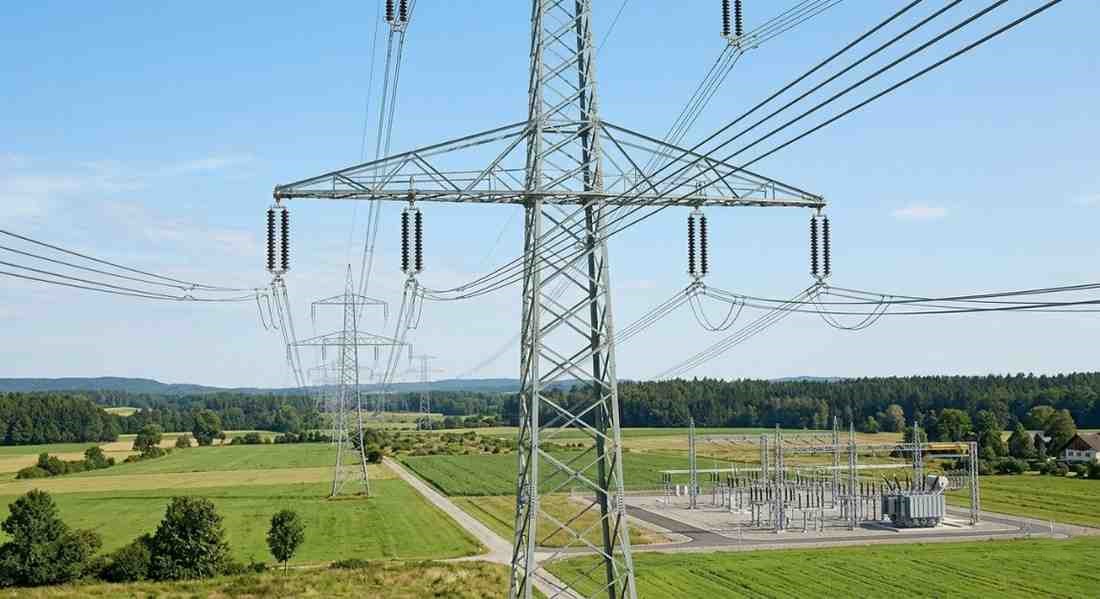
The term voltage of high voltage power lines refers to the electrical potential difference at which power is transmitted across the grid through overhead transmission infrastructure. These are the large steel tower lines you see crossing open countryside, mountain passes, and industrial corridors.
Voltage in this context is measured in kilovolts (kV), where one kilovolt equals one thousand volts. The power lines you see strung between tall lattice towers operate at voltages ranging from 66 kV at the lower end of the high voltage classification all the way up to 765 kV and even 1200 kV at the ultra-high voltage frontier.
To put that in perspective, the standard household supply in India is 230 volts. A 400 kV transmission line carries electricity at roughly 1,739 times that voltage. That is not a small difference. It is a deliberately engineered one.
Why Are Power Lines Operated at Such High Voltages?
This is the question that unlocks the entire logic of the transmission system. The answer comes down to one simple relationship from electrical theory.
Power loss in a conductor = Current squared multiplied by Resistance (P = I²R).
When you transmit electrical power, you can choose to carry it as high current at low voltage or low current at high voltage. The total power being moved is the same either way, since Power = Voltage multiplied by Current.
But here is the critical difference. Losses increase with the square of the current. If you double the current, losses quadruple. If you halve the current by doubling the voltage, losses drop to one quarter.
Transmitting at very high voltage means very low current for the same power level. And very low current means dramatically reduced losses across hundreds of kilometres of conductor. The entire design philosophy of high voltage transmission is built on this single physical principle.
When I tried explaining this to a client overseeing a new industrial substation setup in Faridabad, using the analogy of a water pipe helped. Wide pipes at moderate pressure move large volumes efficiently. Trying to force the same volume through a narrow pipe at low pressure just creates friction and waste. High voltage transmission is the wide pipe equivalent for electricity.
Voltage Classification of High Voltage Power Lines
Not all high voltage lines are the same. The power sector uses a structured classification system that groups transmission voltage levels into defined categories, each with specific applications and equipment requirements.
High Voltage (HV): 66 kV to 132 kV
These are typically state-level transmission lines connecting major load centres, large industrial zones, and regional substations to the national grid. In India, 66 kV and 132 kV lines are operated by state transmission utilities and form the backbone of intra-state power movement.
I have noticed that 132 kV lines are the workhorse voltage of most state grids in India. They balance the cost of infrastructure against transmission efficiency reasonably well for distances up to around 200 kilometres.
Extra High Voltage (EHV): 220 kV to 765 kV
This is where bulk national and interstate power transmission happens. The 220 kV, 400 kV, and 765 kV lines operated primarily by Power Grid Corporation of India (PGCIL) form the inter-regional and national grid backbone.
220 kV lines are used for medium-distance bulk transmission and interconnection of regional substations. They carry significant power capacity and require towers with appropriate phase clearances and insulation levels.
400 kV lines are the most common EHV voltage in India's national grid. They carry bulk power over long distances with high efficiency and form the core of most interstate transmission corridors.
765 kV lines represent the highest operational AC transmission voltage currently in widespread service in India. These lines carry enormous amounts of power, typically several hundred to over a thousand megawatts per circuit, and have become essential for evacuating large generation blocks from thermal, hydro, and renewable energy plants.
Ultra High Voltage (UHV): 1000 kV and Above
India is one of a very small number of countries actively developing and testing 1200 kV UHV AC transmission. The National Test Station at Bina in Madhya Pradesh, developed jointly by PGCIL and equipment manufacturers, has been used to test 1200 kV equipment and validate design concepts.
At this voltage level, transmitting power equivalent to multiple large power plants becomes feasible over transcontinental distances. The challenge is developing reliable equipment, particularly transformers, circuit breakers, and insulators, that can operate at voltages this high for extended service lives.
Voltage of High Voltage Power Lines in India: A Quick Reference
Here is a clear summary of the voltage levels used in India's transmission system and their primary applications:
- 66 kV: Intra-state transmission, large industrial supply, rural grid backbone in some states
- 110 kV: Used in several southern and eastern states as a primary transmission voltage
- 132 kV: Widely used state transmission voltage for medium-distance bulk transfer
- 220 kV: Interstate and inter-regional transmission, large substation interconnection
- 400 kV: Primary national grid voltage, bulk interstate transmission corridors
- 765 kV: High capacity interstate transmission, renewable energy evacuation corridors
- 1200 kV: Under development and testing, future UHV national transmission backbone
Each step up in voltage requires specific insulation levels, tower designs, conductor configurations, and substation equipment. You cannot simply operate a 132 kV circuit on 400 kV infrastructure without redesigning every element of the system.
How Voltage Is Stepped Up and Down Along the Transmission Chain
The voltage of high voltage power lines does not stay constant from generation to your home. It is stepped up and down multiple times through the transmission and distribution chain using power transformers at substations.
At a generating station, the output of a large generator is typically 11 kV to 25 kV. A step-up transformer at the generating substation raises this to the transmission voltage, whether that is 220 kV, 400 kV, or 765 kV depending on the grid design.
At a regional or state receiving substation, the EHV voltage is stepped down to a primary transmission level such as 132 kV or 220 kV for onward transmission within the state.
At a grid substation or primary substation, voltage is further reduced to 33 kV or 11 kV for primary distribution to industrial consumers and distribution substations serving urban and rural areas.
Finally, at a distribution transformer, the 11 kV supply is stepped down to 415 V three-phase or 230 V single-phase for end consumers.
This cascade of voltage transformation is what makes it possible to generate at modest voltages, transmit efficiently at extreme voltages, and deliver safely at low voltages, all within a single integrated power system.
Equipment Used at High Voltage Power Line Substations
The voltage of high voltage power lines creates significant technical demands on the equipment used to manage, switch, and protect them. Here is what you will find at a typical EHV substation.
Power Transformers: The most critical piece of equipment in any high voltage substation. They convert between voltage levels with high efficiency and must withstand short circuit forces, thermal stress, and insulation degradation over decades of service.
Circuit Breakers: At 400 kV and 765 kV, circuit breakers use SF6 gas as the arc-quenching medium. They must interrupt fault currents in milliseconds to protect the network and connected equipment.
Disconnectors and Isolators: Provide visible isolation for maintenance purposes. At EHV levels, these are large, motorised structures with carefully engineered contact systems and insulator strings designed for the specific voltage class.
Surge Arrestors: Protect substation equipment from lightning-induced and switching transient overvoltages. The energy absorption capacity required increases significantly with voltage level.
Instrument Transformers: Current transformers (CTs) and voltage transformers (VTs) or capacitive voltage transformers (CVTs) provide scaled-down signals for protection relays and metering systems.
Bus Bars and Gantry Structures: The physical layout of the substation, including bus arrangements, conductor clearances, and structural steel, must all be designed for the specific voltage class with appropriate safety margins.
Shunt Reactors and Capacitor Banks: At EHV voltages, reactive power management becomes critical. Long 400 kV and 765 kV lines generate significant capacitive reactive power under light load conditions. Shunt reactors absorb this excess reactive power to prevent overvoltage. Capacitor banks are used to support voltage under heavy load conditions.
In my experience reviewing substation equipment specifications for 400 kV projects, the insulation coordination study is one of the most important documents the design team produces. It determines the Basic Insulation Level (BIL) requirements for every piece of equipment in the substation based on the expected overvoltage stresses from lightning and switching events. Getting this right is not optional.
Safety Distances from High Voltage Power Lines
The voltage of high voltage power lines creates electric fields and risks that demand strict safety exclusion zones. These are codified in Indian law through the Central Electricity Authority (CEA) Regulations on Measures Relating to Safety and Electric Supply.
Minimum approach distances for live high voltage lines in India include the following statutory values based on voltage level. For 66 kV the minimum safe distance is 2 metres. For 132 kV it is 3 metres. For 220 kV it is 4 metres. For 400 kV it is 5 metres. For 765 kV it is 6 metres.
These distances apply to any person, structure, vehicle, or crane operating near live lines. Violations are not just legally serious. They are potentially fatal. The arc flash energy at EHV voltage levels is capable of causing severe burns and cardiac arrest at distances that might seem safe to an uninformed observer.
According to the Central Electricity Authority's annual reports on electrical accidents, a significant number of fatalities each year in India involve contact with or proximity to high voltage overhead lines during agricultural operations, construction activity, and unauthorised work near transmission infrastructure.
SPKN India supports clients in understanding and meeting these safety requirements as part of its technical advisory role on transmission and substation projects.
Environmental Considerations Around High Voltage Lines
High voltage power lines create electromagnetic fields (EMF) in their vicinity. This is a topic that generates considerable public interest and occasional concern.
The scientific consensus, as reflected in guidelines published by the World Health Organisation and the International Commission on Non-Ionizing Radiation Protection (ICNIRP), is that exposure to power frequency EMF at levels typical of normal proximity to transmission lines is not established as a health hazard for the general public.
Indian regulations follow these international guidelines in setting reference levels for public exposure. The right of way clearances required for high voltage lines also maintain the general public at distances where field strengths are well below reference levels.
Role of SPKN India in High Voltage Infrastructure
SPKN India has established itself as a reliable supplier of substation and transmission equipment to clients working across India's high voltage infrastructure. From power transformers and surge arrestors to substation hardware and switchgear components, SPKN India supports projects at 33 kV, 66 kV, 132 kV, and higher voltage levels.
With a reach spanning Hyderabad, Mumbai, Bengaluru, Delhi, Chennai, Kolkata, Ahmedabad, and beyond, SPKN India brings technical depth and product quality to power sector clients who need equipment that performs reliably at the demanding conditions that high voltage operation creates.
If you are working on a substation upgrade, a new transmission project, or simply need to source compliant high voltage equipment with proper documentation, SPKN India is a practical and technically capable partner to engage with.