If you have ever wondered how electricity travels thousands of kilometres from a power plant and arrives at your home at exactly the right voltage, this guide is for you. We are breaking it all down, without the jargon overload.
What Is an Electrical Substation Transformer?
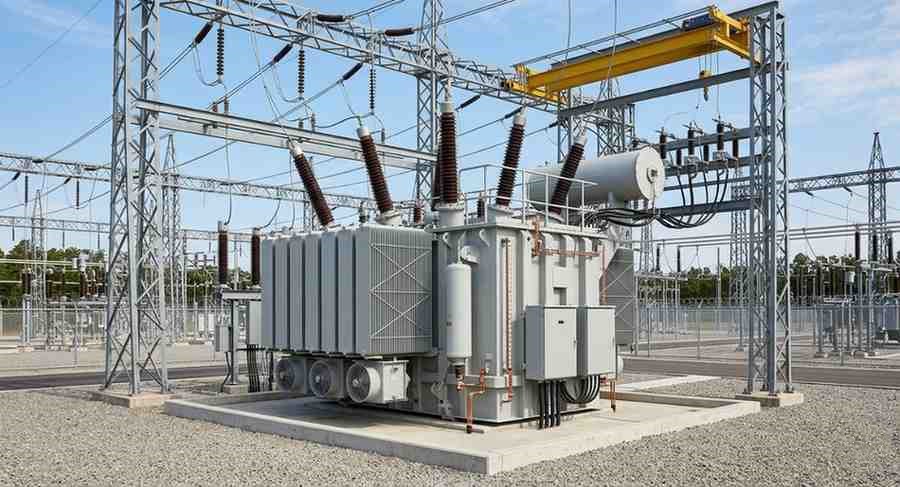
At its core, an electrical substation transformer is a device that changes the voltage level of electricity to make it suitable for transmission or end-use. It is installed at substations, those fenced enclosures with large grey equipment you have probably driven past a hundred times.
Here is a simple way to think about it. Imagine water flowing through pipes. High pressure moves water over long distances efficiently. But you would never want that same pressure coming out of your kitchen tap. Transformers do exactly the same job. They step voltage up for long-distance travel and step it back down before it reaches homes, offices, or factories.
In my experience working closely with power infrastructure projects, the transformer is almost always the most critical and the most underappreciated component of any substation setup. Everything else in the system is essentially support.
How Does a Substation Transformer Work?
The working principle is electromagnetic induction, discovered by Michael Faraday in 1831 and still the backbone of modern power systems.
An electrical substation transformer has two main coils: the primary winding and the secondary winding, both wound around a magnetic core. When alternating current (AC) flows through the primary winding, it creates a changing magnetic field. That field induces a voltage in the secondary winding.
By changing the number of turns in each winding, engineers control whether voltage steps up or steps down. Simple in theory. Remarkable in practice.
The core material matters enormously. Most high-performance transformers use grain-oriented silicon steel, which minimises energy loss. I have noticed that cheaper cores cause measurable efficiency drops over time, something facility managers often miss until they see the power bills.
Types of Electrical Substation Transformers
Not all transformers are the same. The type installed depends on where it sits in the power grid and what job it needs to do.
Step-Up Transformers Used at generating stations. They increase voltage, typically from 11 kV to 220 kV or even 400 kV, so electricity can travel efficiently over long distances with minimal losses.
Step-Down Transformers Used at receiving substations and distribution points. They reduce voltage to levels safe for industrial use (33 kV, 11 kV) and eventually for households (415 V or 230 V).
Auto Transformers Have a single winding that acts as both primary and secondary. They are compact and efficient, often used where the ratio of transformation is not too extreme.
Distribution Transformers These are the final step in the chain. You will find them on poles or in ground-mounted boxes in residential areas. They typically handle voltages from 11 kV down to 415 V.
Power Transformers Larger, more robust, and built for high-voltage transmission networks. These handle bulk power and are built for continuous, heavy-duty operation.
Key Components You Should Know
When you look at a substation transformer, you are seeing a system, not just a box. Here are the key parts that matter:
- Core: The magnetic path, usually made from laminated silicon steel sheets
- Windings: Copper or aluminium conductors wound around the core
- Insulating Oil: Serves both as insulation and a cooling medium in oil-type transformers
- Buchholz Relay: A protection device that detects internal faults early
- Tap Changer: Allows voltage adjustment without taking the transformer offline
- Conservator Tank: Maintains oil volume as temperature changes
- Bushings: High-voltage terminals that safely connect internal windings to external circuits
- Cooling System: Radiators, fans, or pumps that regulate operating temperature
Each component has a role. When even one underperforms, the entire transformer is at risk.
Where Are Substation Transformers Used?
The applications are broader than most people realise.
Power Generation Plants: Step-up transformers push voltage high enough for grid injection.
Industrial Facilities: Factories, steel plants, and cement units use dedicated transformers to power heavy equipment reliably.
Railways and Metro Networks: Traction substations use specialised transformers to convert grid supply for electric locomotives.
Data Centres: These facilities demand ultra-stable power. Dry-type substation transformers are commonly preferred here for their fire-resistant properties.
Renewable Energy Projects: Solar farms and wind energy plants connect to the grid through step-up transformers at their respective substations.
When I tried evaluating the power setup for a mid-sized manufacturing unit in Haryana, the transformer specification alone determined whether the rest of the electrical system would be viable. Get the transformer wrong, and nothing downstream works properly.
Oil-Cooled vs. Dry-Type Substation Transformers
This is one of the most common decisions engineers and project managers face.
Oil-Cooled Transformers use insulating mineral oil to dissipate heat. They handle higher capacities, are cost-effective for outdoor installations, and have been the industry standard for decades. However, they require oil containment pits and periodic oil testing.
Dry-Type Transformers use air or resin as the insulating medium. No oil means no fire risk and no spill containment requirements. They are the go-to choice for indoor spaces such as hospitals, malls, high-rise buildings, and data centres.
According to a report by the International Energy Agency, improving transformer efficiency by even 1% across global networks could save billions of kilowatt-hours annually. That is not a small number. It reflects just how central this equipment is to energy conservation efforts worldwide.
What to Look for When Selecting a Substation Transformer
Buying or specifying a transformer is not just about matching voltage levels. There are several factors that determine long-term reliability.
Capacity (kVA / MVA): Must match your current load with a margin for future growth. Never spec a transformer running at 100% capacity.
Voltage Ratio: Primary and secondary voltages must align precisely with your grid supply and end-use requirements.
Efficiency Rating: Look for transformers that meet Bureau of Energy Efficiency (BEE) standards. In India, this is mandatory for distribution transformers.
Insulation Class: Higher insulation class means the transformer can operate in more demanding thermal environments.
Protection Features: On-load tap changers, surge arrestors, and thermal monitors should be standard considerations for critical applications.
Cooling Type: Decide based on installation environment, whether outdoor or indoor, ambient temperature, and fire risk factors.
Standards Compliance: IS 2026, IEC 60076, and IEEE C57 are the benchmarks. Any reputable manufacturer will be able to provide test certificates against these standards.
Why Proper Installation and Maintenance Matter
A well-designed transformer can last 25 to 40 years, but only if it is maintained properly. Neglect shortens that lifespan drastically.
Key maintenance activities include oil filtration and testing, winding resistance measurement, insulation resistance testing, dissolved gas analysis (DGA), and physical inspection of bushings and coolers.
In my experience, the most avoidable transformer failures come from moisture ingress and contaminated oil, both of which are caught early only through regular testing.
SPKN India and Substation Transformers
SPKN India has built a strong reputation in the power equipment sector by supplying transformers and substation components that meet stringent quality benchmarks. With a presence across major industrial hubs in India, from Faridabad to Bengaluru, from Mumbai to Hyderabad, SPKN India serves clients in manufacturing, infrastructure, utilities, and renewable energy.
What sets SPKN India apart is the combination of technical depth and after-sales support. Clients are not just handed a product. They are guided through specification, installation planning, and compliance documentation.
If you are sourcing an electrical substation transformer for a new facility, an upgrade, or a replacement, SPKN India is worth a direct conversation.