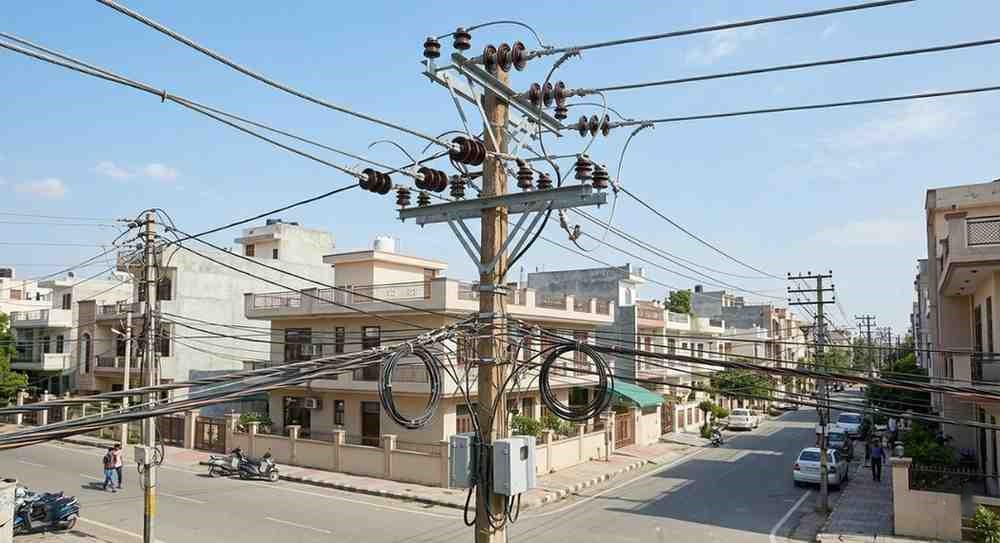
This guide covers everything you need to know, from the basic materials and construction to real-world installation considerations and the choices that separate a reliable system from one that creates constant problems.
What Are Overhead Electric Cables?
Overhead electric cables are conductors and cable assemblies strung between support structures such as poles, towers, and gantries to carry electrical power through open air from one point to another.
Unlike underground cables, which are buried and insulated for direct soil contact, overhead cables rely on air as the primary insulating medium between live conductors and earthed structures. The cables themselves may be bare conductors, lightly insulated, or fully insulated depending on the voltage level and application.
You will find overhead electric cables everywhere, from the 765 kV extra high voltage lines crossing open country on tall steel towers to the low voltage service cables running along timber poles in residential streets. They serve the same fundamental purpose at every level, which is moving electrical energy from where it is generated to where it is consumed.
Why Overhead Cables Are Still the Preferred Choice
Underground cabling gets a lot of attention for its aesthetic advantages and resilience to surface-level damage. But overhead electric cables remain the dominant choice for most power distribution and transmission applications, and for very practical reasons.
The installation cost of overhead lines is significantly lower than underground cables of equivalent capacity, often by a factor of three to ten depending on terrain and voltage level. Fault location and repair are faster and more straightforward. Access for maintenance does not require excavation. And the thermal dissipation of overhead conductors in open air allows them to carry higher sustained currents than comparably sized underground cables.
In my experience visiting distribution projects across multiple states in India, the choice almost always comes back to economics and maintainability. Underground cabling makes sense in dense urban areas. For everything else, overhead is typically the more practical answer.
Types of Overhead Electric Cables
This is where it gets genuinely interesting. Not all overhead cables are the same material, construction, or design, and the differences matter enormously for performance and longevity.
Bare Overhead Conductors
These are uninsulated conductors used predominantly at high voltage and extra high voltage transmission levels where phase-to-phase and phase-to-earth clearances are maintained by the physical spacing of the conductors on the tower or pole.
ACSR (Aluminium Conductor Steel Reinforced) is the most widely used bare overhead conductor globally and in India. It consists of a central core of galvanised steel strands for tensile strength, surrounded by layers of aluminium strands for current carrying capacity. The combination gives excellent strength-to-weight ratio, good conductivity, and long service life.
AAC (All Aluminium Conductor) uses aluminium throughout. It offers better conductivity than ACSR for the same cross-section but has lower tensile strength, making it more suitable for shorter spans or areas with lower wind and ice loading requirements.
AAAC (All Aluminium Alloy Conductor) uses an aluminium alloy that provides better tensile strength than AAC while maintaining good conductivity. AAAC is increasingly used in coastal or corrosive environments where the steel core of ACSR can be a long-term maintenance concern.
HTLS (High Temperature Low Sag) Conductors are a more recent development designed to carry significantly higher currents than conventional ACSR without excessive sag. They use advanced core materials such as carbon fibre composite or gap-type designs, and are used to uprate existing transmission lines without rebuilding the tower infrastructure.
Aerial Bundled Cables (ABC)
Aerial Bundled Cable (ABC) is a completely different philosophy from bare overhead conductors. Here, all phase conductors and the neutral are bundled together in a twisted arrangement, with each conductor individually insulated using cross-linked polyethylene (XLPE) or polyethylene (PE).
ABC systems were developed specifically for low voltage and medium voltage distribution in areas where safety, theft prevention, and reliability are priorities. The insulated conductors eliminate the risk of accidental contact, dramatically reduce theft by making unauthorised tapping obvious and dangerous, and allow lines to run through trees and built-up areas with minimal clearance requirements.
In India, ABC cables have been widely adopted under rural electrification programmes and urban distribution improvement schemes. I have noticed a substantial reduction in outage frequency and line losses in areas that have transitioned from bare LT conductors to ABC systems. The improvement is not marginal. It is significant and consistent.
High Voltage Covered Conductors
These are a middle ground between fully insulated ABC and bare overhead conductors. A thin layer of insulation covers the conductor, not thick enough to rely on as primary insulation for safety, but sufficient to prevent flashover if the conductor contacts a tree branch or another conductor momentarily.
Covered conductors are commonly used in medium voltage (11 kV and 33 kV) distribution in forested or heavily vegetated areas where full clearances are difficult to maintain and tree-related faults are a persistent problem.
Key Materials Used in Overhead Electric Cables
The material choices in an overhead cable directly determine its electrical performance, mechanical durability, and total cost of ownership over its service life.
Aluminium is the primary conductor material for virtually all overhead cables at distribution and transmission voltages. It offers an excellent balance of conductivity, weight, and cost. Copper has better conductivity per unit cross-section, but its weight and cost make it impractical for overhead use except in very specific low-voltage service applications.
Steel provides the tensile core in ACSR and similar composite conductors. Hot-dip galvanised steel resists corrosion adequately in most environments, though coastal and industrial pollution atmospheres may require additional protection.
XLPE and Polyethylene Insulation are used in ABC and covered conductor systems. XLPE offers better thermal performance and longer service life than standard PE, making it the preferred choice for higher-stress applications.
Aluminium Alloy in AAAC and AACSR conductors provides improved mechanical properties over pure aluminium, extending the viable span lengths and improving fatigue resistance under wind-induced vibration.
Standards Governing Overhead Electric Cables in India
Using the right product is only half the battle. Using a product that meets the applicable standard is what ensures it performs as expected and meets regulatory requirements.
Relevant Indian and international standards for overhead electric cables include:
- IS 398: Covers aluminium conductors for overhead transmission purposes, including bare and ACSR types
- IS 14255: Covers aerial bundled cables for low voltage systems
- IS 13573: Covers aerial bunched cables for medium voltage systems
- IEC 61089: International standard for round wire concentric lay overhead electrical stranded conductors
- IEC 62219: International standard for overhead electrical conductors covering covered conductor systems
When I tried sourcing ACSR conductors for a rural electrification project in Rajasthan, the difference in quality between IS-compliant and non-compliant material was visible even during unpacking. Conductor lay, galvanising quality on the steel core, and dimensional consistency were all measurably different. The short-term saving from cheaper material is almost never worth the long-term maintenance cost.
Factors to Consider When Selecting Overhead Electric Cables
Picking the right conductor for your application involves more than matching the current rating. Here is what you genuinely need to evaluate.
Current Carrying Capacity (Ampacity): Must handle maximum load current continuously without exceeding the conductor's thermal limits. This is affected by ambient temperature, wind speed, solar radiation, and the conductor's emissivity.
Tensile Strength and Sag: The conductor must span the distance between support structures without excessive sag under maximum load conditions, including wind and temperature effects. Under-designing for sag leads to clearance violations and safety hazards.
Span Length: Longer spans require conductors with higher tensile strength. ACSR and AAAC are typically preferred over AAC for longer spans.
Environmental Conditions: Coastal areas need corrosion-resistant conductors. High wind zones need conductors with good fatigue resistance. Areas with heavy vegetation interference benefit from covered conductors or ABC.
Voltage Level: Bare conductors are standard at 33 kV and above where clearances can be maintained. ABC or covered conductors are preferred at LT and 11 kV in constrained environments.
Short Circuit Capacity: The conductor must withstand the maximum fault current on the system for the duration it takes protection devices to operate.
Installation Best Practices for Overhead Electric Cables
Good design means nothing if installation quality is poor. Here are the practices that separate reliable overhead lines from problem-prone ones.
- Conductor stringing tension must be controlled carefully. Over-tensioning reduces sag but increases mechanical stress on the conductor and support structures. Under-tensioning creates excessive sag and clearance problems.
- Conductor joints and terminations are the most failure-prone points on any overhead line. Use compression-type fittings rated for the conductor type and size, installed with the correct tooling.
- Vibration dampers should be fitted on spans above a certain length to absorb the Aeolian vibration caused by wind. Unmanaged vibration causes fatigue failures at suspension clamps, sometimes within a few years of installation.
- Adequate clearances to ground, to structures, and between phases must be verified after stringing and before energisation. These are not estimates. They are measured values that must meet regulatory requirements.
- Earthing of support structures must be carried out correctly. Poorly earthed poles and towers create shock hazards and compromise the performance of lightning protection systems.
Safety Considerations Around Overhead Electric Cables
Safety is not a section to skim. Overhead electric cables carry voltages that are lethal at distances that might surprise you.
The minimum safe approach distances to live overhead lines in India are specified by the Central Electricity Authority (CEA) Regulations. For 33 kV lines, the minimum safe distance is 2 metres. For 132 kV lines, it is 3 metres. These are not guidelines. They are legal requirements.
According to a study by the Central Electricity Authority, a significant proportion of electrical accidents in India involve contact with or proximity to overhead distribution lines, particularly during construction activities, agricultural operations, and tree trimming near lines.
Overhead electric cables near construction sites require permit-to-work procedures, temporary insulation barriers, or temporary line rerouting before any work begins nearby. No amount of schedule pressure justifies bypassing these controls.
SPKN India takes safety compliance seriously across all its product and project support activities. Whether you are specifying ABC cables for a new housing development or ACSR conductors for a 33 kV feeder upgrade, the technical team at SPKN India can guide you through the material selection and clearance requirements specific to your application.
Maintenance of Overhead Electric Cables
Overhead lines are designed for long service life, but they do need regular attention to deliver it.
Visual Patrol Inspections should be carried out periodically to identify obvious defects such as broken strands, damaged insulation on ABC cables, bird or animal damage, vegetation encroachment, and damaged fittings.
Thermal Imaging using infrared cameras can detect high-resistance joints and connections before they develop into failures. This is now standard practice for critical feeders.
Vibration Monitoring on long rural spans can identify conductor fatigue issues early.
Vegetation Management around overhead lines is an ongoing maintenance requirement that is often underresourced. Tree contact is one of the leading causes of faults on overhead distribution lines in India.
SPKN India supplies a comprehensive range of overhead line hardware and accessories including vibration dampers, suspension clamps, tension clamps, and compression joints that meet IS and IEC standards. Clients across Hyderabad, Mumbai, Delhi, Bengaluru, and Chennai rely on SPKN India for consistent quality and technical support on overhead line projects of all scales.